


Why Media Publishers Are Losing Programmatic Ad Revenue Without Knowing It
Every publisher knows that programmatic ad revenue is the engine of their digital business. Most publishers also know that CPMs fluctuate, fill rates vary, and some revenue loss is just part of how the ecosystem works. What far fewer publishers know is how much of that lost programmatic ad revenue is not a market problem. It is a data problem. One that is entirely preventable.
The mechanics of programmatic advertising are unforgiving when it comes to data quality. An advertiser’s DSP decides what to bid on your inventory based on the audience signals your pages send. Those signals come from your first-party data, your GA4 setup, your audience collection tags, and the behavioral data your analytics stack captures.
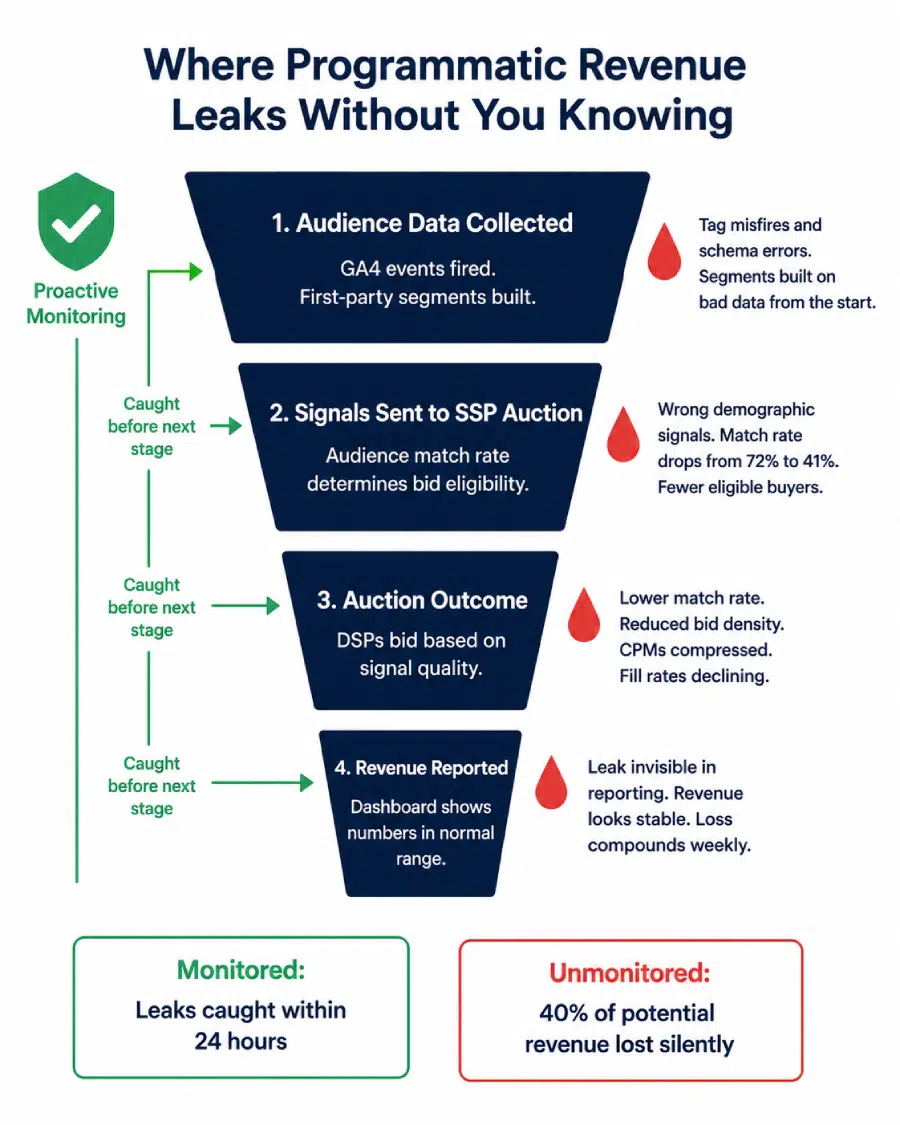
When any part of that data chain breaks silently, your inventory looks less valuable than it actually is. CPMs drop. Fill rates decline. And your revenue dashboard shows numbers that look normal, because they are only slightly lower than they were last week, and slightly lower the week before that.
By the time anyone notices, weeks of compressed programmatic ad revenue have already been lost.
The Revenue Stakes Are Too High to Accept Passive Monitoring
The numbers put this in context.
According to the IAB/PwC Internet Advertising Revenue Report for Full Year 2025, the digital advertising industry reached nearly $300 billion in revenue in 2025, a 13.9% year-over-year increase and the highest level in the report’s 30-year history. Programmatic is the dominant mechanism through which publishers access this market.
eMarketer forecasts that programmatic ad sales on properties owned by digital publishers will reach $22.69 billion by 2027. For most publishers, programmatic ad revenue is not a secondary revenue stream. It is the primary one.
At this scale, even a silent 10% compression in effective CPMs across a publisher’s inventory translates to significant annual revenue loss. The problem is that a 10% CPM compression over four weeks rarely looks like a crisis in a dashboard. It looks like normal market volatility. It gets attributed to seasonal slowdowns or advertiser budget cycles. The data problem underneath it goes unfound.
How Data Failures Silently Drain Programmatic Ad Revenue
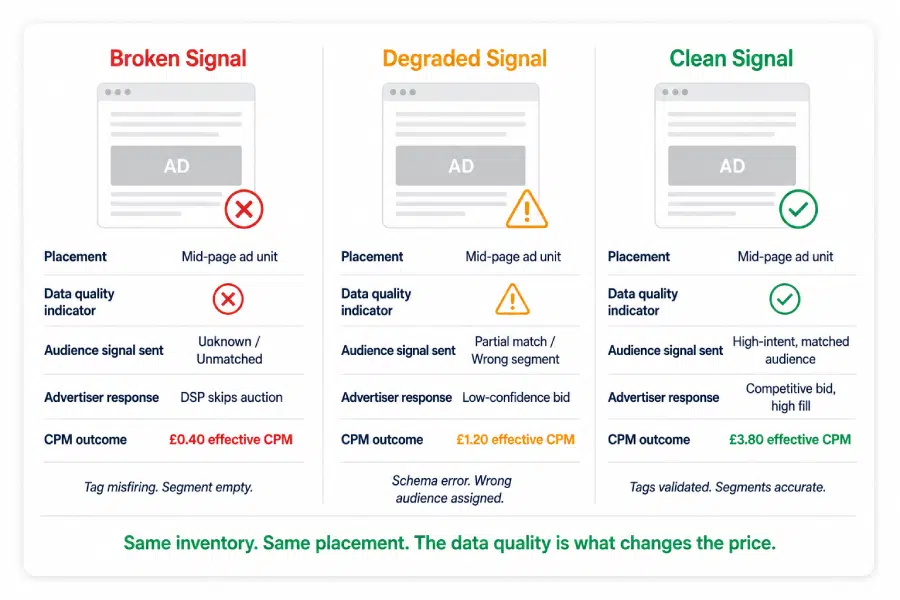
Programmatic ad revenue does not just depend on traffic volume. It depends on the quality and accuracy of the signals your inventory sends to advertisers. Those signals come from your data stack. When the data stack has problems, the signals degrade, and the programmatic revenue follows.
Here is how that happens in practice:
Audience Segment Tags Misfiring
Your first-party audience data is one of the primary signals that determines what advertisers bid for your inventory. When tags misfire, send incorrect values, or stop firing altogether, they feed bad data into your audience segmentation – causing teams to build targeting strategies on inaccurate signals.
An advertiser looking to reach 25-to-34-year-old users with purchasing intent does not lower their bid. Advertisers simply stop bidding on your inventory because the signal that should have identified their target audience never reached them correctly. The auction happens without them. Your programmatic ad revenue reflects that absence without ever explaining it.
GA4 Data Collection Errors Corrupting Audience Quality
GA4 is increasingly the source layer for first-party audience data in publisher environments. Configuration errors in GA4, parameter mismatches, and event schema issues do not just corrupt your analytics reports. They corrupt the behavioral signals that flow from GA4 into your audience building and monetisation stack.
A page category parameter passing incorrect values will cause users to be placed in the wrong content segments. Users in incorrect segments attract the wrong advertisers at lower CPMs. The programmatic ad revenue impact is real, but it is invisible in standard reporting because the impressions are still being served and the revenue is still coming in. Just at a lower rate than it should be.
CPM Floor Price Anomalies Going Undetected
Publishers set floor prices to protect the value of their inventory. When teams misconfigure floor prices – setting them too high and reducing fill rates, or too low and compressing CPMs – programmatic ad revenue takes a direct hit. In reactive monitoring environments, teams often uncover these issues during monthly revenue reviews instead of catching them in real time.Weeks of suboptimal floor pricing pass before anyone investigates.
Viewability Drops Eroding Advertiser Confidence
Advertisers increasingly buy on viewability standards. When a technical change, a layout update, or a lazy-loading configuration causes viewability to drop below buyer thresholds, affected placements start losing bid density. CPMs fall. Some buyers apply exclusions. The programmatic ad revenue impact compounds over time as the inventory’s perceived quality deteriorates in DSP algorithms.
Why Reactive Monitoring Is Not Enough for Programmatic Publishers
Most publishers monitor their programmatic ad revenue reactively. They review weekly revenue reports, compare CPMs against prior periods, and investigate anomalies when someone flags a number that looks wrong.
The problem is that programmatic revenue problems rarely look obviously wrong in aggregate reporting. A 12% drop in CPMs across mobile placements over two weeks, caused by an audience tag misconfiguration, will be visible in detailed SSP reporting but easily explained away as mobile market seasonality. A fill rate decline from 78% to 64% over three weeks, caused by a floor price error introduced during a CMS update, looks like normal programmatic variance until it doesn’t.
This is the same pattern we identified in the context of proactive analytics across marketing analytics. Data problems look like market problems until someone investigates the data. By then, the revenue has already been lost.
The Data Quality Connection
The IAB’s State of Data report found that 71% of brands, agencies, and publishers are currently growing or planning to grow their first-party data sets, nearly double the rate from two years earlier. The shift toward first-party data is accelerating because the industry recognizes that audience signal quality is the primary driver of programmatic ad revenue in a privacy-first world.
But collecting more first-party data does not help if the collection infrastructure is unreliable. More data collected incorrectly is more incorrect audience signals sent to the programmatic ecosystem. The investment in first-party data strategy only returns value when the data quality layer beneath it is sound.
What Proactive Monitoring Looks Like for Programmatic Publishers
Protecting programmatic ad revenue requires monitoring at the data layer, not just at the revenue reporting layer. Waiting for revenue reports to surface a problem is waiting for the 100x cost stage, as covered in Tatvic’s proactive analytics series.
Here is what proactive monitoring looks like specifically for publisher programmatic environments:
Anomaly detection on CPM and fill rate by placement, device, and content category.
Rather than monitoring aggregate programmatic ad revenue, set intelligent baselines for CPMs and fill rates at the segment level: by device type, by content category, by ad placement. When mobile CPMs drop 15% over 48 hours without a corresponding market-wide shift, that is an anomaly worth investigating immediately. Tatvic’s anomaly detection solution applies this logic to publisher-specific KPIs, not just marketing metrics.
Continuous validation of audience segment tags.
The tags that collect first-party audience data need the same continuous validation as conversion tags in an e-commerce environment.
- Are they firing on the right pages?
- Are they passing the correct values?
- Are they populating the intended segments?
Data sanity automation catches parameter-level errors in audience collection before they corrupt segment quality and suppress CPMs.
GTM health monitoring for publisher environments.
Publisher sites typically run complex GTM containers with audience tags, analytics tags, ad tech tags, and consent management scripts all coexisting. Tag conflicts, ghost tags, and misconfigured triggers in publisher GTM containers directly affect the accuracy of audience data collection. Continuous GTM health monitoring catches these issues as they develop, not during an annual ad tech audit.
An alert playbook specific to programmatic revenue signals.
As covered in the analytics alerting system blog, an alert without a named owner and a defined response is just noise. For publishers, P1 programmatic alerts (significant CPM drop, fill rate collapse, audience match rate decline) need a response workflow that connects the analytics team, the ad operations team, and the technical team quickly enough to limit revenue loss.
Is Your Programmatic Revenue Being Protected?
Before accepting the next CPM dip as normal market variance, run through this:
- Are audience segment tags validated continuously or only audited periodically?
- Is CPM monitored by placement and device type with intelligent anomaly detection?
- Does your fill rate tracking account for expected baselines, or is it compared against a single prior period?
- Has your GTM container been reviewed for audience collection accuracy in the last 90 days?
- When a programmatic revenue anomaly is flagged, is there a named owner and a defined response time?
- Are your GA4-sourced audience segments reconciled against SSP audience match rates regularly?
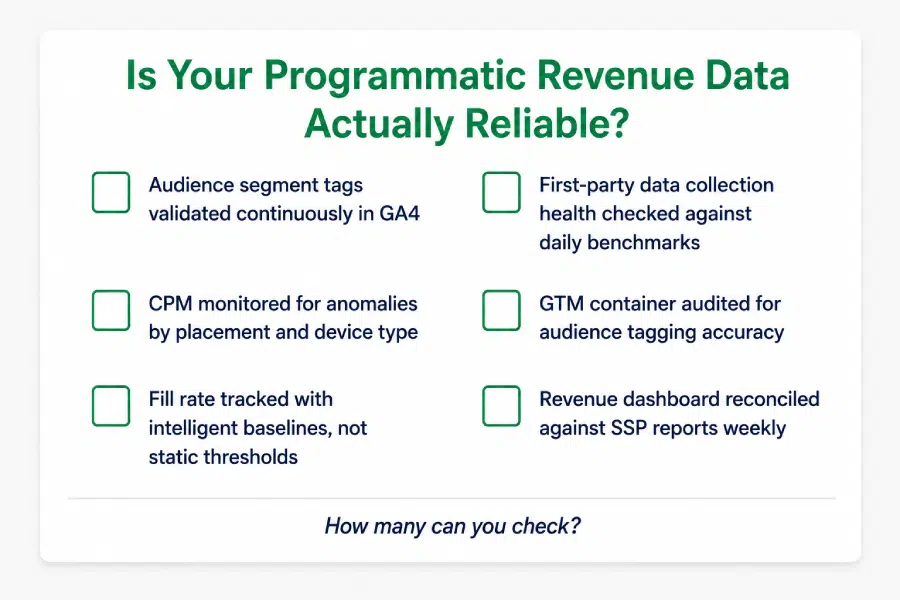
If two or more of these are not in place, your programmatic ad revenue is being managed reactively. Market conditions will always fluctuate. Data quality issues should not be allowed to compound on top of them.
The Takeaway
Programmatic ad revenue at scale is a data quality problem as much as it is a market problem. The signals your inventory sends to DSPs, the audience data feeding your first-party segments, and the behavioral data your analytics stack collects are all points where silent failures reduce what advertisers bid for your inventory.
Proactive monitoring does not change the market.But it ensures teams investigate genuine market shifts – not data failures that slipped through, went unnoticed for 24 hours, and quietly compressed programmatic ad revenue for weeks.
In a market that reached nearly $300 billion in 2025 and is still growing, the publishers who protect their programmatic revenue most effectively will not necessarily be the ones with the most traffic. They will be the ones whose data is most reliably telling advertisers the truth about their audiences.
Want to understand where your programmatic ad revenue may be leaking silently? Tatvic’s team can audit your GA4 setup, audience collection tags, and GTM configuration to identify exactly where data quality issues are suppressing your CPMs and fill rates. Schedule a call with Tatvic’s experts today.