

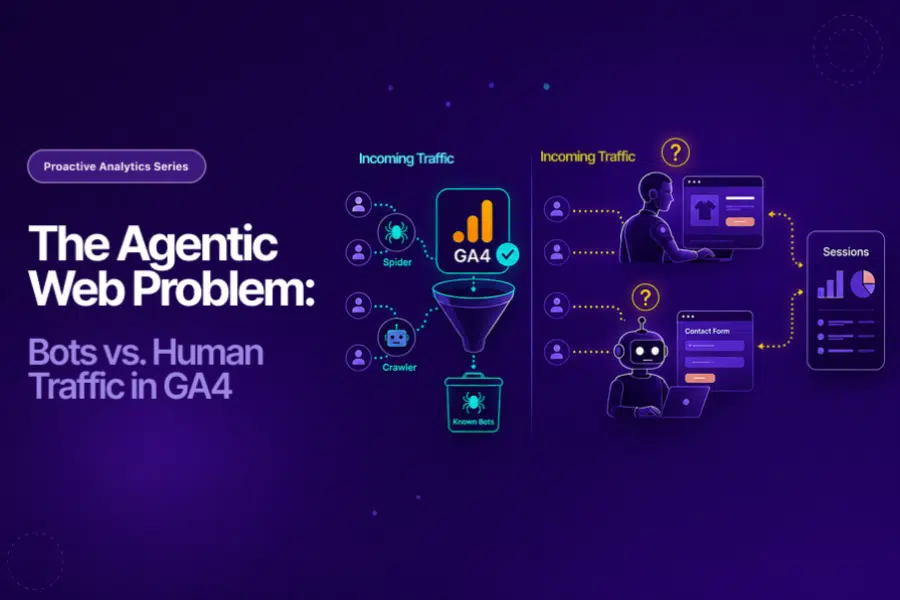
Every analytics team has dealt with bot traffic at some point. A spike in sessions from an unfamiliar country, a crawler indexing every page on the site, a referral spam pattern that inflates pageviews for a week. GA4 handles most of this well. It filters known bots and spiders automatically, and most teams never have to think about it.
But the nature of bot traffic in GA4 is changing fast, and it’s changing in a way that doesn’t fit the old definition of a bot.
AI agents now browse websites, fill out forms, compare prices, and complete purchases on behalf of real people. They don’t look like the crawlers GA4 was built to filter. Some of them behave a lot like engaged human visitors. This is the Agentic web, and it’s quietly becoming one of the more important data quality questions in proactive analytics.
Why the Web Is Becoming an Agentic Web?
The shift isn’t a future prediction anymore. It’s already underway, and the scale is significant.
Gartner predicts that by 2027, 85% of customer data will be collected from automated interactions or those led by AI agents, not direct human input. That’s a structural shift in who, or what, is generating the data flowing into your analytics platform.
At the same time, Gartner also predicts that traditional search engine volume will drop 25% by 2026 as AI chatbots and virtual agents take over more of the discovery process that used to happen directly on websites. Fewer humans are clicking through search results themselves. More AI agents are doing the browsing, the comparing, and increasingly, the deciding, on their behalf.
This matters for one simple reason: every one of those agentic visits lands in your GA4 property as a session. And a session that originated from an AI agent doesn’t always look like a session that should be filtered out.
How GA4 Already Separates Bots From Human Traffic?
It’s worth giving credit to what GA4 already does well here, because it’s a solid foundation.
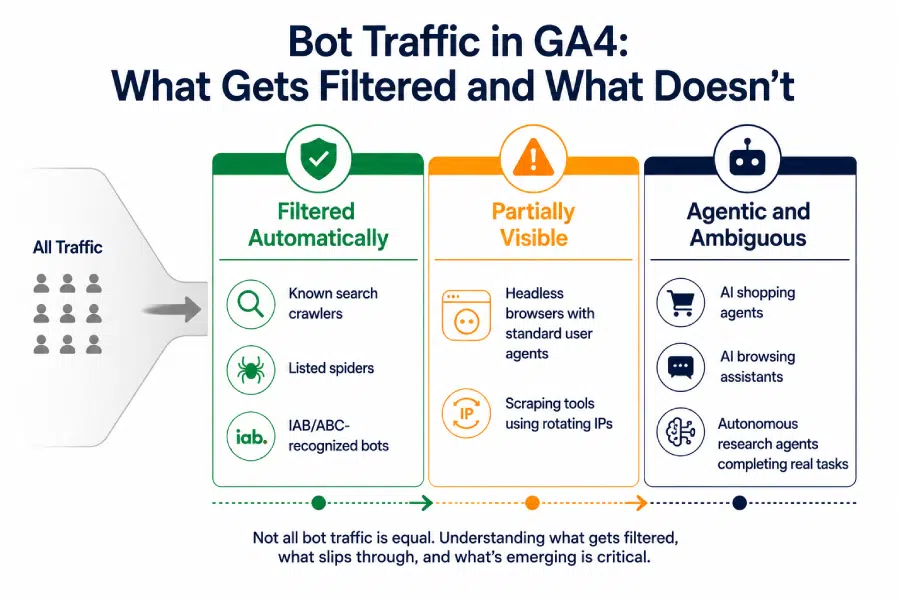
According to Google’s own documentation, known bot-traffic exclusion is automatic and on by default for every GA4 property. Google identifies bot traffic in GA4 using a combination of its own research and the International Spiders and Bots List, which the Interactive Advertising Bureau maintains and updates on an ongoing basis.
This catches the traffic most people picture when they think “bot”:
- Search engine crawlers like Googlebot and Bingbot
- SEO and monitoring tools that regularly scan pages
- Known spiders that match an established signature
For this category, GA4 does the job it’s designed to do. You don’t need to configure anything, and the filtering happens before the data ever shows up in your reports.
The challenge isn’t that GA4 has stopped working. It’s that the definition of “bot” has expanded faster than any static list can keep up with.
Where Agentic Traffic Gets Harder to Classify?
This is the part of bot traffic in GA4 that most teams haven’t fully reckoned with yet.
An AI shopping agent that visits a product page, reads the description, checks the price, and adds an item to a cart doesn’t look like a crawler. It looks like a session with reasonable time on page, a product view event, and possibly even a conversion. It’s automated, but it’s not malicious, and it’s not on any known bots list.
A handful of patterns sit in this genuinely ambiguous middle ground:
- AI browsing assistants that navigate multi-step journeys on a user’s behalf, generating session data that mimics real exploration
- Autonomous research agents that visit comparison pages, pricing tables, and spec sheets across dozens of sites in seconds
- Headless browsers running legitimate automation frameworks that present a standard browser signature, which GA4’s known-bot list was never built to catch
- Form-filling agents that complete lead forms on behalf of a user who delegated the task, generating a conversion event tied to no direct human keystroke
None of these are bad actors in the traditional sense. But they all generate GA4 events that get treated exactly the same as a real, engaged human session unless something is specifically watching for the difference.
The Business Risk When Bot Traffic in GA4 Goes Unmonitored
This isn’t a theoretical data hygiene issue. It has direct consequences for the decisions built on top of GA4 data.
When agentic sessions blend into your standard reporting:
- Engagement metrics get inflated or diluted depending on how the agent behaves, making it harder to read genuine user intent
- Conversion rate calculations include events that didn’t originate from a human decision-making process
- Campaign attribution credits channels for traffic that an AI agent generated, not a person responding to a marketing message
- Audience segments built from this data carry the same distortion into any model trained on top of it
That last point connects directly to a risk covered in When AI Makes Bad Data More Dangerous. If agentic traffic is quietly present in the data feeding a predictive model, the model learns from behaviour that was never a genuine signal of human intent. It doesn’t know the difference. It just learns the pattern and repeats it at scale.
The risk compounds because none of this triggers an obvious red flag. Sessions look populated. Engagement numbers look plausible.
The dashboard looks healthy.
The distortion lives in the composition of the traffic, not in any number that jumps out as clearly wrong.
Building Proactive Visibility Into Bot Traffic in GA4
Closing this gap doesn’t mean replacing what GA4 already does well. It means adding a layer of monitoring specifically built for the patterns that sit outside the known-bots list.
Segment-level anomaly detection on engagement patterns.
Rather than watching only for traffic spikes, set intelligent baselines on behavioural combinations: time on page paired with conversion rate, session depth paired with device type. Agentic sessions often show patterns that are subtly different from genuine human behaviour, even when each individual metric looks normal in isolation. Tatvic’s anomaly detection capability is built to catch exactly this kind of segment-level deviation, not just headline traffic counts.
Continuous validation of conversion event quality.
A form submission or a purchase event should be validated for the parameters that indicate genuine human completion, not just whether the event fired. Data sanity automation checks for these patterns continuously, flagging conversion events with characteristics that don’t match typical human completion behaviour.
Treating agentic traffic as its own category, not noise to discard.
Some agentic traffic is genuinely valuable. An AI shopping agent completing a purchase on a user’s behalf is still a sale. The goal isn’t to filter all automated traffic out of every report. It’s to know which sessions are agentic, so that engagement metrics, attribution, and training data can each be handled with that context in mind.
Is Agentic Traffic Already Skewing Your Data?
Run through this honestly:
- Has engagement rate dropped without a clear traffic source explanation?
- Does conversion rate look diluted despite stable lead quality?
- Have you noticed sessions with near-zero time on page that aren’t flagged as bots?
- Are there form completions from sessions with no prior page browsing history?
- Do high-value product pages show unusual non-purchasing “browse” patterns?
- Is there any segment-level monitoring distinguishing engaged sessions from automated ones?
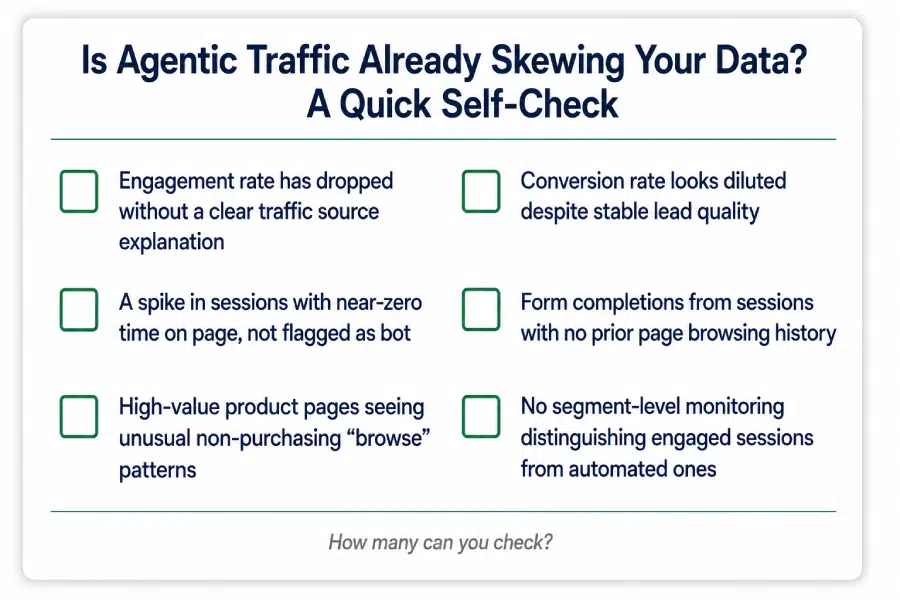
If two or more of these sound familiar, agentic traffic may already be present in your GA4 data without a clear way to identify it.
The Takeaway
Bot traffic in GA4 used to be a solved problem. Known crawlers got filtered, the rest was assumed to be human, and that assumption held up reasonably well for a long time.
The agentic web changes that assumption. AI agents now generate traffic that behaves like genuine engagement, completes real conversions, and falls outside the boundaries of any static bots list. GA4’s built-in filtering still does its job for what it was designed to catch.
The opportunity is in extending visibility to the traffic that sits in between: not human in the traditional sense, not malicious, but not yet accounted for either.
Getting this right protects more than your reporting. It protects every decision, campaign, and AI model that gets built on top of what GA4 tells you about who’s actually visiting your site.
Want to know how much of your GA4 traffic might already be agentic?
Tatvic’s team can assess your current segment-level monitoring and identify where agentic and automated patterns may be blending into your human traffic data. Schedule a call with Tatvic’s experts today.