

The Hidden Cost of Form Tracking Failures in US Real Estate Lead Generation
For property portals and listing platforms operating in the US market, real estate lead generation analytics is the foundation of every business decision. It informs every major growth decision, from which campaigns deserve more budget to which markets and listing categories drive the strongest inquiry quality.
All of it runs on analytics data. And the single most important data point in that system, the form submission, is also the most fragile one.
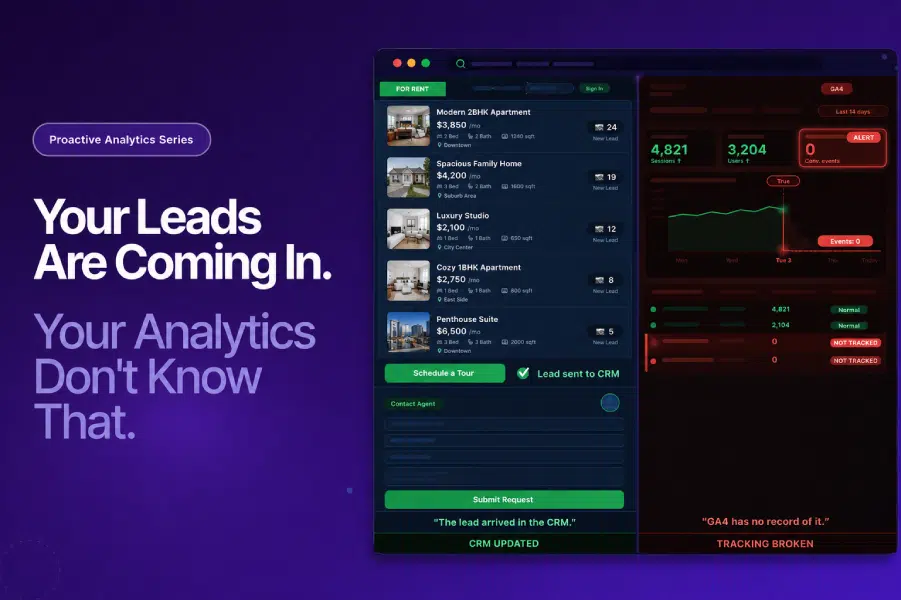
A form tracking failure in GA4 does not announce itself. The inquiry form still works. Users still submit their details. Leads still land in the CRM. But GA4 stops recording them. And everything downstream of that missing data, campaign performance reporting, cost per lead calculations, channel attribution, gets quietly distorted.
This is the real estate lead generation analytics problem that costs US property portals the most, and gets investigated the least.
The US Property Portal Lead Generation Stakes
The US real estate market is unambiguously digital. According to Zillow’s 2025 Consumer Housing Trends Report for Agents, 36% of sellers now find their agents through online channels, more than double the 15% share recorded in 2018. Among buyers, 33% say online research played a key role in selecting their agent.
For property portals and listing platforms, this digital shift is the entire business model. Every page view on a property listing, every saved search, every inquiry form submitted is a lead generation event. The NAR 2025 Technology Survey found that 24% of real estate professionals now spend over $500 per month on technology tools alone, reflecting how central digital infrastructure has become to the industry.
In this environment, real estate lead generation analytics is not a reporting function. It is an operational one. When the analytics are wrong, the operational decisions made from them are wrong too.
The Form Tracking Problem That Property Portals Underestimate
A typical US property portal has multiple form-based conversion events across its listing pages:
- Property inquiry forms (“Contact Agent” or “Request Info”)
- Schedule a Tour or Schedule a Showing requests
- Rental application initiation forms
- Save a Search or Create an Alert sign-ups
- Mortgage calculator lead capture forms
Each of these is a distinct conversion event that needs to be tracked correctly in GA4 to inform real estate lead generation analytics. And each of them is a point where tracking can fail silently.
How Form Tracking Fails on Property Portals
Form tracking failures on property portals follow a consistent set of patterns:
GTM container updates after feature launches.
A new listing feature, a redesigned search experience, or a mobile UX update gets pushed to production. The GTM container is updated as part of the deployment. A form trigger that was firing correctly now looks for a button or form field that no longer exists in the redesigned page. The tag stops firing entirely. GA4 conversion data drops. Nobody catches it during deployment because the form itself still submits correctly from a user perspective.
Mobile vs desktop tracking discrepancies.
US property portal traffic skews heavily toward mobile. A “Schedule a Tour” button event that fires correctly on desktop may not fire at all on mobile if the GA4 event configuration uses a click class that differs between device types. Mobile leads vanish from real estate lead generation analytics entirely. The platform sees lower mobile conversion rates and draws incorrect conclusions about mobile campaign performance.
Cross-domain tracking failures between listing pages and application portals.
Many US rental platforms use a separate subdomain or third-party application for the rental application process. When a user moves from the listing page to the application portal, if cross-domain tracking is not configured correctly in GA4, the session resets. The completed application attributes to “direct” rather than to the paid search or display campaign that brought the user to the listing.
Form confirmation page tracking errors.
Some property portals fire GA4 conversion events on the thank-you page after a form submission, rather than on the form submission event itself. If the confirmation page URL changes, is cached differently on mobile, or becomes inaccessible due to a redirect change, the conversion event stops firing. Leads are still coming in. GA4 has no record of them.
How Form Tracking Failures Cascade Into Business Decisions
This is where real estate lead generation analytics failures become genuinely expensive. Not because the leads are lost, but because the decisions made from the distorted data cost more than the tracking fix would have.
Here is a scenario that plays out regularly on US property portals:
A platform running a Google Ads campaign targeting apartment renters in Chicago has been averaging 340 qualified leads per week with a cost per lead of $42. A new listing page redesign goes live on a Tuesday. By Thursday, GA4 is recording 190 leads per week from the same campaign. Cost per lead appears to have jumped to $75.
The campaign manager sees the cost per lead spike in the dashboard. They reduce the Google Ads budget by 40%, reasoning that the campaign has become inefficient. The budget is reallocated toward an organic content push that appears to be holding its conversion numbers because its separate landing page was not affected by the GTM change.
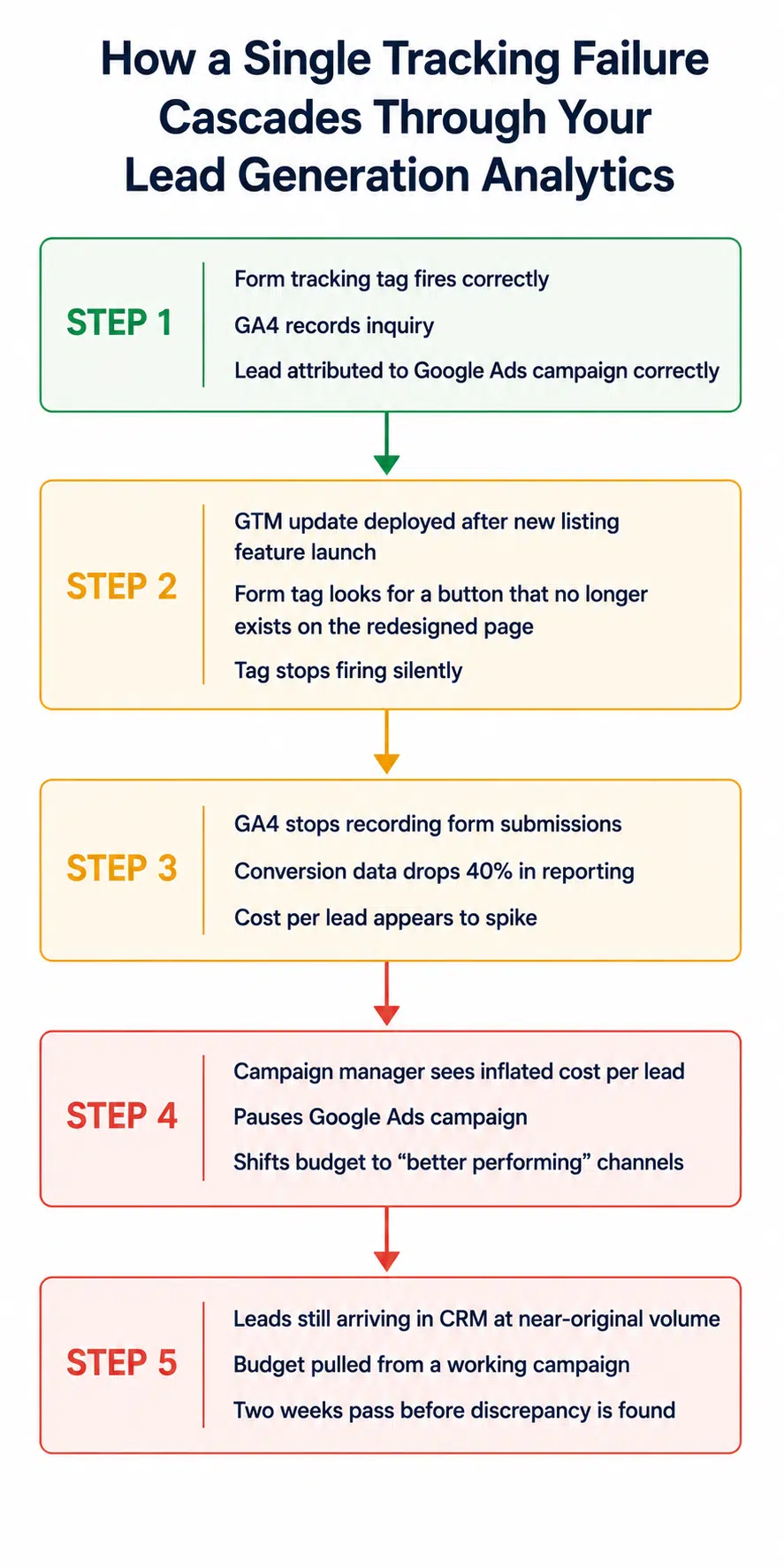
Leads are still coming in at close to the original volume. The CRM is still receiving around 320 inquiries per week. But GA4 shows 190 because the form tag stopped firing on the redesigned listing pages. The campaign that was working at $42 per lead is now running at a reduced budget because the real estate lead generation analytics said otherwise.
Two weeks later, a monthly performance review catches the discrepancy between GA4 lead volume and CRM intake. The investigation begins. The GTM error is found and fixed. But two weeks of reduced Google Ads budget have already passed, and the platform lost competitive positioning in the Chicago rental market during a peak leasing period.
This is the 100x cost problem identified in proactive analytics research: catching the issue at the point of entry costs almost nothing. Finding it two weeks later costs significantly more.
What Proactive Monitoring Looks Like for US Property Portal Analytics
Protecting real estate lead generation analytics requires monitoring at the tracking layer, not just the reporting layer. By the time a discrepancy between GA4 and the CRM is visible in a monthly review, the business decisions have already been made.
Anomaly detection on form submission event volume.
Set intelligent baselines for each form event by device type, listing category, and traffic source. When mobile “Schedule a Tour” events drop 35% over 48 hours without a corresponding traffic decline, that is a tracking anomaly, not a lead gen performance drop. Tatvic’s anomaly detection solution applies ML-driven baselines specifically to conversion events, not just traffic metrics.
Continuous GTM tag validation after every deployment.
Every site update, feature launch, or GTM container change is a potential tracking failure point. Automated validation of form tracking tags after each deployment confirms that events are still firing correctly before the analytics data has time to mislead campaign decisions. Tatvic’s data sanity automation runs these checks continuously, not just at scheduled audit intervals.
Weekly reconciliation of GA4 lead volume against CRM intake.
For US property portals, the CRM is the ground truth for lead volume. Building a weekly reconciliation step that compares GA4-recorded form submissions against CRM lead intake catches tracking gaps before they compound. A consistent 15% gap between the two systems is a signal worth investigating immediately.
A response playbook for form tracking failures.
As covered in Tatvic’s analytics alerting system blog, a P1 alert for a form tracking failure on a primary conversion event needs a named owner, a one-hour response SLA, and a defined escalation path to the development team. For a US property portal running paid campaigns with significant daily budgets, a same-day response to a form tracking failure prevents the campaign decision cascade described above.
Is Your Real Estate Lead Generation Analytics Setup Actually Reliable?
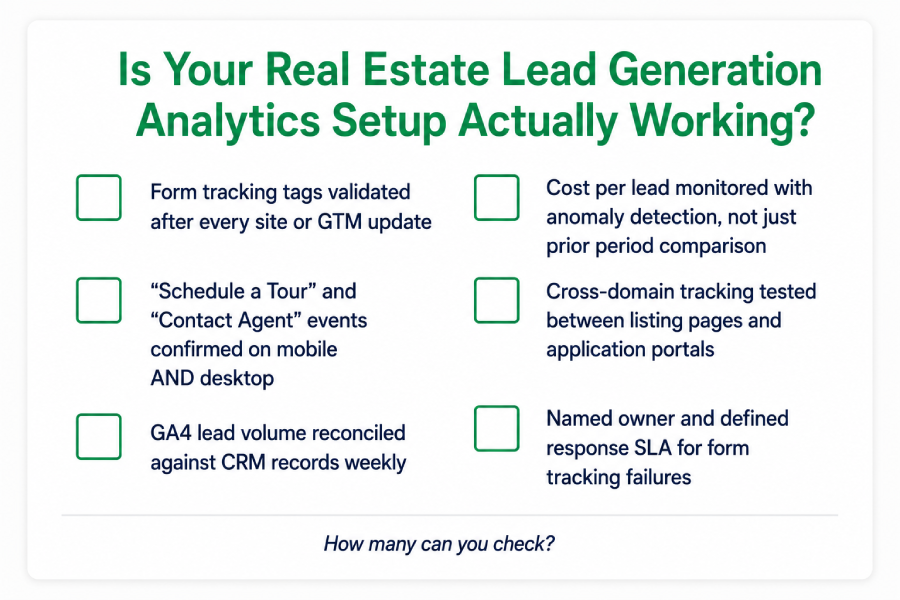
Before the next campaign launch, run through this:
- Has every form tracking tag been validated since the last site or GTM update?
- Are “Schedule a Tour” and “Contact Agent” events confirmed firing on both mobile and desktop separately?
- Is GA4 lead volume reconciled against CRM records at least weekly?
- Is cost per lead monitored with anomaly detection, or just compared manually to the prior period?
- Is cross-domain tracking configured and tested between your listing pages and any third-party application portals?
- Is there a named owner and a defined response time for form tracking failures?
For US property portals running paid campaigns across Google, Meta, and listing network placements, each of these gaps represents a potential decision failure waiting to happen.
The Takeaway
Real estate lead generation analytics is only as strong as the tracking layer behind it. For US property portals and listing platforms, every qualified inquiry carries a measurable acquisition cost, and every campaign decision depends on accurate conversion data. When form tracking breaks, the impact goes far beyond analytics.
High-performing campaigns get deprioritized, budgets shift in the wrong direction, and growth decisions are made on incomplete data. What looks like a reporting issue quickly becomes a business cost. The competitive positioning lost during a peak leasing season does not come back.
Proactive monitoring of form tracking health, combined with intelligent anomaly detection on conversion event volume and a clear response playbook, turns real estate lead generation analytics from a lagging indicator into a live operational signal. That is the difference between a portal that discovers tracking failures in monthly reviews and one that resolves them the same day they begin.
Running lead generation campaigns across your property portal and want to make sure your GA4 tracking is giving you the full picture?
Tatvic’s team can audit your form tracking setup, GTM configuration, and cross-domain tracking health across your US listing platform. Schedule a call with Tatvic’s experts today.