

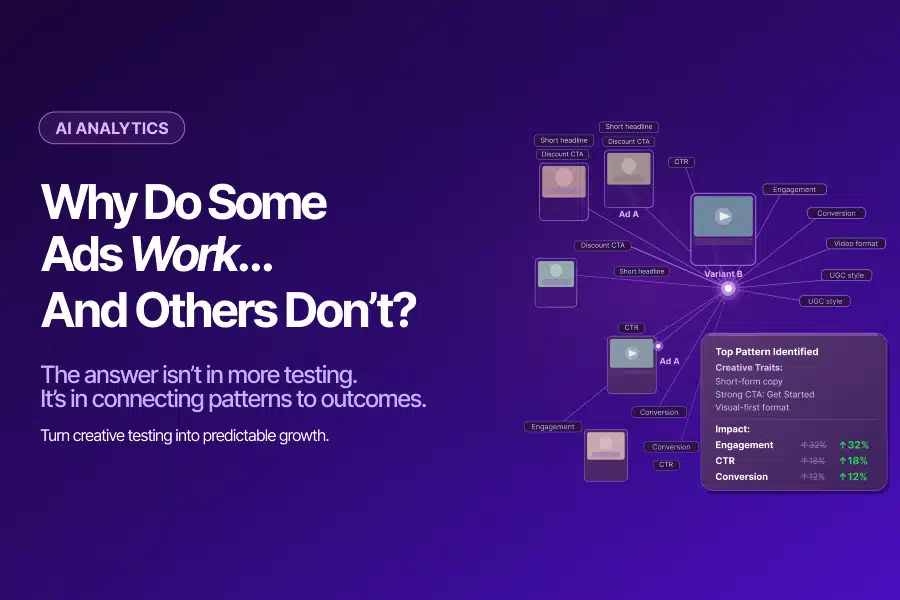
If Your Creative Worked Once… Why Can’t You Make It Work Again?
You launch a few creatives, and one clearly outperforms the rest. It drives higher clicks, better engagement, and stronger conversions. Naturally, you scale it, expecting similar results across audiences and campaigns.
But the performance doesn’t hold. The next iteration underdelivers, and what once seemed like a “winning creative” suddenly feels inconsistent. At that point, most teams go back to testing – new hooks, new formats, new variations – hoping to find the next winner.
The real issue isn’t the lack of testing. It’s the lack of clarity.
Most teams don’t actually know why the first creative worked. They only know that it did. And that distinction is what separates repeatable growth from inconsistent performance.
The Illusion of a “Winning Creative”
Marketing teams today are highly data-driven, but that data is often interpreted at a surface level. Performance is measured through metrics like CTR, conversions, engagement rates, and ROAS, and based on those numbers, a creative is labeled as “winning.”
This approach answers an important question: what performed better?
But it doesn’t answer the more critical one: what made it perform better?
That gap becomes visible when you try to scale. Without understanding the drivers behind performance, scaling becomes repetition rather than optimization. And repetition without context rarely produces consistent outcomes.
Why Performance Doesn’t Repeat
A creative is not a single variable. It is a combination of elements working together – messaging, visuals, structure, timing, and audience context. When a creative performs well, it’s usually because a specific combination of these elements aligns effectively.
However, when teams treat the creative as one unit, they miss that nuance. Any attempt to replicate it often changes key variables unintentionally. The hook might shift slightly, the audience might differ, or the context might change.
As a result, performance drops – not because the idea was flawed, but because the underlying drivers were never clearly understood.
This Isn’t a Data Problem. It’s a Clarity Problem.
Most organizations already have access to abundant data. Campaign dashboards, attribution tools, and analytics platforms provide detailed visibility into performance across channels and audiences.
But visibility alone does not create clarity.
As discussed earlier in the series, simply having access to data does not mean teams can instantly understand it. (Read more in What if you didn’t have to explore data to understand it?.)
Even today, most workflows rely on manual analysis – segmenting performance, comparing trends, forming hypotheses, and validating assumptions. This process is time-intensive and often inconsistent, especially when applied to creative performance.
What Creative Intelligence Actually Means
Creative intelligence goes beyond identifying high-performing creatives. It focuses on breaking down performance into meaningful components and understanding how each element contributes to outcomes.
Instead of evaluating an ad as a single unit, creative intelligence analyzes it at a granular level. It looks at how specific hooks, formats, tones, and calls-to-action influence engagement and conversion across different audiences.
This shift changes the core question teams ask. Instead of asking “Which ad worked?”, the focus moves to “What within this ad worked – and where else can we apply it?”
That is where optimization becomes intentional rather than reactive.
From Creatives to Patterns
When performance is analyzed at the element level, patterns begin to emerge. These patterns often remain hidden when looking only at campaign-level metrics.
For instance, certain messaging styles may consistently drive higher engagement among new users, while user-generated content formats may outperform polished creatives for specific segments. Similarly, emotional hooks may increase interaction, but not always lead to conversions.
These are not isolated observations. Over time, they form repeatable patterns that can be applied across campaigns. This is what turns creative performance from unpredictable outcomes into structured insights.
Why This Matters More Than Ever
The importance of understanding creative drivers has increased significantly in recent years. Marketing environments are more dynamic, audiences are more fragmented, and content fatigue sets in faster.
At the same time, expectations around personalization continue to rise. According to McKinsey & Company, 71% of consumers expect personalized experiences, yet most brands struggle to deliver them consistently.
The gap exists because personalization is often applied at a superficial level. Without understanding what truly resonates with different audience segments, personalization becomes difficult to scale effectively.
Creative intelligence addresses this by linking content patterns directly to audience response, making personalization more actionable and less dependent on guesswork.
Why Traditional Workflows Break at Scale
Most creative workflows follow a familiar cycle: launch, measure, identify a winner, and scale. While this approach works in controlled scenarios, it begins to break down as complexity increases.
Modern campaigns operate across multiple channels, audiences, and formats. Each variable introduces additional layers of complexity, making it harder to isolate what actually drives performance.
As highlighted earlier in the series, analytics systems today are largely built for investigation rather than real-time understanding (explored in Analytics today is built for investigation-not detection).
This limitation extends to creative analysis as well. By the time insights are derived, the opportunity to act on them has often passed.
How Agentic AI Enables Creative Intelligence
This is where agentic AI changes the equation. Instead of relying on manual analysis, it continuously evaluates creative performance at a deeper level and connects multiple data points in real time.
Rather than focusing only on outcomes, it links creative elements to performance signals and identifies patterns across campaigns. It breaks down creatives into components such as hooks, visuals, messaging, and calls-to-action, and maps each component to engagement and conversion metrics.
Over time, this creates a structured understanding of what drives performance. Instead of isolated campaign insights, teams gain access to reusable patterns that can be applied across contexts.
This shift transforms the workflow. Teams no longer start with exploration. They start with insight – clear, contextual, and actionable.
What Gets Measured &Why It Changes Decisions
To support this approach, measurement frameworks need to evolve beyond campaign-level metrics. Creative intelligence introduces new dimensions of analysis that focus on element-level performance.
This includes evaluaitng:
By shifting measurement to this level, teams move from observing performance to understanding it. Decisions are no longer based solely on outcomes but on the drivers behind those outcomes.
From Testing More to Learning Faster
Many teams believe that increasing the number of tests will lead to better performance. While experimentation is important, the real advantage lies in how quickly teams can learn and apply insights.
Creative intelligence shortens this cycle by making insights more accessible and actionable. Instead of running multiple tests without clear direction, teams can focus on refining elements that are already proven to work.
According to McKinsey & Company, organizations that effectively use data and AI in marketing can improve ROI by 20-30%. These improvements are not driven by more testing alone, but by faster and more informed decision-making.
The Compounding Impact of Understanding
The benefits of creative intelligence extend beyond individual campaigns. Over time, every campaign contributes to a growing repository of insights.
These insights do not remain isolated. They compound.
As a result, future campaigns start with a stronger foundation. Testing cycles become shorter, performance becomes more predictable, and resource allocation becomes more efficient.
This is where marketing shifts from reactive execution to strategic optimization.
The Role of Human Creativity
Despite the increasing role of advanced analytics, human creativity remains central to the process. Creative intelligence does not replace human judgment; it enhances it.
By providing clearer insights, it allows teams to focus on strategy, storytelling, and innovation rather than spending time on repetitive analysis. Teams still define the narrative and direction, but they do so with greater confidence and clarity.
This combination of human creativity and structured insight leads to more effective outcomes.
The Real Shift in Marketing Analytics
Analytics has already evolved significantly over the years. It has moved from enabling basic measurement to providing deeper visibility into performance.
Now, it is entering a new phase – one that focuses on understanding.
Instead of simply showing what happened, analytics is beginning to explain why it happened. When this capability extends to creative performance, it unlocks a new level of optimization.
Performance is no longer reactive. It becomes repeatable.
Closing Thought
If your team is still scaling “winning creatives” without understanding why they worked, the problem isn’t execution – it’s insight.
Repeating outcomes without understanding their drivers leads to inconsistent performance and missed opportunities. Over time, this creates inefficiencies that are difficult to measure but expensive to sustain.
The real advantage today lies in understanding what drives engagement and conversion at a deeper level. When that understanding becomes part of your workflow, you move from guessing what might work to confidently applying what already does.
That is the difference between testing for results and building for repeatable growth.