

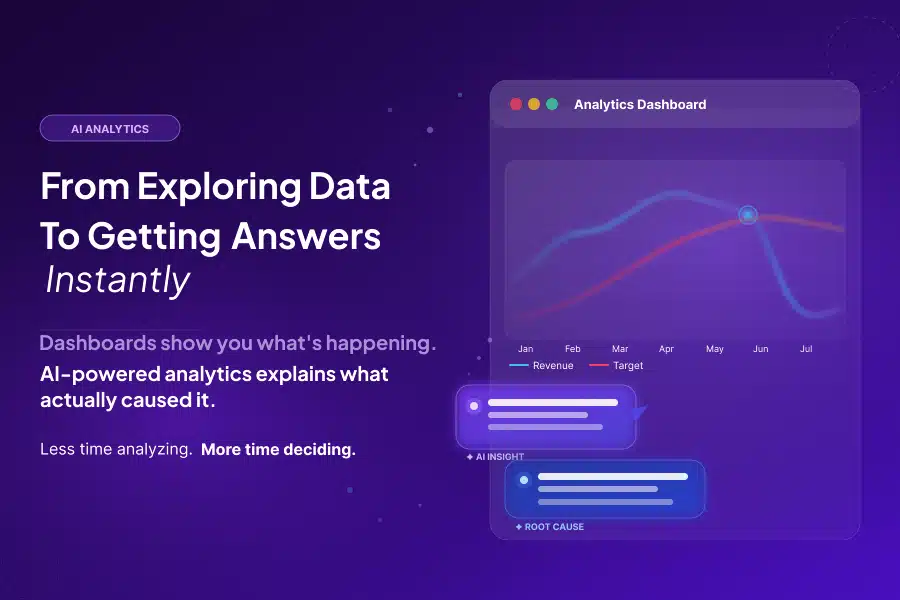
AI Analytics in Marketing: The Missing Layer Between Data and Action
AI analytics in marketing is no longer just about reporting performance – it’s about reducing the time it takes to understand and act on it.
Over the past decade, marketing analytics has evolved significantly. Tools like Google Analytics 4 have made data more accessible, structured, and reliable. Most organizations today have invested heavily in dashboards, tracking, and reporting layers to strengthen their analytics setup.
But even with this progress, something still feels slower than it should.
Teams can see what’s happening almost instantly. Yet understanding what the data actually means – and deciding what to do next – still takes time.
This shift from data access to data interpretation is something we explored in detail in our earlier piece on how AI Analytics: Marketing Decision-Making Speed blog impacts decision speed.
This is exactly where AI analytics is beginning to redefine how modern marketing teams operate.
What is AI Analytics in Marketing?
AI analytics refers to the use of artificial intelligence to analyze marketing data, identify patterns, and generate actionable insights that improve marketing decision making.
Unlike traditional marketing analytics, AI analytics helps teams move beyond reporting by answering:
- Why performance changes are happening
- What factors are driving those changes
- What actions should be taken next
This shift is what makes AI powered analytics a critical layer in modern analytics workflows.
The Evolution of Marketing Analytics: What Changed, and What Didn’t
To understand why this problem exists, it helps to look at how marketing analytics has evolved.
Earlier, analytics was heavily manual. Teams depended on multiple tools, spreadsheets, and delayed reporting cycles. Pulling even a basic campaign report required time, coordination, and validation. Data existed – but accessing it was difficult.
Then came structured platforms like Google Analytics 4, which transformed how teams interacted with data.
These platforms made analytics:
- Centralized across channels
- Available in near real time
- Easier to visualize through dashboards
This was a major leap forward for marketing analytics. However, while access improved, interpretation did not evolve at the same pace.
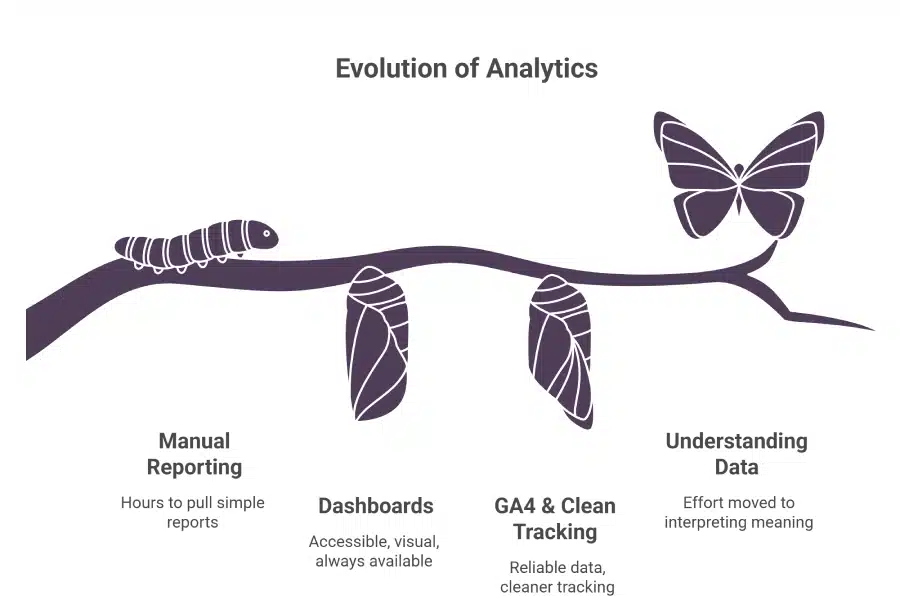
Even today, most analytics systems are designed to show data – not explain it. Teams still rely on manual workflows to understand why something happened and what actions should follow. This is where AI analytics begins to play a critical role.
The Real Bottleneck in Marketing Analytics
Most organizations today have a mature marketing analytics setup. They have:
- Clean event tracking
- Structured dashboards
- Defined KPIs
- Cross-channel visibility
On the surface, this looks like a fully optimized analytics system. But when performance changes occur, decision-making still slows down.
The issue is no longer data quality or reporting accuracy.
The issue is how long it takes to interpret the data.
Without AI analytics, teams still rely on manual workflows to connect data points, validate assumptions, and derive insights. This is where time gets consumed, and where decision speed breaks down.
What Happens After a Performance Drop (In Reality)
Consider a typical scenario.
A drop in conversions is detected in your dashboard. The signal is clear, and the data is reliable. But that’s only the starting point.
From there, the team begins a structured investigation process:
- Comparing performance across time periods
- Breaking down results by channel
- Analyzing campaign-level changes
- Segmenting by audience, device, or geography
- Validating whether the trend is real or an anomaly
In many cases, a data analyst is involved to conduct deeper analysis.
At this stage, the team is not making decisions yet.
It is still trying to answer a basic question:
“What exactly is happening here?”
This is where time gets consumed. And without AI analytics, this process repeats every time a new question arises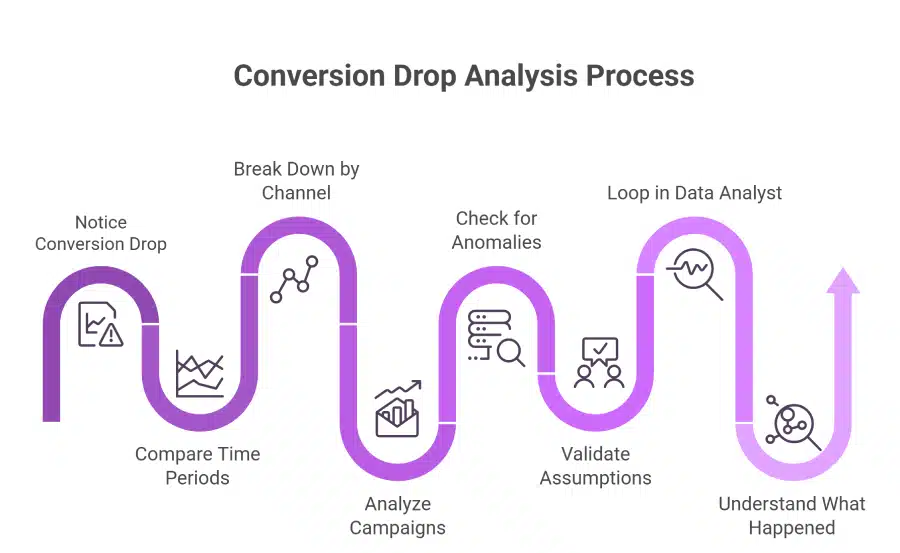
Why This Process Persists Across Teams
The reason this workflow continues is not because teams are inefficient. It’s because traditional analytics tools are designed for exploration.
They are built to answer descriptive questions such as:
- What changed?
- Where did it change?
- How significant is the change?
But they do not directly answer:
- Why did it change?
- What caused it?
- What should we do next?
That gap creates a dependency on manual interpretation.
Even in sophisticated google data analytics setups, teams rely on human judgment to connect data points, validate hypotheses, and derive insights. This makes marketing decision making slower than it should be.
The Hidden Cost of Manual Interpretation
This interpretation gap has a measurable impact on performance. Without AI analytics, teams continue to rely on repetitive manual analysis to bridge this gap.
A significant portion of marketing analytics effort is spent on:
- Repeating similar analyses for recurring questions
- Validating insights across multiple stakeholders
- Explaining findings in different contexts
Over time, this leads to:
- Delayed decisions
- Slower optimization cycles
- Missed opportunities
These are not visible issues in dashboards, but they directly affect outcomes. If you want to quantify what this delay is costing your team, you can estimate the impact using the AI ROI Forecaster.
This is precisely where AI analytics creates value – not by improving visibility, but by improving understanding.
The Shift Toward AI Analytics
The shift toward AI analytics is not just conceptual – it is already delivering measurable impact.
According to research by McKinsey & Company, organizations adopting AI in marketing and sales are seeing significant improvements in performance, efficiency, and ROI.
AI analytics introduces a new way of interacting with data. Instead of starting with dashboards and exploring multiple dimensions manually, teams can start with insights that are already contextualized. This reduces the effort required to interpret data and accelerates decision-making.
At a practical level, AI analytics enables:
- Automatic detection of anomalies
- Pattern recognition across large datasets
- Identification of likely causes
- Generation of actionable insights
This is what differentiates AI analytics from traditional marketing analytics.
It is not about replacing existing tools.
It is about enhancing them with an interpretation layer.
What AI Powered Analytics Looks Like in Practice
With AI powered analytics, workflows change in a meaningful way.
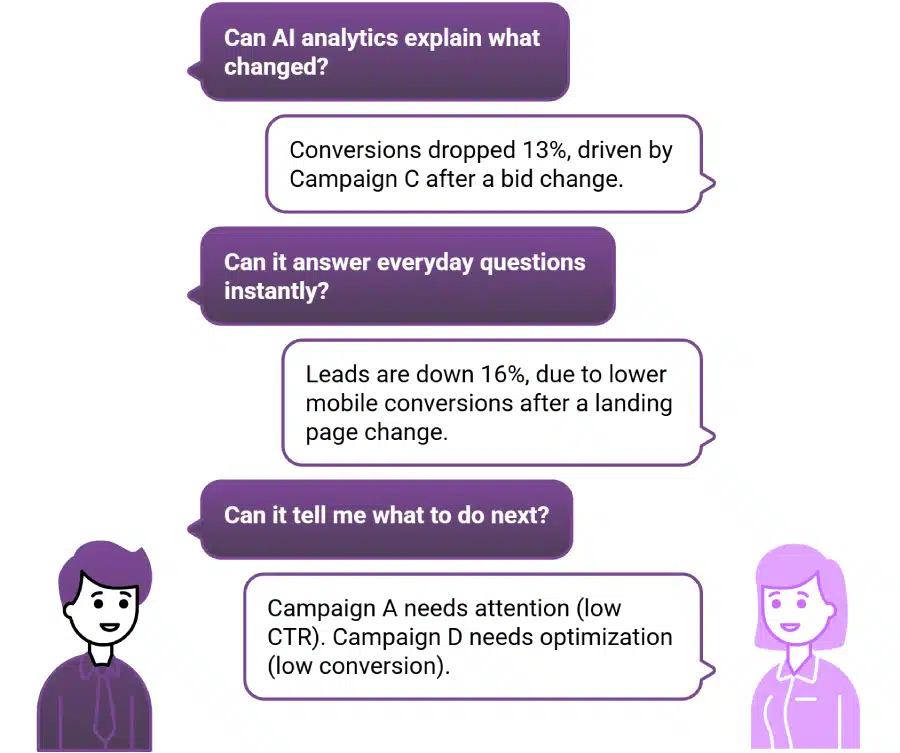
Instead of manually investigating a drop in performance, teams receive insights such as:
- “Conversions declined by 14% due to reduced engagement in mobile traffic from Campaign A.”
- “Lead volume dropped due to lower conversion rates on landing page X after a recent update.”
These insights provide immediate context.
The team no longer needs to start from scratch. Instead, it can:
- Validate the insight
- Assess business impact
- Decide on the next step
This shift reduces the time between data and action. That is the real promise of AI analytics.
In fact, we recently broke down a few real-world scenarios – from “simple questions” that take hours to answer, to situations where teams struggle to decide what to do next – in a more conversational format.
The Role of Agentic AI in Analytics
As AI analytics continues to evolve, agentic AI is emerging as a key enabler of continuous intelligence.
Unlike traditional automation, which executes predefined tasks, agentic AI systems can operate more independently. They continuously monitor data, identify changes, and surface insights without requiring manual input.
In the context of marketing analytics, this means:
- Insights are generated proactively
- Patterns are identified continuously
- Teams are alerted to meaningful changes in real time
This transforms analytics from a passive system into an active decision-support layer. Explore how Agentic AI Services for Marketing Transformation can introduce a continuous intelligence layer into your analytics workflows
This is also where modern ai solutions are heading – toward systems that assist not just in reporting, but in understanding and action.
How AI Analytics Improves Marketing Decision Making
The impact of AI analytics on marketing decision making is significant.
Faster Time to Insight
Teams no longer spend hours or days interpreting data. Insights are available much earlier in the process.
Reduced Dependency on Manual Workflows
Routine questions can be answered without repeated analysis, reducing the burden on analysts.
More Consistent Interpretation
Standardized insights reduce variability in how different stakeholders interpret data.
Better Resource Allocation
Teams spend less time analyzing and more time optimizing and experimenting.
Together, these improvements lead to more efficient and effective marketing operations.
AI Analytics Use Cases in Marketing
To understand how this works in practice, AI analytics use cases in marketing highlight where teams gain the most value. Some common AI analytics use cases include:
- Campaign Performance Monitoring
AI analytics identifies underperforming campaigns and highlights the root cause before significant budget is wasted. - Conversion Drop Analysis
Instead of manual investigation, AI analytics pinpoints the exact drivers behind performance changes. - Cross-Channel Insights
AI analytics connects performance trends across platforms, providing a unified view of what’s happening. - Opportunity Identification
AI analytics highlights areas that require attention, enabling teams to act faster.
These use cases demonstrate how AI analytics moves beyond reporting into actionable intelligence.
Evaluating Your Current Analytics Setup
Most organizations evaluate their analytics maturity based on:
- Data quality
- Tracking accuracy
- Reporting capabilities
While these are important, they do not fully capture effectiveness.
A more relevant question is: How much effort does it take to get an answer?
If answering a simple question requires multiple steps, coordination, or extended analysis, it indicates that the analytics setup is incomplete. This is where AI analytics can create the most impact.
From Dashboards to an Analytics Intelligence Layer
Modern marketing analytics is evolving into a layered system.
Foundation Layer:
- Data collection
- Tracking (Google Analytics 4)
- Reporting dashboards
Intelligence Layer:
- AI analytics
- AI powered analytics
- Agentic AI
The intelligence layer focuses on interpretation.
It continuously analyzes data, connects signals to causes, and surfaces insights without requiring repeated manual effort. This is what defines an analytics intelligence layer.
The Strategic Advantage of AI Analytics
The real value of AI analytics lies in speed.
In competitive environments, the ability to understand data quickly leads to faster decisions. Faster decisions lead to better outcomes.
Organizations that adopt AI analytics gain:
- Faster optimization cycles
- Reduced wasted spend
- Improved campaign performance
This is not just an operational improvement.
It is a competitive advantage.
Where Most Organizations Get It Wrong
Many organizations assume that improving dashboards will solve their analytics challenges.
In reality:
- More dashboards increase complexity
- More data does not equal better decisions
Another common mistake is treating AI analytics as a standalone tool.
It is not just a tool.
It is a shift in how analytics workflows operate.
Without aligning workflows, even the best AI analytics solutions will not deliver full value.
Closing Perspective
Analytics has always evolved to reduce effort.
First, it reduced the effort of collecting data.
Then, it reduced the effort of accessing it.
Now, it is reducing the effort of understanding it. This is where AI analytics is making the biggest impact.
By transforming how insights are generated and consumed, AI analytics enables teams to move faster from data to decision. It reduces manual effort, improves clarity, and supports better marketing decision making.
The advantage today is no longer about having more data. It is about understanding it faster – and acting on it sooner.
→ Explore how Agentic AI Services for Marketing Transformation can introduce a continuous intelligence layer into your analytics workflows