AI Analytics: From Dashboards to Decisions
Where Marketing Decision-Making Slows Down
For years, marketing teams were solving for one core problem: They couldn’t trust their analytics.
Different dashboards showed different numbers.
Attribution didn’t add up.
Teams spent more time validating marketing analytics than using it.
So naturally, the focus shifted:
- Better tracking
- Cleaner Google Analytics 4 implementations
- Standardized dashboards
- Stronger reporting layers
And to be fair - this worked.
Today, many organizations finally have reliable analytics. They trust their data. But something unexpected happened next: Decision-making didn’t speed up. This is exactly where AI analytics is changing how modern marketing teams operate.
What Is AI Analytics in Marketing?
AI analytics in marketing refers to the use of artificial intelligence to analyze data, identify patterns, and generate actionable insights that improve marketing decision making.
Unlike traditional marketing analytics, which focuses on dashboards and reporting, AI analytics goes a step further. It helps teams understand:
- Why performance changes are happening
- What factors are driving those changes
- What actions should be taken next
This is what makes AI powered analytics fundamentally different. Instead of relying entirely on a data analyst, teams can use intelligent systems to:
- Detect anomalies in real time
- Analyze cross-channel performance
- Surface insights proactively
- Recommend next best actions
In practice, this means your analytics evolves from:
‘Reporting what happened‘ to ‘Explaining what’s happening - and guiding what to do next‘
This shift is central to modern ai solutions and is increasingly powered by advancements like agentic AI, which enables continuous monitoring and decision support. This is why AI analytics is becoming a critical layer in modern marketing systems.
If Data Isn’t the Problem, What Is?
Most teams assume that once data is fixed, decisions should become faster. But in reality, the bottleneck hasn’t disappeared. It has moved.
From: “Can we trust this data?”
To: “What does this data actually mean - and what should we do next?”
And that second question is where things slow down again. Because while data collection and reporting have matured, data interpretation is still manual. This is where modern AI analytics enters the conversation.
The Hidden Bottleneck in Marketing Analytics
Let’s look at how this plays out in a typical marketing analytics workflow.
A team today has:
- Clean analytics implementation
- Accurate tracking
- Structured dashboards
- Cross-channel visibility
Everything looks right. But when performance drops:
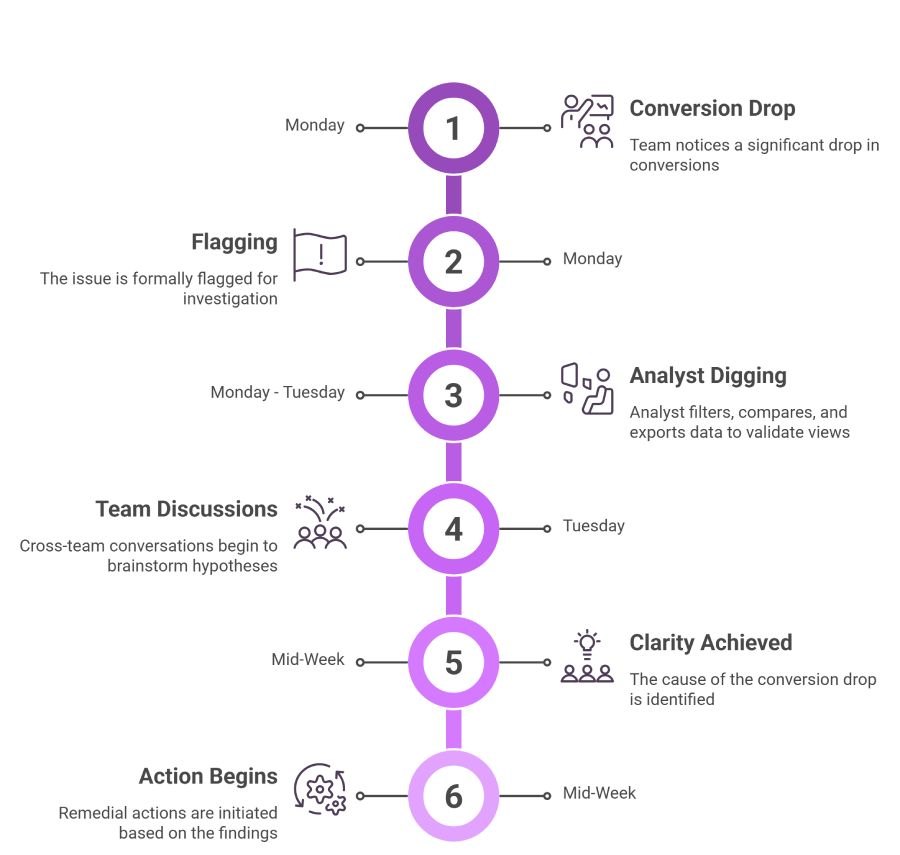
What looks like a simple performance drop turns into a multi-day process - not because the data is wrong, but because understanding it takes time. This is where marketing decision-making speed breaks down. Every delay between signal and clarity slows action, extends impact, and reduces the ability to respond in real time. Without AI analytics, this interpretation gap continues to slow down decision-making.
Nothing Is Broken. But It’s Still Slow.
This is the reality of modern analytics. The issue is no longer:
- Data quality
- Reporting accuracy
The issue is: Time taken to interpret data
And that’s exactly the gap AI powered analytics is designed to solve. If you want to understand the real impact on your business, you can evaluate the potential ROI of faster decisions with the AI ROI Forecaster
The Core Limitation of Dashboards
Most marketing dashboards are designed to answer one question:
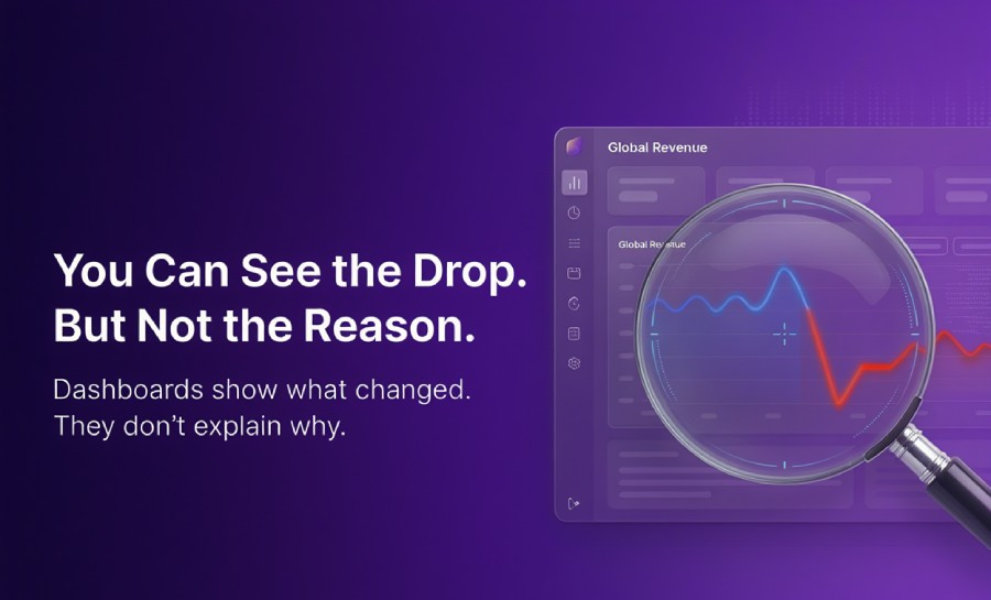
“What changed?”
They can show:
- Drop in conversions
- Channel-level performance
- Campaign-level trends
But they don’t explain:
- Why the change happened
- Whether it’s temporary or systemic
- What action should be taken
The biggest limitation impacting marketing decision-making speed is lack of automated interpretation. This creates a gap. And that gap is filled manually - every single time.
Why AI Analytics Is Becoming Essential
The shift toward AI analytics isn’t theoretical - it’s already delivering measurable impact.
Research compiled from firms including McKinsey Digital (2026) shows that AI in marketing can drive an average ROI improvement of around 35%.
At the same time, broader studies indicate that organizations using AI in marketing and sales are already seeing tangible gains in performance and efficiency.
This reinforces a clear shift: The competitive advantage is moving from access to data → speed of understanding.
Instead of just showing data, it helps teams:
- Detect anomalies automatically
- Analyze patterns across dimensions
- Identify likely causes
- Recommend next steps
This is where AI powered analytics transforms marketing decision making.
Why Marketing Analytics Still Feels Slow
Even with AI analytics capabilities emerging, most teams are still operating with manual interpretation layers where teams face the following challenges:
1. Analysis Is Reactive
Teams analyze data after something goes wrong.
This means:
- Insights come late
- Impact has already occurred
- Opportunities are missed
2. Analysts Become a Bottleneck
As data complexity increases, so does reliance on analysts.
They handle:
- Ad-hoc queries
- Deep dives
- Reporting requests
- Data validation
When multiple stakeholders ask questions, everything slows down.
3. Interpretation Isn’t Standardized
Two people can look at the same dashboard and reach different conclusions.
Why?
Because interpretation depends on:
- Context
- Experience
- Assumptions
This leads to:
- More discussions
- Delayed decisions
- Lack of consistency
4. Decision Latency Impacts Performance
This is the hidden cost.
In marketing:
Timing matters as much as the decision itself.
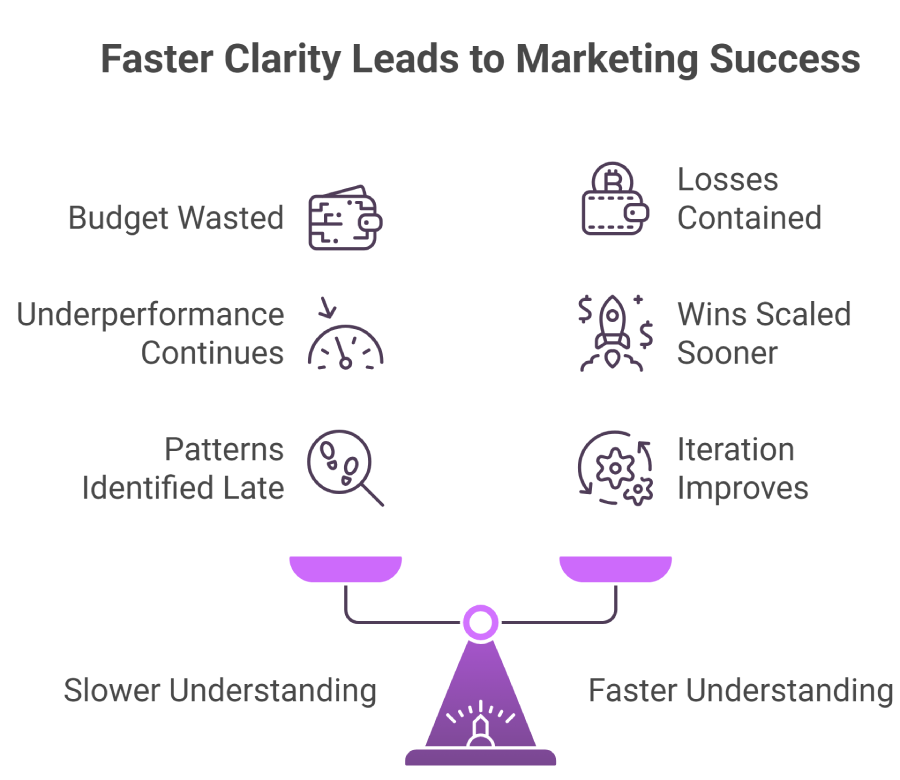
If understanding is delayed:
- Budgets are wasted before correction
- Underperformance continues longer
- Winning strategies are identified late
Decision latency directly reduces marketing decision-making speed across teams.
The Real Shift: From Data Accuracy to Decision Speed
Over the last few years, organizations have optimized for: Data accuracy, tracking reliability, and reporting consistency but the next evolution isn’t better dashboards. It’s analytics intelligence powered by ai solutions.
It’s about: How fast your team can move from data → insight → action
This is where most organizations still struggle.
Introducing Analytics Intelligence
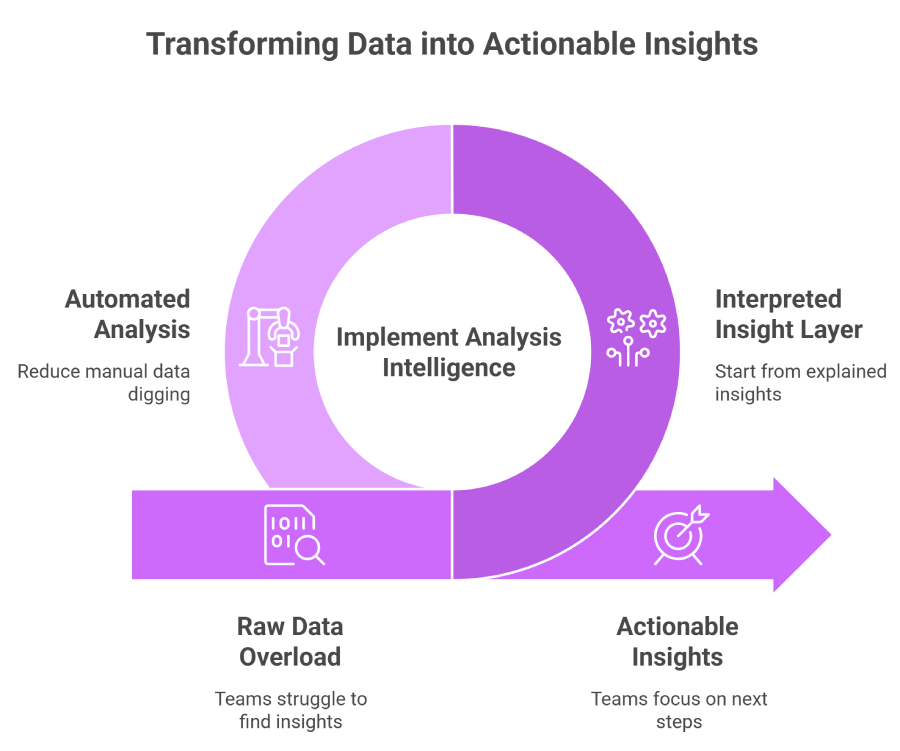
This is where AI analytics evolves into a true intelligence layer.
An Analytics Intelligence Layer
This sits on top of your existing analytics setup and focuses on:
- Continuous performance monitoring
- Automated analysis of changes
- Contextual explanation of trends
- Identification of likely causes
Instead of starting with raw data,
teams start with interpreted insights.
Is Your Current Process Ready for This Shift?
Not every analytics workflow is ready for an intelligence layer. The key question is: Where is your team still dependent on manual analysis? This is where evaluating your internal workflows becomes critical.
→ Use the AI Process Eligibility Calculator to identify where AI analytics can create the most impact
From Manual Analysis to AI-Powered Clarity
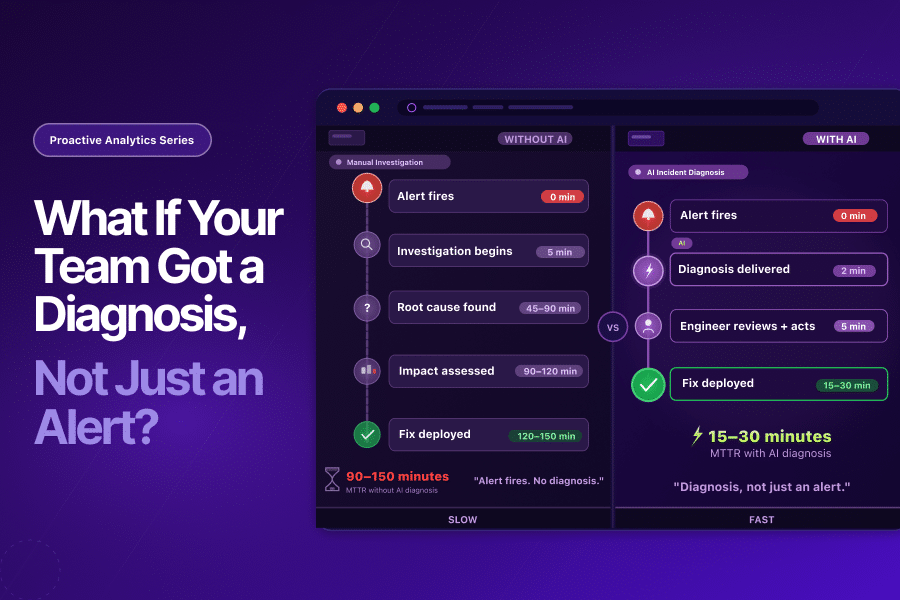
Let’s revisit the earlier scenario. Instead of spending 2-5 days analyzing data, the team receives:
“Conversions dropped 18% yesterday, primarily from paid search.
The decline is concentrated in Campaign X after a recent bid adjustment.”
Now the conversation changes.
From: “What happened?”
To: “What should we do next?”
This shift reduces:
- Time spent analyzing
- Back-and-forth discussions
- Dependency on manual workflows
And compresses decision cycles from days to hours. With AI analytics, teams no longer start from raw data - they start from insight.
Does This Replace Analysts or Teams?
No, and it shouldn’t.
The role of AI Analytics Intelligence is not to replace human expertise. It’s to enhance it.
Teams still:
- Validate insights
- Apply business context
- Make final decisions
But they start from a position of clarity, not confusion.
Why This Matters More Than Ever
Marketing environments today are more complex than ever.
- More channels
- More campaigns
- More segmentation
- More data
At the same time:
- Decision cycles are shorter
- Expectations are higher
- Teams are leaner
In this environment: AI use cases in analytics are no longer optional - they’re a competitive advantage.
How to Identify If You Have a Decision Speed Problem
Ask yourself:
- How long does it take to understand a performance drop?
- How many people are involved in analysis?
- How often do decisions get delayed due to unclear insights?
- How quickly can your team act on new opportunities?
If the answer is measured in days,
there’s a clear opportunity to improve.
From Reporting to Decision Intelligence
Most organizations have already invested in: Marketing analytics tools, data pipelines, reporting dashboards
But reporting only answers: “What happened?”
To improve performance, you need systems that answer: “Why did it happen - and what should we do next?”
That’s the shift from: Reporting to Decision Intelligence
The Role of Agentic AI in Analytics
Agentic AI takes this further. Instead of just analyzing data, it can:
- Continuously monitor performance
- Trigger insights automatically
- Assist in decision workflows
This creates a system where analytics is no longer passive - it becomes active. Not just to inform decisions. But to support how marketing actually operates at scale.
Closing Thought
Fixing your data was a critical step. But it was never the final one. Because clean data doesn’t create clarity on its own. And in today’s environment:
The advantage doesn’t come from having more data.
It comes from understanding it faster - and acting on it sooner.
Improving marketing decision-making speed is no longer about fixing data. It is about reducing the time between insight and action. The faster teams interpret what is happening, the faster they can respond - and that is where competitive advantage now lies. This is the real promise of AI analytics - faster understanding, faster action, and better outcomes.
Explore what faster, more consistent decision-making could look like:
If your team is still spending days moving from data to action, it may be time to rethink how your AI analytics layer operates.
→ Start your Analytics Intelligence discussion
→ Evaluate your AI readiness