


In the previous blog in this series, we covered what proactive analytics means and why reactive monitoring costs businesses more than they realise. This blog goes one level deeper into one of the most financially damaging places where reactive measurement fails: marketing attribution analytics.
Here is the core problem:
- Attribution tells you which channels, campaigns, and touchpoints drove a conversion
- When it works, it is one of the most powerful tools a marketing team has
- When it breaks silently, and it breaks far more often than most teams acknowledge, it becomes one of the most expensive problems in digital measurement
The critical issue: marketing attribution analytics does not fail loudly. No error is thrown. No warning appears in GA4. Your reports still populate. Your dashboards still update. The numbers just quietly stop reflecting reality.
The Attribution Confidence Gap Is Larger Than Most Teams Admit
The data on this is striking:
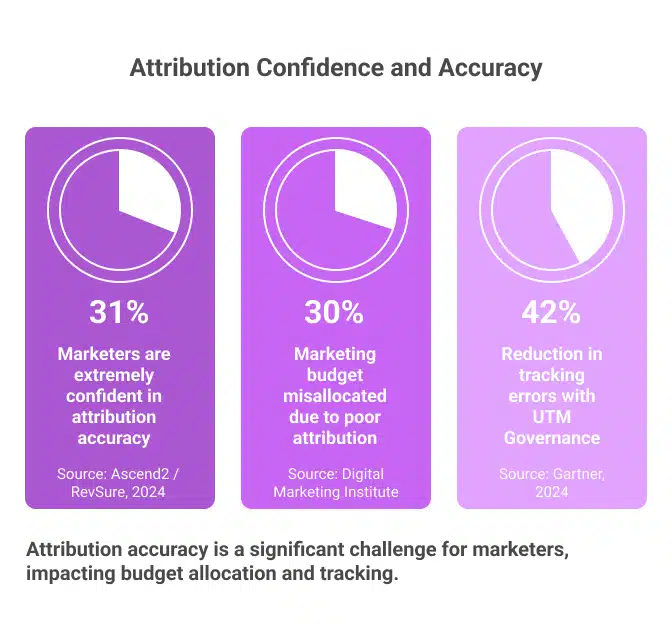
- A 2024 survey by Ascend2 and RevSure found that only 31% of marketing professionals are extremely confident in the accuracy of their attribution data
- Nearly 7 in 10 marketers are making budget decisions on data they are not fully confident in
- McKinsey’s 2024 Digital Marketing Survey found that 76% of marketers still struggle to determine which channels deserve credit for conversions
- Research from the Digital Marketing Institute puts the cost at up to 30% of total marketing budget misallocated due to poor attribution
For a team spending $500,000 per quarter on paid media, that is $150,000 allocated based on flawed or incomplete attribution.
These are not niche problems affecting underfunded teams. They are systemic failures that exist inside sophisticated, well-resourced marketing organisations.
How Attribution Breaks Silently
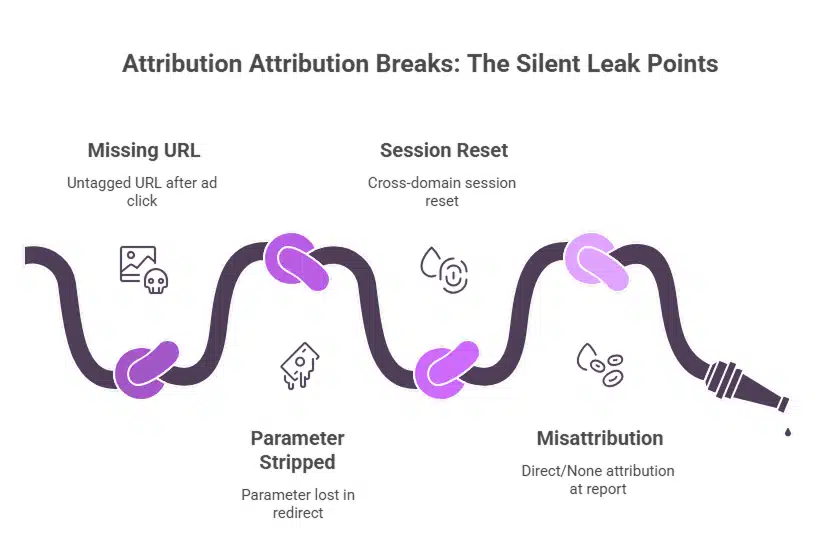
Marketing attribution analytics breaks in predictable ways. None of them surface as obvious errors in your reporting. Understanding where the breaks happen is the first step toward catching them proactively.
UTM parameters go missing or inconsistent.
- Campaign launches without properly tagged URLs
- Traffic lands in GA4 as “direct/none” with no campaign credit
- According to a SEMrush 2024 study, 42% of companies implement UTMs without a clear strategy
- Only 58% of marketing teams have a documented naming convention
- The same LinkedIn campaign can appear as “LinkedIn,” “linkedin,” and “LI” in three separate reports, fragmenting data across three false sources
UTM parameters get stripped in redirects.
- Campaign URL is tagged correctly at launch
- Landing page involves a redirect and UTM parameters are dropped during it
- Session lands as direct traffic with no recoverable attribution
- Common failure point: domain migrations and cross-subdomain tracking setups
Cross-domain tracking gaps misroute sessions.
- User clicks a paid ad, lands on a campaign page, then moves to the main site to purchase
- If cross-domain tracking is not configured correctly in GA4, the session resets at the domain boundary
- The purchase attributes to “direct” instead of the paid campaign that started the journey
Channel self-competition distorts spend decisions.
- Paid and organic results for the same brand terms compete for attribution credit
- A conversion from organic search after an earlier paid click may attribute to organic entirely
- Neither channel gets an accurate picture, and neither budget gets optimised correctly
Privacy changes are widening the gaps further.
- 56% of marketers say privacy regulations have made attribution harder
- iOS14’s App Tracking Transparency reduced observable mobile conversions by 18 to 32%
- Cookie deprecation is expected to impact 78% of existing attribution setups by 2026
- These are structural signal losses that passive monitoring cannot compensate for
Why Reactive Attribution Monitoring Fails Here
In reactive marketing attribution analytics, failures are typically discovered in one of three ways:
- A finance reconciliation shows GA4 revenue does not match backend sales
- A channel’s ROAS inexplicably drops and someone investigates retroactively
- A quarterly audit finds a campaign that has been running untagged for weeks
By the time any of these discoveries happen, the damage is already compounded:
- Budget has been reallocated away from channels that were actually performing
- Channels that looked strong were benefiting from misattributed credit
- Leadership has made strategic decisions on a picture of performance that was never real
This is the 100x cost principle from Blog 1 applied directly to attribution. Finding a UTM tagging error before campaign launch costs almost nothing. Finding it six weeks later, after it has shaped budget decisions, costs orders of magnitude more.
What Proactive Marketing Attribution Analytics Looks Like
Proactive attribution monitoring does not wait for a finance discrepancy or a quarterly review to surface problems. It continuously watches the signals that indicate attribution is breaking, and flags them in near real-time.
1. Monitoring direct traffic spikes proactively.
- A sudden, unexplained spike in direct traffic is almost always a symptom of attribution failure, not genuine behaviour change
- Proactive marketing attribution analytics sets intelligent baselines for direct traffic by channel, device, and landing page
- When direct traffic spikes beyond expected variance, an alert fires with context: which pages, which segments, and since when
- The team investigates a tracking gap, not a phantom behaviour change
2. Validating UTM parameter coverage continuously.
- Proactive systems scan incoming traffic for untagged or inconsistently tagged sessions in real time
- When a campaign drives traffic with missing or malformed parameters, the monitoring layer flags it within hours of launch, not weeks after data has been permanently misfiled
- This is where Tatvic’s data sanity automation plugs directly into attribution health
3. Detecting cross-domain tracking failures at the session level.
- Proactive monitoring tracks session continuity across domain boundaries
- When a known cross-domain journey starts producing sessions that reset at the transition point, a break in the tracking chain is flagged immediately
- This is caught before it inflates direct traffic figures and before budget decisions are influenced by the distorted picture
4. Running anomaly detection on channel attribution patterns.
- Proactive marketing attribution analytics uses anomaly detection not just on volume metrics but on attribution patterns themselves
- When paid social’s share of conversion credit drops sharply over 48 hours without a corresponding spend change, that is an anomaly
- When organic search suddenly claims attribution credit for conversions that previously traced to email, that is a signal worth investigating
- Tatvic’s anomaly detection framework applies this logic to attribution data, not just traffic and conversion volume
5. Monitoring the GA4 data layer and GTM for tracking integrity.
- Attribution in GA4 is only as reliable as the data collection layer beneath it
- Tatvic’s AI-powered GTM health monitoring continuously checks that conversion tags, GA4 configuration tags, and event parameters are firing correctly
- A misconfigured conversion tag does not just break conversion data. It breaks the entire attribution chain downstream
Signs That Your Attribution Has Already Broken
Run through this list quickly:
- Direct traffic has grown as a percentage of conversions over the last 90 days without a clear explanation
- Two or more channels show overlapping conversion credit for the same campaigns
- GA4 revenue and backend/CRM revenue differ by more than 5% consistently
- Your paid campaigns show ROAS figures your finance team cannot reconcile
- A campaign launched in the last 60 days without a UTM audit before go-live
- Your team has not tested the cross-domain tracking setup since the last site update.
- You discovered a UTM error from a completed campaign only after reviewing its performance
If three or more of these apply, your marketing attribution analytics setup has active gaps. Each one is fixable, but only if detected before it compounds.
Where to Start with Proactive Attribution
The order of intervention matters. Starting with the wrong layer wastes effort and still leaves spend leaks open.
Step 1: Audit and automate UTM governance.
- Standardise naming conventions across all channels and teams
- Automate UTM generation where possible to eliminate manual errors
- Add a pre-launch validation step to every campaign workflow
A formal UTM governance framework reduces tracking errors by 42% on average (Gartner 2024)
Step 2: Set anomaly detection on direct traffic and channel attribution shares.
- These two signals catch the widest range of attribution failures
- When either moves outside expected ranges, something in your tracking chain has broken
- Intelligent, ML-driven alerts on these signals surface problems before data propagates into decisions
Step 3: Validate conversion and GA4 configuration tags continuously.
- Attribution is downstream of data collection
- A broken conversion tag disrupts attribution accuracy, regardless of how well you structure your UTMs.
- Continuous monitoring of your GA4 tagging layer creates the foundation for reliable marketing attribution analytics.
Step 4: Reconcile GA4 attribution against a second source monthly.
- Use your CRM, e-commerce backend, or media mix model as the comparison point
- Regular reconciliation catches attribution drift before it becomes attribution blindness
- Teams that build this into a monthly workflow catch errors an average of three weeks earlier than those that wait for discrepancies to surface in reporting
The Takeaway
Marketing attribution analytics is not a set-and-forget configuration. It is a living system that breaks in predictable, silent ways, and those breaks compound the longer they go undetected.
Proactive attribution monitoring does not add complexity to your stack. It adds:
- A monitoring layer that watches for signals indicating your attribution chain is failing
- Near real-time alerts that surface issues while there is still time to act
- A foundation for budget decisions that are based on real performance data, not a distorted picture
The difference between reactive and proactive attribution is not just operational. It is the difference between a marketing budget allocated on truth, and one allocated on a fiction your reporting has been quietly telling you.
If your attribution is reactive today, the spend leaks have already started. The question is how long they go undetected.
Not sure if your attribution setup is telling you the truth? Tatvic’s analytics team can run a full attribution health check across your GA4 setup, GTM configuration, and UTM governance in one structured review. Schedule a call with Tatvic’s experts today.