

Marketing analytics has evolved significantly over the past decade. Today, teams have access to detailed dashboards, multi-channel attribution models, and near real-time reporting capabilities. Campaign performance, user journeys, and conversion metrics are no longer hidden behind fragmented systems-they are visible, measurable, and accessible at scale.
Yet despite this progress, one persistent problem continues to impact marketing performance.
Teams can see what is happening.
But they often realize what changed far too late to act effectively.
This gap between data visibility and timely awareness is where most inefficiencies in modern analytics systems originate. And in performance-driven environments, this delay does not just affect reporting-it directly affects revenue outcomes.
This is precisely where AI analytics is beginning to redefine how analytics systems operate. Instead of simply enabling access to data, AI analytics focuses on detecting meaningful changes as they happen and enabling faster decision-making.
Analytics Today Is Built for Investigation, Not Detection
Most analytics platforms in use today-whether it is Google Analytics 4, Adobe Analytics, or similar tools-are fundamentally designed for exploration. They are highly effective at organizing data, enabling segmentation, and allowing teams to analyze performance across multiple dimensions.
However, they are not designed to proactively identify what matters most.
In practice, this means that analytics systems function more like repositories of information rather than active intelligence layers. They store and present data, but they do not interpret it in a way that prioritizes immediate action.
As a result, teams rely heavily on manual workflows.
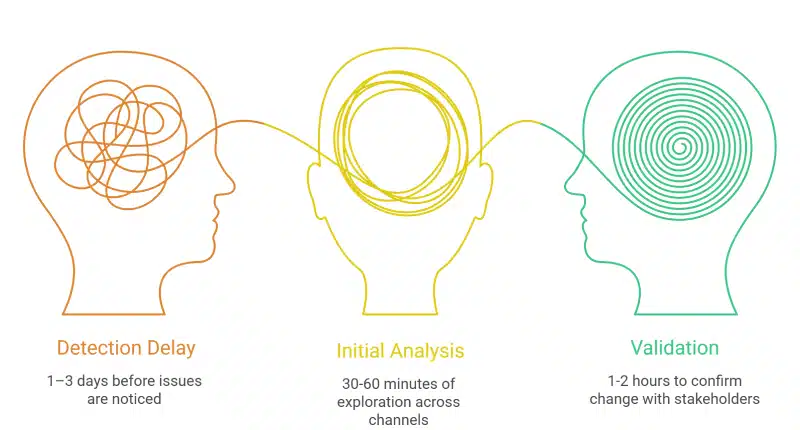
A marketer logs into a dashboard, reviews key metrics, compares trends, and tries to identify whether something has changed. This process is repeated daily or weekly, depending on the team’s operating rhythm.
The limitation here is subtle but critical.
Performance changes do not occur when dashboards are checked.
They occur continuously.
And this disconnect creates a delay between when an issue arises and when it is discovered.
This limitation is explored further in: What if you didn’t have to explore the data?
The Real Problem: Detection Lag
To understand the impact of this gap, it is important to look at how detection typically happens in real-world workflows.
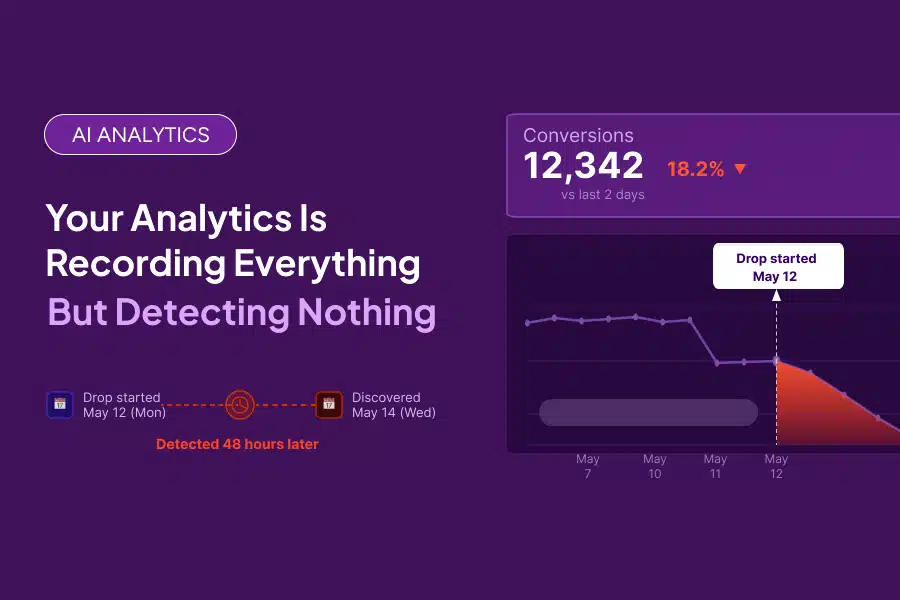
Consider a common scenario. A campaign begins to underperform due to a change in bidding strategy, audience targeting, or external market conditions. The decline is not immediately obvious-it happens gradually over a few hours or a day.
Since no alert is triggered, the issue remains unnoticed.
It is only during a routine dashboard check-often one or two days later-that someone notices a dip in performance. At this point, the team begins investigating the issue, analyzing trends, and validating whether the change is significant.
By the time corrective action is taken, the impact has already occurred.
Budget has been spent inefficiently.
Conversions have declined.
Opportunities for early optimization have been missed.
This is what is referred to as detection lag.
And it is one of the most overlooked sources of inefficiency in marketing analytics.
Detection lag is not just a delay in awareness. It is a delay in action-and that delay has compounding consequences.
This is the core problem that AI analytics is designed to address.
Why Traditional Analytics Workflows Break at Scale
As marketing systems grow more complex, the limitations of manual analytics workflows become more pronounced.
Modern marketing environments involve multiple channels, campaigns, audience segments, and data streams. Each of these variables introduces additional layers of complexity, making it increasingly difficult to identify meaningful changes quickly.
In such environments, manual analysis does not scale effectively.
Teams are required to:
- review multiple dashboards
- segment data across dimensions
- identify patterns manually
- validate findings across tools
This process is not only time-consuming but also prone to inconsistency. Different team members may interpret the same data differently, leading to delays in decision-making.
More data does not simplify decision-making. Without the right systems, it increases the effort required to reach clarity.
This is where the role of AI analytics becomes critical.
The Hidden Metric Most Teams Ignore: Time-to-Detection
While marketing teams are highly focused on performance metrics such as conversion rate, return on ad spend (ROAS), and customer acquisition cost (CAC), very few track a metric that directly influences all of them.
That metric is time-to-detection.
Time-to-detection refers to the duration between when a performance change occurs and when it is identified.
This metric is critical because it determines how quickly corrective action can begin.
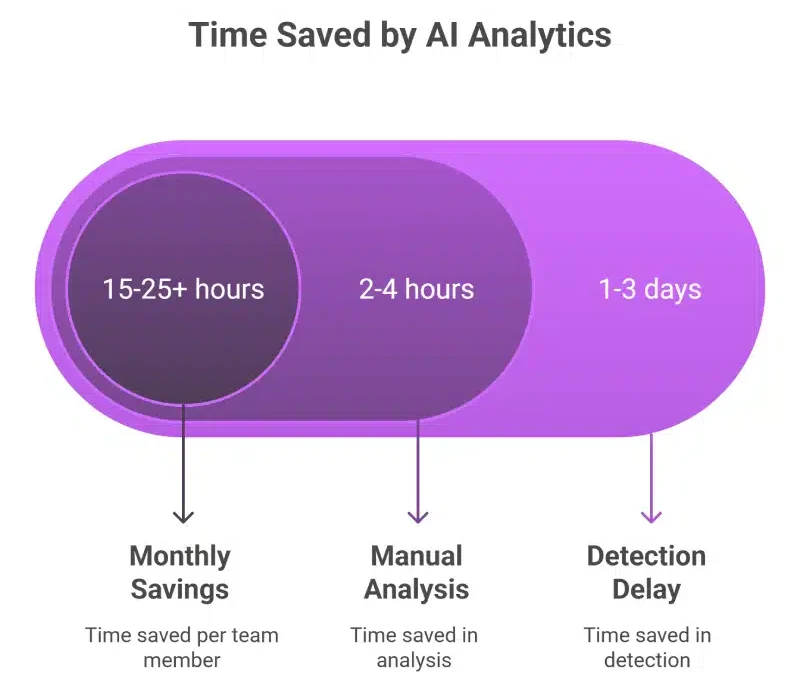
A delay of even 24–48 hours can significantly impact performance, especially in high-spend environments. During this time, underperforming campaigns continue to consume budget, and high-performing opportunities remain under-optimized.
According to Gartner, organizations often fail to fully leverage their analytics investments due to delays in insight generation and inefficient data utilization.
This highlights an important reality.
The challenge is not a lack of data.
It is the inability to act on data at the right time.
AI Analytics: Shifting from Passive Data to Active Intelligence
AI analytics introduces a fundamental shift in how analytics systems operate.
Instead of relying on users to explore data and identify issues, AI analytics continuously monitors performance metrics and detects anomalies automatically. It evaluates data in real time, compares it against historical patterns, and identifies deviations that require attention.
This transforms analytics from a passive system into an active intelligence layer.
With AI analytics, teams are no longer dependent on manual checks. Instead, they receive timely insights that highlight what has changed, where the change has occurred, and why it matters.
This shift significantly reduces the time required to move from data observation to decision-making.
What AI-Powered Analytics Looks Like in Practice
To understand the practical impact of AI analytics, it is helpful to compare how workflows operate with and without it.
Without AI Analytics
A retail brand running multiple campaigns experiences a gradual decline in conversions due to a change in bidding strategy. The decline begins on a Monday but goes unnoticed because there are no alerts.
By Wednesday, the team notices a drop during a routine dashboard review.
They begin analyzing:
- campaign performance
- channel-level data
- device segmentation
- geographic trends
After spending considerable time exploring the data, they identify the root cause and take corrective action.
By this time, two to three days of inefficient spend have already occurred.
With AI Analytics
In the same scenario, AI analytics detects the anomaly on Monday itself.
The system identifies that the performance deviation is outside expected patterns and surfaces an insight such as:
“Conversions have dropped by 15%, primarily driven by Paid Search. The decline is linked to recent changes in bidding strategy and exceeds expected variance.”
The team receives this insight immediately and can act within hours.
The difference is not just operational efficiency-it is financial impact.
Pain Points vs Outcomes: A Clear Contrast
Without AI analytics, teams experience:
- delayed awareness of performance issues
- significant time spent on manual analysis
- reactive decision-making
- increased risk of wasted budget
With AI analytics, teams benefit from:
- near real-time detection of anomalies
- reduced dependency on manual workflows
- faster and more confident decision-making
- improved campaign stability and efficiency
This contrast highlights why AI analytics is not just an enhancement but a necessity for modern marketing systems.
The Measurable Business Impact of AI Analytics
The impact of AI analytics can be quantified across multiple dimensions.
Research from McKinsey & Company indicates that organizations using AI in marketing can achieve improvements of up to 20–30% in ROI.
Similarly, Deloitte highlights that AI-driven organizations are able to respond more quickly to market changes and operate with greater efficiency.
These improvements are driven by:
- reduced detection delays
- faster decision-making cycles
- more efficient allocation of resources
Over time, these benefits compound, leading to sustained improvements in marketing performance.
Why This Gap Is Becoming More Expensive
As marketing systems become more dynamic, the cost of delayed detection continues to increase.
Automation, real-time bidding, and multi-channel strategies amplify the impact of even small inefficiencies. If a system reacts late, it continues to execute outdated strategies, leading to further performance decline.
This makes AI analytics a foundational capability rather than an optional enhancement.
Organizations that adopt it early gain a significant advantage in terms of speed, efficiency, and performance consistency.
AI Analytics and the Evolution Toward Agentic AI
AI analytics plays a critical role in enabling more advanced systems such as Agentic AI.
While AI analytics focuses on detecting and interpreting changes, Agentic AI extends this capability by enabling automated actions based on those insights.
Together, they create a continuous loop:
- detection
- interpretation
- execution
This evolution is explored further in: Marketing decision speed with AI Analytics
The Cost of Waiting
One of the most overlooked aspects of analytics transformation is the cost of inaction.
Organizations often delay adopting new approaches because existing systems appear to function adequately. However, this delay results in repeated inefficiencies over time.
Each campaign cycle without AI analytics introduces:
- avoidable performance losses
- repeated manual effort
- missed optimization opportunities
These costs are not always visible in a single report, but they accumulate over time.
The real cost is not the problem itself. It is how long it continues before being addressed.
Moving from Insight to Action
Recognizing the gap is only the first step.
The next step is quantifying its impact and identifying where improvements can be made.
Tools such as:
can help organizations evaluate the potential benefits of adopting AI analytics and determine their readiness for implementation.
This shifts the conversation from theoretical value to measurable impact.
Conclusion
The evolution of analytics is no longer about improving visibility.
It is about improving responsiveness.
The ability to detect and act on changes quickly is becoming a key differentiator in marketing performance.
AI analytics enables this shift by transforming analytics systems from passive reporting tools into active intelligence layers.
And as marketing environments continue to evolve, this capability will become essential for organizations looking to maintain a competitive edge.