

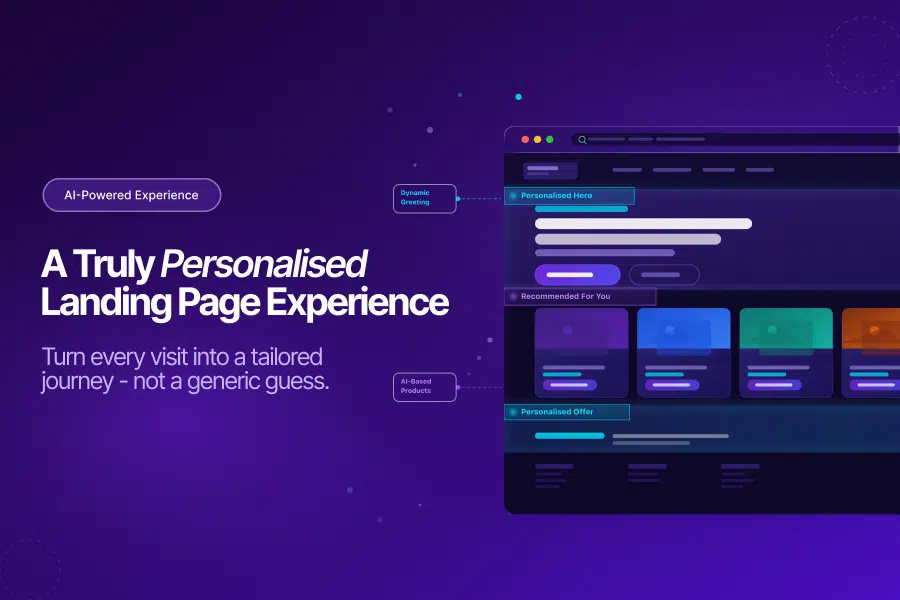
Your Landing Page Is the Hole in the Ecommerce Bucket; And You Keep Filling From the Top
Let’s skip the part where I tell you ecommerce is growing fast and the market is huge.
You know that. You’re in it.
What you might not have stared at long enough is this: Baymard Institute pulled together 48 independent studies on shopping behavior and found that the average cart abandonment rate in 2025 sits at 70.19%. Seven out of ten people who got close enough to buy, close enough to add something to a cart, didn’t. And Baymard’s own modelling says that better page and checkout design could recover $260 billion in lost orders every year across US and EU ecommerce.
Not new customers. Not bigger ad budgets. Better pages.
That’s the part most brands don’t want to look at, because it means the problem isn’t outside, it’s inside. The traffic isn’t failing you. Your landing page is.
Nobody Wants to Feel Like They Landed on the Wrong Page
Here’s what actually happens when someone clicks your ad.
They arrive with a specific thought in their head. Maybe they were looking for a particular product. Maybe they’re a return visitor who already knows your brand and just needs one more nudge. Maybe they’re completely new, skeptical, and need a reason to trust you in about four seconds. Whatever the case, they arrive as a specific person, with a specific context and a specific need.
And most of the time, your landing page ignores all of that.
Same headline for everyone. Same hero image. Same generic “Shop Now” button. It’s a page built for the average visitor, which, in practice, means it’s built for nobody, because nobody thinks of themselves as average.
McKinsey put some real numbers on what this costs. Their Next in Personalization research found that 71% of consumers expect personalized interactions from the brands they buy from. And 76% get frustrated when that doesn’t happen. They don’t write angry emails. They just leave. And they don’t come back.
What’s quietly devastating about that statistic is the other side of it. The same McKinsey research found that 76% of consumers said personalized communications were a key factor in whether they even considered a brand. Not whether they liked the brand. Whether they considered it in the first place. And 78% said personalized content made them more likely to repurchase.
So personalization isn’t just about squeezing a few extra points of conversion rate. It’s about whether you’re in the consideration set at all – and whether the people who do buy come back.
The Gap Between What Brands Think They’re Doing and What Customers Actually Experience
There’s a Salesforce stat that I find weirdly uncomfortable every time I read it.
Their State of the Connected Customer report found that 66% of customers expect brands to understand their needs and preferences. Fine. Brands know this. They talk about it in every strategy deck. But here’s the part that stings: only 34% of those customers believe brands actually deliver on it.
Two-thirds of your shoppers arrive expecting to feel understood. Fewer than half of them do.
And this isn’t just a feelings problem – it’s a revenue problem. Gartner’s 2024 CMO Spend Survey found that 22% of marketing organizations reported gaps in their digital commerce capabilities that were actively preventing them from hitting business goals. That number was 14% the year before. The gap isn’t closing. It’s widening – even as brands pour more money into driving traffic to those same underperforming pages.
More traffic into a leaking funnel doesn’t fix the leak. It just makes it more expensive.
What Actually Happens When You Fix It
Okay, so personalization matters. That’s not a controversial take anymore. The more useful question is: how much does it actually move the needle, in terms brands can take to a CFO?
McKinsey’s data on this is pretty consistent. Personalization, when it’s executed well, not just “we put your first name in the email” but genuinely tailored experience, drives 10-15% revenue lift on average, with some companies seeing up to 25%. It can cut customer acquisition costs by up to 50%. It increases marketing ROI by 10-30%.
BCG went bigger in their 2024 research. They found that brands leading on personalization are growing revenue roughly 10 percentage points faster than their peers, and they’re positioned to capture $570 billion in incremental retail growth by the end of the decade. Not a slice of existing revenue. New revenue that will go to whoever earns it.
There’s also the retention angle, which tends to get underweighted in conversion-focused discussions. Bain & Company’s research, the work that essentially defined how the industry thinks about customer loyalty, established that a 5% improvement in customer retention can lift profits by 25-95%. That’s not a typo. The range is wide because it depends on sector, but the direction is always the same: keeping customers is dramatically more profitable than finding new ones.
And the bridge between acquisition and retention runs directly through the landing page experience. If someone’s first visit feels generic, there may not be a second one.
So Why Isn’t Everyone Already Doing This?
Honestly? Because personalization at scale is hard, or at least it was, until recently.
You can manually build five landing page variants. You can test two headlines against each other. But you can’t manually create a tailored experience for every meaningful combination of traffic source, device type, behavioral history, geographic context, and purchase intent signal. There are too many variables and not enough hours in any team’s day.
This is the gap that agentic AI is specifically designed to close.
Agentic AI doesn’t just analyze data and produce a recommendation for a human to act on. It reads signals in real time and acts, adjusting what a visitor sees based on who they are, where they came from, what they’ve done before, and what they’re most likely to respond to. It’s the difference between a one-size-fits-all storefront and a page that actually meets each visitor where they are.
Deloitte’s research on this is fairly direct. 63% of global retailers now believe that companies without AI agents will fall behind competitors within two years. Not eventually. Two years. McKinsey frames the commercial upside just as plainly: agentic AI could generate up to $1 trillion in US B2C ecommerce revenue by 2030, with global projections of $3-5 trillion.
These numbers are big enough to feel hypothetical. Here’s something more concrete. During the 2025 holiday season, Salesforce and Adobe tracked AI-influenced shopping driving 20% of all retail sales globally, generating $262 billion in revenue through personalized recommendations and engagement. That wasn’t a forecast. That was last November and December.
What This Looks Like in Practice
It might help to talk about what actually changes when a brand takes landing page personalization seriously.
ASOS applied machine learning to customize product listings and landing pages for individual visitors, specifically for return customers who already had behavioral history. The result was a 13% lift in conversion rate. Not from more traffic. Not from a redesign. From showing the right visitor the right page.
Bain & Company cites Sephora as the clearest benchmark for what loyalty-driven personalization looks like at scale. Sephora combines purchase history, real-time browsing behavior, and individual preference data to personalize homepage content and product recommendations for every loyalty member, online and in-store. It works because the experience feels continuous. It remembers you. It knows what you like. It doesn’t show you things that have nothing to do with you.
That’s the standard shoppers are starting to hold all brands to. Not just luxury or beauty. All brands.
The Real Cost Is Waiting
Here’s a question worth sitting with.
If 70% of the shoppers hitting your landing pages right now are leaving without converting – and McKinsey says personalization drives 10-15% revenue lift while cutting acquisition costs in half, what does another quarter of inaction actually cost you?
Run the math on your own numbers. Take your monthly traffic. Apply a 70% abandonment rate. Then apply a 10-15% lift from better personalization. The number you get is the revenue you’re currently not capturing from traffic you’re already paying for.
The personalization gap is real, it’s measurable, and it’s solvable. Agentic AI means it’s no longer a question of whether brands can deliver personalized landing experiences at scale; it’s a question of whether they choose to.
The ones choosing to are building a compounding advantage. The ones waiting are paying for traffic that keeps bouncing.
Tatvic works with brands to close the gap between traffic and revenue through agentic AI-powered landing page personalization and customer experience optimization. If you want to talk about what your current pages are leaving on the table, we’re happy to dig in.