
Right now, a shopper is asking ChatGPT to find the best running shoes under $120. Another is asking Perplexity to compare skincare serums for sensitive skin. A third is asking Google’s AI Mode to build a sustainable gift set under $80.
Your brand either shows up in those answers or it doesn’t.
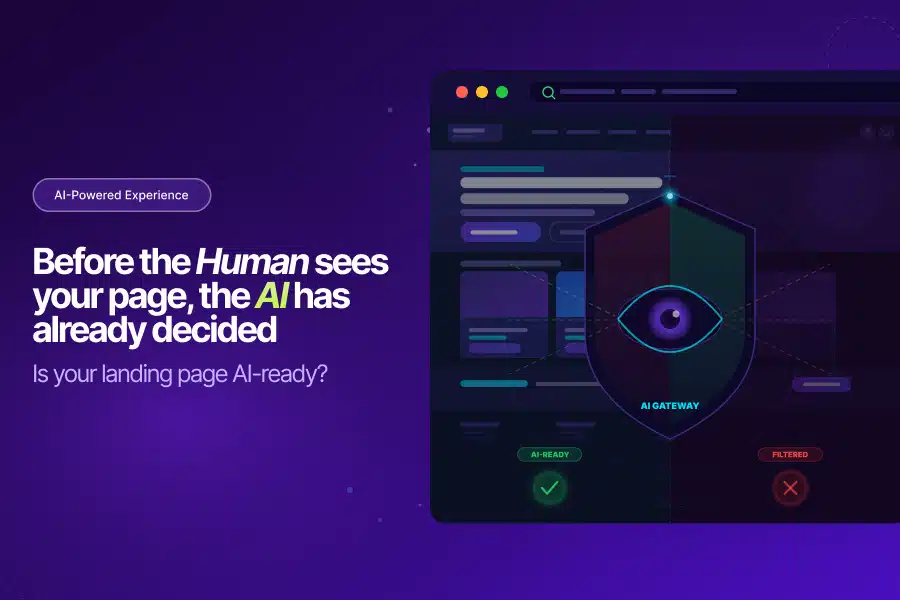
This is the new reality of landing page optimization. And most e-commerce teams are only solving half the problem. They’re building pages for humans who arrive. They’re not building pages for the AI systems that decide whether to send those humans in the first place.
That gap is where revenue is being lost right now.
The Funnel Has a New Front Door
For two decades, e-commerce started with Google. You optimized keywords, earned backlinks, bought ads, and drove traffic to your pages. The playbook was consistent, well-understood, and it worked.
That formula is breaking down faster than most teams realize.
McKinsey‘s AI Discovery Survey found that 50% of consumers now use AI when searching online. Among those who’ve tried it:
- 44% say AI has become their primary way to search
- Only 31% still prefer traditional search
This isn’t a slow, gradual shift. It’s already the majority behavior among high-intent, high-spending shoppers, exactly the audience ecommerce brands work hardest to reach. These are people with purchase intent who are actively looking for product recommendations, comparisons, and trusted sources.
Gartner‘s forecast: Traditional search engine volume will drop 25% by 2026 as AI chatbots take over queries that once ran through Google and Bing. Their analyst put it plainly: companies will need to rethink their entire marketing channel strategy as generative AI becomes embedded across every aspect of commerce.
Organic Traffic Is Already Sliding
BCG‘s research adds an uncomfortable reality check for brands still focused entirely on traditional SEO:
- Nearly 10% of businesses are already seeing year-over-year organic traffic decline
- Traditional organic search traffic in the US is falling at roughly 10% annually
- Traffic to retail sites from generative AI sources grew 4,700% year over year in July 2025 alone
That last number isn’t a trend to watch. It’s a signal that landing page optimization now means something fundamentally different than it did 12 months ago. The channel driving the fastest growth in qualified e-commerce traffic is AI.
Brands still treating landing page optimization as a purely human-facing discipline are optimizing for a shrinking pool of traffic while the fastest-growing pool passes them by.
Your Landing Page Now Serves Two Audiences
Here’s what most ecommerce teams haven’t fully processed yet.
When a consumer asks an AI assistant to recommend a product, the AI doesn’t just Google it. It pulls together information from your product pages, your reviews, your structured data, third-party citations, forums, and comparison sites. It evaluates credibility, consistency, and clarity.
Then it decides whether your brand belongs in the answer.
That decision happens before any human ever lands on your page.
As McKinsey puts it: “In an agentic world, your customer may no longer be a human with a browser; it is just as likely to be an autonomous agent, acting on that customer’s behalf.”
This means landing page optimization in 2026 has two distinct jobs:
| Job | What It Means |
| Job 1 | Convert the human who arrives |
| Job 2 | Be clear, trustworthy, and recommendable to the AI that decides to send them |
Most brands are doing Job 1 reasonably well. Job 2 is almost entirely ignored, which means the AI gatekeeping the recommendation never sends the human in the first place.
What the Second Job Actually Requires
Deloitte’s 2025 Digital Media Trends puts it plainly:
“We are moving away from optimising for clicks and toward optimising for understanding. When an AI system generates a response, it draws on content it can interpret and trust.”
Effective landing page optimization for AI audiences requires a specific set of structural changes most brands haven’t made yet:
- Rich product schema and clean metadata
- Descriptive content that language models can actually parse
- Consistent, current information across all channels
- FAQ content that answers real shopper questions
- Pricing, delivery windows, and return policies in machine-readable formats
- Third-party citations and review signals that establish credibility
Deloitte is specific about why this matters: metadata, taxonomy, and signals of expertise now play a significant role in whether a brand’s content gets surfaced accurately by AI systems. This isn’t optional polish; it’s the foundation of landing page optimization for the current environment.
Brands that skip this work don’t just miss an optimization opportunity. They become invisible to the fastest-growing discovery channel in ecommerce history.
What AI Agents Look for When Comparing Products
When AI agents compare products on a shopper’s behalf, BCG’s research shows they rely on a narrow and specific set of signals:
- Price – Is it clearly visible and machine-readable?
- Reviews – Are aggregated scores structured and prominently surfaced?
- Delivery speed – Is the fulfilment window stated explicitly?
- Return policy – Is it clear, accessible, and easy to parse?
Brands whose landing page optimization surfaces all four signals in structured, machine-readable formats have a clear structural advantage over brands presenting the same information in ways only humans can interpret.
This is not a one-time technical fix. It’s an ongoing discipline. Every product page, FAQ section, and comparison document needs to be structured for AI comprehension, not just human readability. As your inventory, pricing, and policies change, those updates need to flow consistently across every channel where AI systems might pull your information.
Why This Matters for Your Revenue
The commercial case for better landing page optimization is now impossible to ignore.
Adobe Analytics studied over a trillion visits to US retail sites during the 2025 holiday season. Shoppers arriving from generative AI assistants significantly outperformed every other traffic source:
| Metric | AI-Referred Shoppers |
| Conversion rate | +31% vs all other traffic |
| Thanksgiving conversion | +54% |
| Black Friday conversion | +38% |
| Bounce rate | 33% lower |
| Time on site | 45% more |
| Pages viewed per visit | +13% |
Revenue per visit from AI-referred shoppers increased 254% year over year during the 2025 holiday season. That’s not a rounding error. That’s a different category of visitor entirely, one that only arrives if your landing page optimization has done the work of earning the AI recommendation upstream.
The Highest-Intent Traffic on the Internet
Salesforce data reinforces the same story from a different angle.
In the first six months of 2025, conversion rates from AI channels were 700% higher than traffic referred from social media. That puts AI-referred traffic in its own category, more intent-loaded than paid search, more purchase-ready than any other digital acquisition channel currently available.
These visitors didn’t stumble onto your site. They arrived because an AI system evaluated your brand, found it credible and relevant, and recommended it by name. They came pre-qualified.
Proper landing page optimization is what earns that recommendation in the first place. Without it, the pre-qualification never happens, and the high-intent visitor never arrives.
The Stakes Are $5 Trillion
McKinsey’s agentic commerce report, published in October 2025, laid out what’s commercially at stake globally:
- AI agents could mediate $3–5 trillion in global consumer commerce by 2030
- US B2C retail alone could see up to $1 trillion in AI-orchestrated revenue
Their framing was deliberate: “This is not just an evolution of e-commerce. It’s a rethinking of shopping itself.” They compare this transition to the web and mobile revolutions and project that it will move faster than either one did.
How Much Time Do You Actually Have?
Deloitte’s Agentic Commerce research puts a concrete deadline on the urgency:
- 63% of global retailers believe companies without an AI strategy will fall behind within two years
- By 2030, 55% of digital consumers will start product research on LLM platforms
- 25% of global e-commerce sales will be enabled by AI agents by 2030
Brands investing in landing page optimization for AI audiences now are locking in positions in the recommendation layer that will be hard for slower competitors to displace.
BCG’s research makes the compounding effect explicit: once a brand becomes an established, authoritative source that AI systems trust and cite, it tends to get cited more often, creating a visibility advantage that grows over time. Brands waiting for this to be “fully proven” before acting will find those positions already taken.
One Page. Two Audiences. One Strategy.
Here’s the good news: optimizing for AI agents and optimizing for human visitors are not competing priorities. They reinforce each other.
The same qualities that make a page convert real people are the qualities that earn AI recommendations:
- Clear, well-structured product information
- Honest reviews surfaced prominently
- Transparent delivery and return policies
- FAQ content that answers real questions shoppers actually ask
Effective landing page optimization in 2026 doesn’t mean choosing between SEO and AIO. It means treating both as one coherent strategy: get found before the visit, convert after it.
Your Quick Action Checklist
Before your next product launch, run your landing page against these questions:
[ ] Is pricing visible in a machine-readable format?
[ ] Does the page include FAQ schema for common shopper questions?
[ ] Is the delivery window and return policy explicitly stated?
[ ] Is product metadata consistent across all channels?
[ ] Are credible third-party sources citing or reviewing this page?
If you answered no to two or more, your landing page optimization is only serving one of your two audiences and leaving the highest-converting traffic source on the table.
Ready to Close the Gap?
The brands winning in 2026 aren’t choosing between old and new. They’re doing both with infrastructure built for both audiences from the ground up.
Tatvic works with e-commerce brands to close the gap between traffic and revenue through agentic AI-powered landing page optimization and customer experience strategy.
Curious what your current pages are leaving on the table? Let’s find out.