E-commerce in 2026 is no longer constrained by lack of traffic. It is constrained by inefficient monetization of existing traffic.
Customer acquisition costs continue to rise, attention spans are shrinking, and consumers are overwhelmed with choices. In this environment, the brands that win are not the ones that attract the most visitors - but the ones that guide visitors to better decisions faster.
This is where e-commerce product recommendations have evolved from a “nice-to-have” feature into a core revenue growth system.
Modern product recommendations do far more than show “related products.” When implemented correctly, they increase average order value (AOV), improve conversion rates, shorten decision cycles, and strengthen long-term customer value.
This guide breaks down how product recommendations actually work in 2026, where they belong, how personalization and AI have changed the game, and how to measure real business impact.
Why Product Recommendations Matter More Than Ever in 2026
In today’s e-commerce landscape:
- Traffic growth is expensive and unpredictable
- Shoppers expect relevance, not browsing
- Too many choices often reduce conversions instead of increasing them
Product recommendations solve a fundamental problem: decision friction.
Instead of forcing users to search, filter, and compare endlessly, recommendations help them discover what they are most likely to buy - based on context, behavior, and intent.
When executed well, product recommendations:
- Increase AOV through cross-sell and upsell
- Improve conversion rates by reducing choice overload
- Build trust by guiding users, not selling aggressively
- Improve retention and repeat purchases
In 2026, recommendations are no longer just merchandising tools, they are conversion and retention levers.
What E-commerce Product Recommendations Really Mean Today
Product recommendations today are often misunderstood.
They are not:
- Static “related products” blocks
- Rule-based widgets with fixed logic
- Generic “you may also like” sections
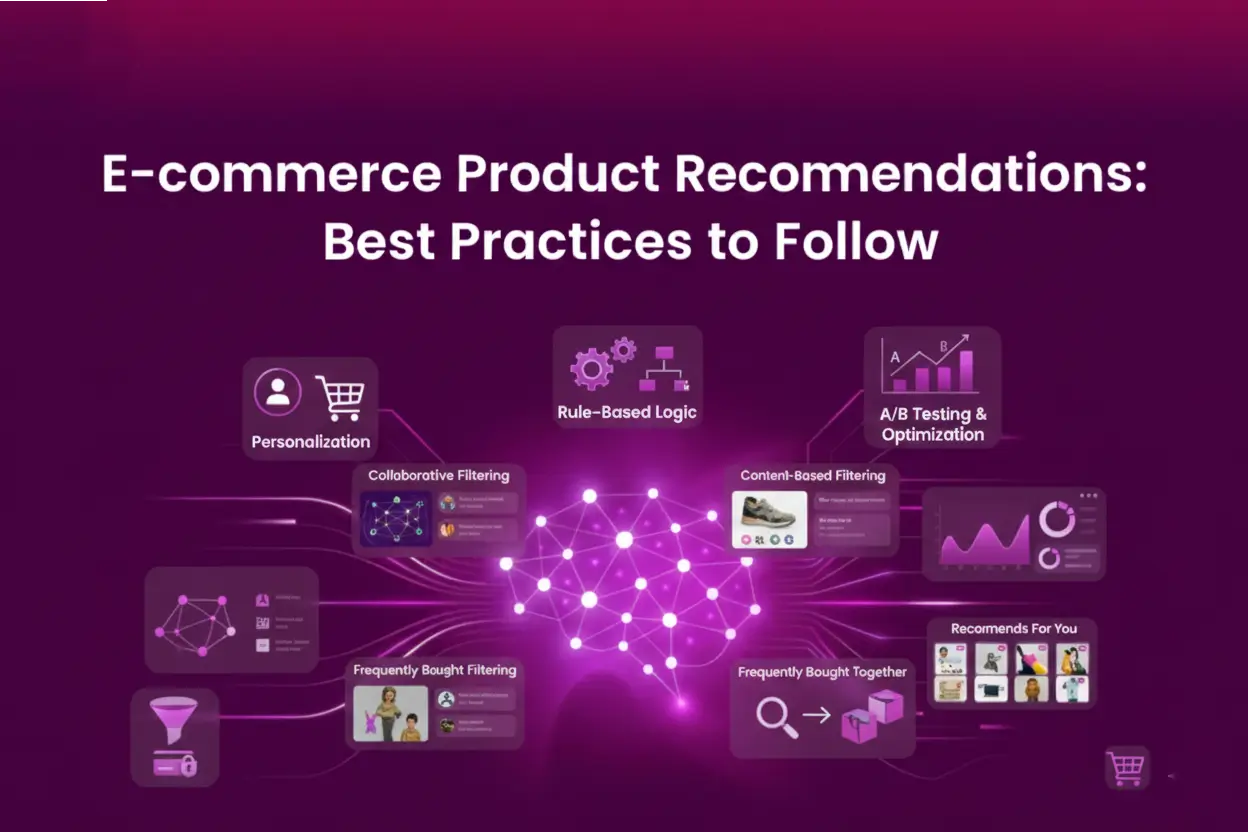
Modern product recommendations are dynamic decision-support systems.
They combine:
- User behavior (views, clicks, scrolls, intent signals)
- Context (page type, device, location, traffic source)
- Product intelligence (availability, margin, popularity)
- Timing within the user journey
The goal is simple:
Show the right product, to the right user, at the right moment with the least cognitive effort.
The Psychology Behind Why Product Recommendations Work
Product recommendations work because they align with how humans make decisions.
Key psychological principles at play:
- Social proof: “Frequently bought together” reduces risk perception
- Anchoring: Showing higher-priced options reframes value
- Choice reduction: Fewer relevant options increase confidence
- Trust transfer: Users trust recommendations from platforms they trust
- Cognitive ease: Less effort equals faster decisions
In most cases, a recommended product converts better than a searched one not because it’s better, but because it removes uncertainty.
Types of E-commerce Product Recommendations (With Strategic Use Cases)
Not all product recommendations serve the same purpose.
In 2026, high-performing e-commerce brands treat product recommendations as journey-specific conversion levers, not generic widgets. Each recommendation type is designed to solve a different customer decision problem at different stages of the funnel.
The biggest mistake brands make is using one recommendation logic everywhere.
The most effective stores use multiple recommendation types strategically, aligned with intent, context, and business goals.
Below are the most important types of e-commerce product recommendations in 2026 - and when to use each for maximum revenue impact.
1. Frequently Bought Together (FBT)
Primary goal: Increase Average Order Value (AOV)
Frequently Bought Together recommendations show products that customers commonly purchase in the same transaction. These work because they reduce friction at the moment of high intent.
Best use cases:
- Product Detail Pages (PDPs)
- Cart pages
- Quick-buy modals
Why it works in 2026:
- Leverages social proof and behavioral validation
- Feels helpful rather than promotional
- Reduces the effort of finding complementary items
Best practices:
- Limit to 2-3 highly relevant items
- Clearly show combined value or savings
- Ensure real behavioral data powers the logic, not static rules
FBT recommendations are one of the highest AOV-driving modules when implemented correctly.
2. Similar or Alternative Products
Primary goal: Prevent exits and reduce bounce rates
Similar or alternative product recommendations help users who are unsure, price-sensitive, or comparing options.
Best use cases:
- Product pages with high exit rates
- Out-of-stock scenarios
- Comparison-heavy categories (electronics, fashion, SaaS)
Why it works in 2026:
- Reduces “decision paralysis”
- Keeps users engaged instead of returning to search
- Supports informed decision-making
Best practices:
- Clearly differentiate alternatives (price, features, use case)
- Avoid overwhelming users with too many options
- Ensure relevance is contextual, not generic
These recommendations are especially powerful for conversion recovery.
3. Complementary / Cross-Sell Recommendations
Primary goal: Increase basket value and product utility
Complementary recommendations focus on accessories, add-ons, or products that enhance the primary purchase.
Best use cases:
- Product pages
- Cart and checkout flows
- Post-purchase experiences
Why it works in 2026:
- Improves perceived value of the main product
- Helps customers feel “fully prepared”
- Drives incremental revenue without increasing acquisition costs
Best practices:
- Ensure true functional relevance
- Avoid aggressive upselling during checkout
- Position as “recommended for best experience”
Well-executed cross-sells feel like customer support, not sales tactics.
4. Recently Viewed / Continue Browsing
Primary goal: Reduce drop-offs and re-engage consideration
Recently Viewed recommendations help users resume their journey without friction - especially important in multi-session buying behavior.
Best use cases:
- Homepage for returning users
- Category pages
- Email and remarketing experiences
Why it works in 2026:
- Supports fragmented browsing behavior
- Reduces rediscovery effort
- Reinforces memory and intent
Best practices:
- Keep the list short and relevant
- Persist across devices when possible
- Combine with subtle nudges (price drop, low stock)
This recommendation type is essential for longer consideration cycles.
5. Trending / Best Sellers
Primary goal: Discovery and trust-building
Trending or Best Seller recommendations highlight what is popular or currently in demand.
Best use cases:
- Homepage
- Category landing pages
- New user experiences
Why it works in 2026:
- Uses social validation to reduce uncertainty
- Helps first-time visitors orient quickly
- Supports faster decision-making
Best practices:
- Ensure “trending” is time-bound and dynamic
- Avoid showing irrelevant best sellers across categories
- Pair with light context (“Popular this week”)
These recommendations work best at the top of the funnel.
6. Personalized Product Recommendations
Primary goal: Maximize relevance, conversion, and lifetime value
Personalized recommendations adapt based on user behavior, intent signals, lifecycle stage, and context - not just demographics.
Best use cases:
- Homepage for returning users
- Product and category pages
- Email, push, and remarketing channels
Why it works in 2026:
- Users expect relevance, not repetition
- AI enables real-time intent prediction
- Privacy-first personalization focuses on behavior, not identity
Best practices:
- Personalize progressively, not aggressively
- Focus on intent over profile data
- Continuously test personalization logic via CRO experiments
Personalization is most effective when it simplifies choices, not when it tries to predict everything.
Key Insight: Strategic Combination Wins
The most successful e-commerce brands in 2026 do not rely on a single recommendation type. They:
- Map recommendation types to funnel stages
- Test placement and logic through CRO
- Measure success using revenue impact, not clicks
- Continuously refine based on user behavior
Product recommendations are no longer widgets. They are intent-driven decision systems and when used strategically, they become one of the most powerful levers for sustainable e-commerce growth.
Where Product Recommendations Should Appear Across the E-commerce Funnel
In e-commerce, where you show product recommendations is just as important as what you recommend.
Even the most advanced AI-driven recommendation logic will fail if it appears at the wrong moment in the customer journey. In 2026, high-performing brands treat recommendation placement as a conversion optimization strategy, not a design afterthought.
The guiding principle is simple: Product recommendations should support the user’s intent at that stage of the funnel not compete with it.
Below is a funnel-aligned framework for placing product recommendations to maximize engagement, conversion rates, and lifetime value.
1. Homepage: Inspiration, Discovery, and Returning User Personalization
Primary intent: Exploration and orientation
The homepage sets the first impression and shapes user expectations. For new visitors, recommendations help them discover what the brand offers. For returning users, they provide continuity and relevance.
Best recommendation types:
- Trending products
- Best sellers
- Recently viewed items
- Personalized picks for returning users
2026 best practices:
- Personalize progressively, especially for logged-in users
- Avoid overwhelming new visitors with too many options
- Use social proof signals (popular today, trending this week)
Homepage recommendations should guide users forward, not distract them from primary navigation.
2. Category & Listing Pages: Assisted Exploration Without Replacing Navigation
Primary intent: Browsing and comparison
Category pages are designed for structured exploration. Recommendations here should enhance discovery, not disrupt it.
Best recommendation types:
- Popular items within the category
- Personalized sorting (based on past behavior)
- Contextual highlights (top-rated, most viewed)
2026 best practices:
- Keep recommendations visually integrated with product grids
- Avoid inserting unrelated products
- Use recommendations to reduce cognitive load, not add it
When done right, recommendations on category pages help users find relevant products faster without feeling steered.
3. Product Detail Pages (PDPs): Accelerating Decision-Making
Primary intent: Evaluation and purchase consideration
PDPs are one of the highest-impact locations for product recommendations. Users here are already engaged and evaluating options.
Best recommendation types:
- Frequently bought together
- Similar or alternative products
- Complementary accessories
2026 best practices:
- Keep recommendations highly relevant and limited in number
- Clearly differentiate alternatives (price, features, use case)
- Ensure recommendations reduce hesitation, not introduce confusion
On PDPs, recommendations should reinforce confidence, not create doubt.
4. Cart & Checkout Pages: High-Intent Cross-Sell Without Distraction
Primary intent: Purchase completion
This is the most sensitive stage of the funnel. Recommendations must be handled carefully to avoid cart abandonment.
Best recommendation types:
- Complementary add-ons
- Low-friction cross-sells
- Replenishment or protection items
2026 best practices:
- Never block or delay checkout flow
- Avoid high-priced or complex products
- Position recommendations as optional enhancements
Cart and checkout recommendations should feel like a last helpful suggestion, not a sales push.
5. Post-Purchase & Thank You Pages: Driving Repeat Purchases
Primary intent: Confirmation and future intent seeding
Once a purchase is completed, the user is most receptive to suggestions that enhance or extend their experience.
Best recommendation types:
- Accessories related to the purchased product
- Refill or replenishment items
- Subscription or repeat-use suggestions
2026 best practices:
- Focus on relevance to the recent purchase
- Avoid immediate upselling of unrelated products
- Use this space to increase lifetime value, not immediate AOV
Post-purchase recommendations are a powerful lever for retention and repeat revenue.
6. Email & Remarketing Channels: Extending Recommendations Beyond the Website
Primary intent: Re-engagement and recovery
Product recommendations should not stop at the website. In 2026, off-site recommendation experiences are critical for conversion recovery.
Best recommendation types:
- Recently viewed products
- Abandoned cart items
- Personalized suggestions based on browsing behavior
2026 best practices:
- Ensure consistency between on-site and off-site recommendations
- Avoid over-personalization that feels intrusive
- Respect consent and privacy-first data practices
When aligned properly, email and remarketing recommendations bring users back with intent, not noise.
Above the Fold vs Contextual Placement: What Works in 2026
Visibility alone does not guarantee effectiveness.
Best practices include:
- Prioritizing contextual relevance over prominence
- Ensuring at least the recommendation headline appears in the first fold
- Using scroll-based or intent-based triggers
- Optimizing placement for mobile-first experiences
- Avoiding clutter and repetition across pages
A recommendation that is seen but ignored is worse than one that appears later but feels relevant.
How Personalization Transforms Product Recommendations
Personalization in 2026 is no longer about knowing who the user is - it’s about understanding what they are trying to do.
Modern personalization uses:
- Behavioral signals over demographics
- Anonymous intent before logged-in data
- Lifecycle context (new, returning, loyal)
- Traffic source and device context
Effective personalization feels helpful, not invasive.
The goal is not to show “everything tailored” but to remove what doesn’t matter.
AI-Driven Product Recommendations: What’s Changed
AI has shifted recommendations from reactive to predictive.
Modern AI-driven systems can:
- Predict next likely actions
- Adjust recommendations in real time
- Optimize bundles dynamically
- Learn from outcomes, not just clicks
However, AI does not fix bad foundations.
Without:
- Clean product data
- Reliable tracking
- Clear business rules
AI recommendations amplify noise instead of value.
Data & Tracking Foundations for High-Performing Recommendations
You cannot optimize what you cannot measure.
A strong analytics foundation includes:
- Tracking recommendation impressions, clicks, and assisted conversions
- Measuring AOV uplift and revenue contribution
- Avoiding click-only success metrics
- Aligning GA4 data with CRO and experimentation tools
The real KPI is not “CTR on recommendations.” It is incremental revenue impact.
Best Practices for High-Converting Product Recommendations
High-performing recommendation sections follow these principles:
- Fewer, more relevant products
- Clear labels that explain why something is recommended
- Consistent visual hierarchy and design
- Price and value transparency
- Logical refresh frequency
Good recommendations feel curated not automated.
Common Mistakes That Kill Recommendation Performance
Many e-commerce brands fail because they:
- Treat recommendations as static widgets
- Over-personalize too early
- Ignore mobile UX constraints
- Optimize for clicks instead of revenue
- Never test or iterate logic and placement
Product recommendations require continuous learning not one-time setup.
How Product Recommendations Improve AOV, LTV & Retention
When done right, recommendations compound value:
- Higher average order values
- Better first-purchase experience
- Increased repeat purchase rates
- Stronger customer lifetime value
The impact grows over time especially when paired with CRO and experimentation.
How CRO and Product Recommendations Work Together
Product recommendations are not separate from CRO. They are a core part of it.
CRO helps answer:
- Where recommendations should appear
- Which logic converts better
- How messaging affects trust
- What friction prevents engagement
Recommendations then become tested growth levers, not assumptions.
Measuring Success: KPIs That Actually Matter
Focus on:
- Recommendation-assisted revenue
- Incremental AOV uplift
- Conversion rate lift
- Repeat purchase behavior
Avoid vanity metrics that look good but don’t grow revenue.
The Future of E-commerce Product Recommendations
The future is:
- AI-first discovery experiences
- Conversational and intent-led commerce
- Integration with AI-driven search and shopping
- Privacy-first personalization
Product recommendations will increasingly shape how products are discovered, not just purchased.
Final Takeaway: Product Recommendations as a Revenue System
In 2026, e-commerce product recommendations are no longer optional features or visual enhancements.
They are strategic revenue systems that:
-
Reduce decision friction across the buyer journey
-
Increase average order value through intelligent cross-sell and upsell
-
Improve retention by delivering relevance at every interaction
-
Strengthen long-term, compounding revenue growth
Brands that treat product recommendations as part of their growth architecture-integrated with analytics, CRO, and personalization-consistently outperform those that treat them as isolated UI components.
This is where partners like Tatvic play a critical role. By combining deep analytics, conversion rate optimization, experimentation, and AI-driven personalization, Tatvic helps e-commerce brands design recommendation systems that are not only contextual-but measurable, scalable, and revenue accountable.
The future of e-commerce belongs to businesses that don’t just show products but guide customers to the right decisions, at the right moment, with the right intelligence.