India’s digital commerce revolution is entering a new phase of rapid expansion. With online shopping becoming mainstream across urban, tier-2 and even rural markets, the Direct-to-Consumer (D2C) segment has emerged as one of the fastest-growing drivers of this transformation.
According to recent forecasts, India’s eCommerce market is projected to grow at approximately a 27% CAGR to reach nearly $163 billion by 2026, fueled by increasing internet penetration, smartphone adoption, and digital payments infrastructure.
~ India Brand Equity FoundationEven more strikingly, the D2C eCommerce market in India is estimated at around $108.8 billion in 2026 and is forecast to nearly triple by 2030, growing at a robust CAGR of ~24-25%.
~ Mordor Intelligence
Yet, despite this scale and momentum, many D2C startups struggle to realize their full revenue potential-not for lack of traffic or ambition, but because their marketing analytics foundations are suboptimal.
To scale sustainably in 2026 and beyond, having the right marketing analytics strategy is no longer optional, it’s essential.
Why D2C Startups Need Marketing Analytics in 2026
Most D2C brands are launched as digital-first ventures with strong instincts for acquisition. They invest in paid media, influencer campaigns, social commerce, and brand storytelling. However, having data and analytics tools alone doesn’t guarantee growth how you interpret and act on the data does.
Here’s the disconnect many D2C startups face:
- High acquisition spend but low profitability
- Remarketing to broad audiences rather than high-intent segments
- Limited understanding of customer lifetime value (LTV)
- Product and UX decisions driven by assumptions, not signals
- Funnel bottlenecks uncovered too late rather than proactively addressed
These issues highlight an important reality:
Marketing analytics is not just about reporting what happened, it’s about enabling decisions that drive business performance.
In this blog, we’ll explore how D2C brands can build analytics foundations that improve marketing efficiency, conversion rates, retention, and long-term scale.
Understanding the Role of Marketing Analytics
What Is Marketing Analytics?
In 2026, marketing analytics for D2C startups means:
Using structured, data-driven insights to optimize customer acquisition, conversion, retention, and lifetime value across digital channels and touchpoints.
It goes beyond simple dashboards and spreadsheets. At its core, it answers:
- Who are your most valuable customers?
- Where do they come from?
- How do they behave across the funnel?
- What actions maximize revenue with the least cost?
- Which experiences hurt or help conversions?
In short, marketing analytics turns raw data into actionable business intelligence.
The Business Value of Marketing Analytics for D2C Startups
Marketing analytics directly influences 2 critical D2C growth outcomes:
1. Optimize Marketing Spend
The days of “spray and pray” growth are over. Digital channels have become more competitive and expensive, making it imperative to spend smarter. Analytics helps brands:
- Evaluate audience profitability rather than vanity metrics
- Shift budget to high-intent segments
- Forecast growth based on leading indicators
- Improve Return on Ad Spend (ROAS) without proportionally increasing budgets
In 2026, marketers demand not just which channel works, but which audience works best, under what context, and at what cost.
2. Increase Conversion Rates Across the Funnel
Driving traffic without converting it efficiently is expensive.
Marketing analytics enables brands to:
- Identify where users drop off
- Understand why drop-offs occur
- Prioritize interventions that move metrics reliably
- Increase funnel efficiency without increasing acquisition spend
This is where analytics becomes a conversion engine rather than just a reporting tool.
Mapping Analytics to the AIDAR Funnel
Growth for a D2C startup isn’t linear, it’s cyclical and multi-dimensional.
The AIDAR model-Attention → Interest → Desire → Action → Retention-offers a structured view of the customer journey.
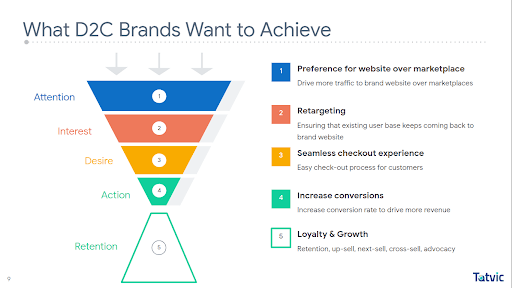
Here’s How Analytics Plays Into Each Phase:
Stage |
Analytics Role |
|---|---|
| Attention | Identify scalable, high-quality audiences |
| Interest | Measure engagement signals and intent |
| Desire | Track product interaction and intent signals |
| Action | Diagnose conversion bottlenecks and UX friction |
| Retention | Forecast LTV, churn risks, and repeat purchase behavior |
Analytics isn’t just measurement, it’s strategic context that aligns efforts with business priorities.
Building a Marketing Analytics Foundation in 2026
Reaching digital maturity is a strategic journey. A strong marketing analytics foundation has three core pillars:
1. Clean, Unified Data Architecture
Without trustworthy data, insights will always be shaky.
Key components include:
- GA4 (or equivalent) event-based tracking to measure meaningful behavior
- Unified tracking for web + app experiences
- Server-side or hybrid measurement for accuracy
- Robust consent and privacy compliance infrastructure
This clean foundation ensures that all subsequent analytics-segmentation, attribution, funnel analysis-are reliable.
2. Relevant Audience Segmentation
A common mistake is treating all traffic as equal.
Analytics frameworks help brands identify segments that matter, such as:
- Users who added products to cart but didn’t checkout
- Visitors who bounced from product pages
- High-engagement users with repeat sessions
- High-LTV cohorts based on past purchase behavior
These segments can then be:
- Activated in paid channels
- Used to enhance personalization
- Applied for automated remarketing
This moves analytics from reporting to activation where insights drive tactical action.
3. Actionable Insights Over Dashboards
Analytics tools can produce beautiful dashboards full of metrics-but if they don’t point to decisions, they add noise.
Actionable analytics should:
- Highlight what changed
- Explain why it matters
- Recommend what action to take
For example:
“Cart abandonment increased by 15% this week due to checkout friction on mobile devices.”
This insight is actionable. It tells the D2C team where to focus optimizations.
From Audience Segments to Growth Activation
Once meaningful segments are defined, D2C brands should use these data segments to:
- Export audiences to paid media platforms like Google Ads, DV360, Meta
- Trigger remarketing campaigns tailored to behavior
- Personalize messaging based on intent signals
- Create lookalike audiences for discovery campaigns
For example:
- Cart abandoners receive a compelling offer
- Users who browsed high-margin products are targeted with educational messaging
- High-LTV customers get loyalty perks to retain them longer
This is how marketing analytics becomes a growth activation platform, not a reporting function.
Turning Analytics into UX & CRO Improvements
Conversion Rate Optimization (CRO) is not guesswork it’s data-driven experimentation.
Analytics plays a critical role in diagnosing:
- UX friction points
- Funnel leaks
- Pain points in checkout flows
- Drop-off patterns on key product pages
By combining analytics data with user research and UX heuristics, D2C brands can implement high-impact tests that boost conversions with statistical confidence.
Retention & LTV: The Real Growth Multiplier
Acquisition gets users to the store. Retention keeps them coming back.
Analytics plays a central role in forecasting Lifetime Value (LTV) and retention patterns by:
- Tracking purchase frequency
- Identifying churn cues
- Modeling repeat purchase probabilities
- Segmenting customers by predicted future value
Once brands understand which customers are likely to return and which are at risk of churn they can tailor:
- Personalized loyalty incentives
- Retargeting audiences
- Win-back campaigns
- Product subscription models
This is where marketing analytics evolves into a predictive engine that powers sustainable growth.
Common Marketing Analytics Mistakes D2C Startups Should Avoid
Even advanced teams sometimes fall prey to:
1. Treating Analytics as Reporting Only
If analytics aren’t tied to decisions, they become passive rather than strategic.
2. Measuring Everything But Acting on Nothing
More metrics don’t equal better outcomes. Focus on signal over noise.
3. Ignoring LTV and Cohort Analysis
CAC alone doesn’t tell the whole story-LTV contextualizes profitability.
4. Siloed CRO and Analytics
If CRO operates independently of analytics, opportunities for optimization are missed.
In 2026, clarity beats complexity. Analytics should reduce uncertainty, not add confusion.
How to Choose the Right Analytics Partner as a D2C Startup
When D2C brands outgrow DIY analytics, a strong partner can accelerate maturity.
Look for partners who:
✔ Back analytics with real business outcomes
✔ Tie analytics to CRO and UX improvements
✔ Understand eCommerce measurement fundamentals
✔ Focus on activation, not just dashboards
✔ Bring cross-industry experience
This partnership should build capability within your team not replace it.
The Bottom Line: Analytics Is Strategic, Not Tactical
In 2026, marketing analytics is no longer a luxury.
It has become the strategic foundation that fuels:
- Lower customer acquisition costs
- Higher conversion rates
- Predictable LTV and retention
- Smarter budget allocation
- Sustainable, scalable growth
Without a strong analytics foundation, D2C brands risk stagnation-even in a fast-growing market.
By building a structured, actionable analytics practice, startups can ensure their growth is not just fast-efficient, resilient, and long-lasting.
Ready to Build a Future-Ready Marketing Analytics Foundation?
If your D2C brand has traffic but is struggling to convert insights into profit your analytics foundation might be the missing piece.
It’s time to shift from vanity reporting to strategic decision intelligence.
Build marketing analytics frameworks that drive:
✔ Sustainable growth
✔ Efficient spends
✔ Data-informed decisions
✔ Higher conversion and retention
Let’s get it right for 2026 and beyond.