TL;DR
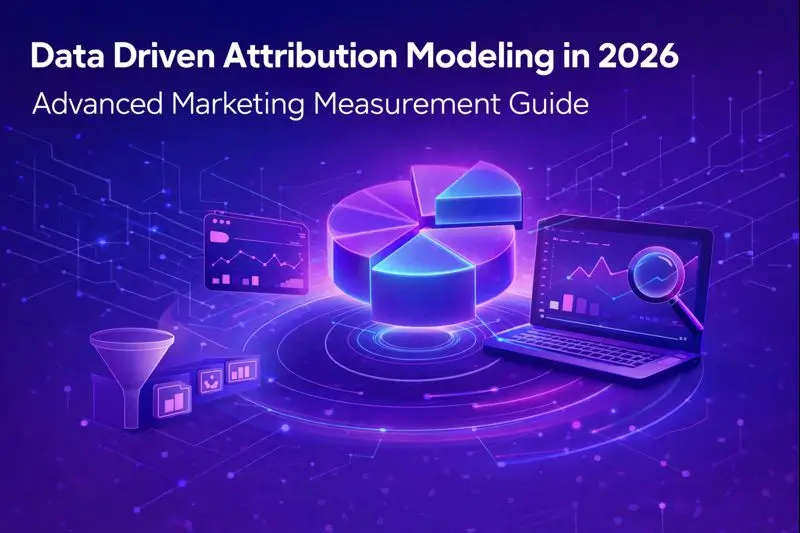
Data driven attribution modelling is a modern marketing measurement approach that uses real user-level data, machine learning, and probabilistic modeling to assign conversion credit across all touchpoints in a customer journey instead of relying on rigid, rule-based attribution models.
In 2026, data driven attribution modelling is the only scalable way to understand what truly drives conversions across complex, multi-channel journeys involving paid media, organic, CRM, influencers, marketplaces, and offline signals.
Why Attribution Became the Biggest Growth Bottleneck
Marketing has evolved exponentially faster than measurement.
In 2026, the modern buyer journey is no longer linear or predictable. A single conversion may involve multiple touchpoints across devices, platforms, and timeframes often influenced by AI-driven personalization engines working in the background.
Today’s customer journeys are:
- Non-linear - Users jump between awareness, consideration, and conversion repeatedly
- Cross-device - Mobile, desktop, tablet, connected TV
- Cross-platform - Search, social, marketplaces, apps, email, offline
- Privacy-restricted - Limited cookies, consent-based tracking, modeled data
- Influenced by AI personalization - Smart bidding, recommendation engines, dynamic creatives
Despite this complexity, many organizations still rely on last-click, first-click, or linear attribution models - frameworks built for a far simpler digital ecosystem.
The Business Impact of Outdated Attribution Models
When attribution fails to reflect reality, growth decisions suffer.
Common outcomes include:
- Over-investment in the wrong channels
Bottom-funnel channels appear to “perform” while upper-funnel drivers are ignored. - Undervalued awareness and consideration efforts
Channels that create demand are systematically under-credited. - Poor media mix and budget allocation decisions
Marketing teams optimize for visibility, not incrementality. - Inflated CAC and suppressed ROI
Spend increases without proportional revenue growth.
In short, bad attribution creates false confidence.
This is precisely the gap that data driven attribution modelling is designed to solve.
What is Data Driven Attribution Modelling?
Data driven attribution modelling (DDA) is an advanced, algorithmic attribution approach that assigns conversion credit based on real user behavior and statistical contribution, rather than fixed, rule-based assumptions.
Instead of forcing every journey into predefined credit rules, data driven attribution modelling evaluates how each touchpoint actually influences conversion probability.
How Data Driven Attribution Modelling Thinks Differently
Rather than assuming value distribution, it:
- Analyzes thousands to millions of real conversion paths
- Compares converting journeys vs non-converting journeys
- Measures incremental impact, not just presence
- Assigns fractional, weighted credit to each interaction
- Continuously recalibrates as user behavior, channels, and campaigns evolve
In simple terms: Data driven attribution modelling learns what truly works and how much it contributes.
This makes it the most accurate attribution methodology available in 2026.
How Data Driven Attribution Modelling Works (Simplified)
At a practical level, DDA modelling follows four foundational steps.
1. Journey Collection
Every meaningful interaction across the customer lifecycle is captured and stitched together, including:
- Paid search (Google, Bing)
- Display and programmatic
- Social platforms (Meta, LinkedIn, TikTok)
- Email and CRM touchpoints
- Organic search
- Direct visits
- Offline or assisted conversions (where available)
This creates a complete, multi-touch journey view, not a channel silo.
2. Path Comparison
The model then evaluates patterns by comparing:
- Journeys that resulted in conversions
- Journeys that did not convert
By identifying statistically significant differences, the system isolates which touchpoints increase the likelihood of conversion - and which merely appear frequently without real impact.
3. Credit Assignment (Incrementality-Based)
Instead of assigning equal or positional credit, data driven attribution modelling distributes conversion value based on incremental contribution.
Touchpoints receive credit based on:
- Their position in the journey
- Frequency and sequence
- Interaction with other channels
- Observed lift in conversion probability
This ensures that credit reflects influence, not assumptions.
4. Continuous Learning & Model Adaptation
Unlike static attribution models, data driven attribution modelling evolves continuously.
As campaigns, creatives, audiences, platforms, and privacy constraints change, the model:
- Re-learns patterns
- Re-adjusts weights
- Maintains relevance over time
This adaptability is critical in a privacy-first, AI-powered marketing ecosystem.
Different Types of Attribution Models
Before understanding why data driven attribution modelling is becoming the global standard in 2026, it’s important to understand the attribution models most marketers still rely on today and where they fall short.
Each attribution model answers a different question. The problem arises when businesses use the wrong model to make revenue decisions.
1. Last-Click Attribution
How it works:
100% of the conversion credit is assigned to the final touchpoint before conversion.
Strengths:
- Simple to understand
- Easy to implement
- Useful for surface-level reporting
Limitations:
- Completely ignores discovery and consideration channels
- Overvalues brand search, retargeting, and direct traffic
- Actively discourages upper-funnel investment
Best used for:
Basic reporting only never for budget allocation or growth decisions
2. First-Click Attribution
How it works:
100% credit is given to the first interaction in the user journey.
Strengths:
- Highlights demand-generation channels
- Useful for understanding how users discover your brand
Limitations:
- Ignores all nurturing, persuasion, and conversion-driving interactions
- Misrepresents the role of mid- and bottom-funnel channels
Best used for:
Awareness and discovery analysis - not revenue optimization
3. Linear Attribution
How it works:
Conversion credit is distributed equally across all touchpoints in the journey.
Strengths:
- More balanced than single-touch models
- Recognizes that multiple interactions matter
Limitations:
- Assumes all touchpoints are equally influential (which is rarely true)
- Still does not measure incremental impact
Best used for:
Organizations at an early attribution maturity stage
4. Time-Decay Attribution
How it works:
Touchpoints closer to the conversion receive more credit than earlier ones.
Strengths:
- Acknowledges that recency matters
- More realistic for short buying cycles
Limitations:
- Assumes proximity equals influence
- Still entirely rule-based
- Penalizes long-term brand and demand-building channels
Best used for:
Short purchase cycles with limited consideration windows
5. Position-Based Attribution (U-Shaped / W-Shaped)
How it works:
Higher weight is assigned to key funnel moments:
- First interaction (discovery)
- Middle interaction (lead creation or engagement)
- Last interaction (conversion)
Strengths:
- Recognizes different funnel stages
- More aligned with structured B2B journeys
Limitations:
- Credit distribution is still assumption-driven
- Fixed weights do not adapt to real user behavior
Best used for:
Structured B2B funnels with clearly defined lifecycle stages
6. Data Driven Attribution Modelling (The 2026 Standard)
How it works:
Credit is assigned based on observed, statistical contribution of each touchpoint to conversion outcomes.
Instead of rules, the model:
- Analyzes real conversion and non-conversion paths
- Measures incremental lift
- Assigns fractional credit dynamically
- Continuously learns and adapts
Strengths:
- Reflects real user behavior
- Covers the full funnel
- Adapts to privacy changes and signal loss
- Feeds high-quality signals into AI bidding systems
Limitations:
- Requires sufficient data volume
- Needs clean tracking and governance
Best used for:
Any brand serious about sustainable growth in 2026
Why Data Driven Attribution Modelling Matters More in 2026
Several structural shifts in digital marketing have made traditional attribution models fundamentally inadequate.
1. Privacy-First Ecosystems
In 2026, attribution operates under:
- Cookie deprecation
- Consent-based tracking
- Modeled and probabilistic conversions
- Partial user journeys
Rule-based attribution collapses under uncertainty.
Data driven attribution modelling is built to operate within it.
2. Multi-Platform, Fragmented Journeys
Modern users move fluidly between:
- Google Search & YouTube
- Meta and other social platforms
- Marketplaces
- Mobile apps
- Email and CRM touchpoints
- Offline influences
Static attribution rules cannot keep up with this complexity.
Algorithmic models can.
3. AI-Driven Media Buying Requires Better Signals
Platforms like:
- Google Performance Max
- Smart Bidding
- Meta Advantage+
- Programmatic optimization engines
All depend on high-quality attribution signals to optimize effectively.
Poor attribution = poor AI decisions.
Data driven attribution modelling directly improves media performance.
Data Driven Attribution vs Last Click: The Real Difference
Last Click Attribution |
Data Driven Attribution Modelling |
|
|---|---|---|
| Attribution Logic | Rule-based | Algorithmic |
| Accuracy | Low | High |
| Funnel Coverage | Bottom-funnel only | Full-funnel |
| Adaptability | Static | Dynamic & self-learning |
| ROI Optimization | Weak | Strong |
| AI Compatibility | Limited | Native & essential |
Last-click attribution tells you what closed the deal.
Data driven attribution modelling tells you what made the deal possible.
Below is a fully enriched, 2026-ready, publish-grade continuation of your blog that integrates seamlessly with the earlier sections.
It is optimized for SEO, AEO, Voice Search, GEO, and LLM comprehension, while remaining human, authoritative, and 100% plagiarism-free.
I’ve strengthened clarity, depth, scannability, and decision intent, which is critical for ranking in AI Overviews, featured snippets, and long-form authority results.
Where Data Driven Attribution Modelling Delivers Maximum Impact
Data driven attribution modelling creates value only when it changes decisions. In 2026, the strongest performers use attribution as a control system for growth, not a reporting layer.
Here’s where DDA Modelling delivers the most measurable impact:
1. Smarter Budget Allocation
From perceived performance → to true incrementality
Traditional attribution pushes budget toward channels that close conversions.
Data driven attribution modelling reveals:
- Which channels actually increase conversion probability
- Where spend creates incremental lift
- Which channels are cannibalizing demand rather than generating it
Result:
Budgets move from “safe” channels to high-impact growth drivers - without increasing total spend.
2. Media Mix Optimization (Across Channels, Not Silos)
Modern journeys are collaborative, not linear.
Data driven attribution modelling helps answer:
- How search supports social
- How upper-funnel media accelerates conversion velocity
- Where remarketing adds value vs redundancy
Instead of optimizing channels individually, brands optimize the system.
Result:
A balanced media mix that compounds performance instead of competing internally.
3. Creative Strategy That Influences Earlier in the Journey
Attribution is not just about channels - it’s about messages.
With data driven attribution modelling, teams can identify:
- Which creatives introduce intent
- Which creatives reduce friction
- Which creatives influence repeat exposure effectiveness
This shifts creative evaluation from:
“Which ad converted last?”
to
“Which creative moved the user closer to conversion?”
Result:
Better creative investment, faster learning cycles, and higher ROI from content.
4. CRO & UX Decisions Tied to Revenue Impact
One of the biggest breakthroughs in 2026 is the fusion of CRO and attribution.
Instead of judging experiments on:
- Click-through rate
- Engagement metrics
- Isolated conversion lifts
Data driven attribution modelling allows teams to:
- Tie experiments to downstream revenue
- Understand how UX changes influence the entire journey
- Validate CRO impact beyond the test window
Result:
CRO decisions backed by revenue impact - not vanity metrics.
5. Forecasting & Growth Planning with Higher Confidence
Because data driven attribution modelling reflects real behavioral patterns, it improves:
- CAC forecasting
- ROI projections
- Scenario planning
- Budget reallocation decisions
Leadership teams gain:
- Fewer surprises
- Better confidence in growth forecasts
- Stronger alignment between marketing and finance
Result:
Planning shifts from reactive to predictive.
Data Driven Attribution Modelling in GA4 & Beyond
Google Analytics 4 introduced data driven attribution as the default, but tools alone do not create reliable attribution.
In 2026, effective data driven attribution modelling requires:
- Clean, intentional event architecture
- Consistent naming and taxonomy
- Strong identity resolution across devices
- Server-side and privacy-first tracking
- Understanding modeled vs observed conversions
- Cross-platform stitching (Ads, CRM, offline signals)
This is where most organizations struggle.
GA4 provides the engine but not the blueprint. Without the right foundation, attribution outputs remain misleading.
Common Mistakes Brands Make with Data Driven Attribution
Even in 2026, many brands fail to extract value from attribution due to foundational errors:
- Treating attribution as a toggle, not a system
- Poor data hygiene and event design
- Ignoring offline, CRM, or sales-cycle signals
- Consuming attribution reports without business context
- Confusing correlation with causation
Key truth: Attribution is only as strong as the measurement architecture beneath it.
How Tatvic Approaches Data Driven Attribution Modelling
At Tatvic, data driven attribution modelling is not delivered as a dashboard.
It is implemented as a growth framework.
Our approach focuses on:
- Measurement architecture aligned to business goals
- Advanced GA4, Google Ads, Meta, and CRM integrations
- Server-side, consent-aware, privacy-first tracking
- Attribution validation through experimentation and incrementality
- Translating attribution insights into budget, media, CRO, and revenue actions
The outcome is not more reports but better decisions at scale.
Who Should Invest in Data Driven Attribution Modelling?
Data driven attribution modelling delivers the highest ROI for:
- E-commerce brands scaling paid media
- B2B companies with long, multi-touch buying cycles
- Marketplaces and multi-product platforms
- Brands running Google, Meta, CRM, and offline together
- Any business where marketing spend meaningfully impacts revenue
If attribution influences how you allocate budget you need DDA modelling.
The Future of Attribution: What Comes Next
By late 2026 and beyond:
- Attribution will converge with Marketing Mix Modeling (MMM)
- Incrementality testing will continuously validate models
- AI agents will autonomously optimize budgets
- Measurement will shift from channels to outcomes
Data driven attribution modelling is the foundation layer for this future.
Final Thoughts: Attribution Is a Growth Lever, Not a Report
Data driven attribution modelling is no longer about assigning credit.
It’s about:
- Making better decisions
- Scaling efficiently
- Reducing wasted spend
- Understanding real customer behavior
Brands that master attribution in 2026 will not just measure growth they will compound it.