Hello There!

Lorem ipsum dolor sit amet, consectetur adipiscing elit,

DV360 Programmatic Advertising: How It Works, Campaign Types, and Best Practices

DV360 Programmatic Advertising

DV360 programmatic buying gives advertisers one platform to plan, bid on and measure ads across several channels. The platform alone does not guarantee results, though. Teams still need to choose the right audiences, inventory, formats and success metrics.

This guide explains how DV360 programmatic campaigns work and which campaign types you can run. It also covers best practices, common challenges and ways to get access. For a wider product overview, read Tatvic’s guide to Display & Video 360.

What Is Programmatic Advertising in DV360?

Programmatic advertising automates media buying through software. Advertisers bid on impressions as they become available, instead of negotiating each placement by hand. Targeting, budget and frequency rules guide every bid.

A demand-side platform (DSP) makes this possible. It connects to inventory sources, applies your targeting and bids on your behalf.

Display & Video 360 (DV360) is Google’s enterprise DSP. Advertisers use DV360 programmatic tools to manage campaigns, creatives, audiences and reporting from one interface.

Where DV360 Fits in the Ecosystem

Programmatic buying involves three main groups:

  • Advertisers and agencies set goals, budgets and creatives inside the DSP.
  • Exchanges and supply-side platforms connect the DSP to publisher inventory.
  • Publishers sell ad space through open auctions or negotiated deals.

In a DV360 programmatic setup, the platform sits on the buy side. Its role is to decide which impressions deserve a bid.

How Does Programmatic Advertising Work in DV360?

A DV360 programmatic campaign follows a repeatable path from planning to measurement. The example below uses a hypothetical skincare brand launching a new serum.

A Step-by-Step Example

  1. Plan the objective. The brand wants first-time buyers. It sets a target cost per acquisition and a monthly budget.
  2. Choose audiences and inventory. The team targets in-market shoppers and past site visitors. It adds open-auction display inventory and a private deal with a beauty publisher.
  3. Set up the campaign. The team builds the advertiser, campaign, insertion order and line items. Creatives and conversion tags, such as Floodlight, are added here.
  4. Set bidding. An automated bid strategy is matched to the acquisition goal. Budget and pacing settings keep spend even.
  5. Deliver the ads. When a page loads, DV360 checks the impression against the targeting rules. If it fits, DV360 bids, and a winning bid serves the creative. Frequency caps limit repeat exposure.
  6. Measure and refine. Each week, the team reviews cost, conversions and placements. Weak sites are blocked, and stronger creatives receive more budget.

Timing matters at launch. According to Google’s line item guide, an activated line item can take up to 24 hours to start serving. Build that buffer into your plan.

What Types of Campaigns Can You Run With DV360?

DV360 organizes buying by line item type. Google’s help documentation lists display, video and audio types, plus an over-the-top type for connected TV. Availability can vary by market, inventory and account setup, so confirm what applies to your seat before planning.

Every DV360 programmatic campaign starts with a format choice:

  • Display: Image, HTML5 and rich media ads suit awareness and remarketing.
  • Video: Online video ads support storytelling and reach on desktop and mobile.
  • Connected TV: These ads run on TV and streaming content. Google notes that such line items can only be created inside a Connected TV insertion order.
  • Audio: Audio ads reach people in listening environments and can reinforce a video message.

DV360 Native Ads: Where They Fit

Native ads blend with the style of the page around them. In DV360, native creatives run under display line items, alongside image and HTML5 ads.

They suit content-led goals, such as promoting articles, guides or product stories. Check supported inventory before you commit budget, because native availability depends on the publisher and exchange.

Key DV360 Capabilities for Programmatic Campaigns

These capabilities shape most DV360 programmatic campaigns. Not every option applies to every campaign type or market, so review each one against your setup.

Audience Targeting

DV360 can combine first-party lists, Google audience segments and contextual signals. The mix depends on your data, consent setup and local policies.

Inventory Access

Advertisers can buy through open auctions or negotiate private deals and packages. Authorized-seller controls also help filter inventory by source quality.

Bidding and Optimization

Line items support fixed and automated bidding. Automated strategies optimize toward goals such as cost per action, within the options your campaign type allows.

Frequency, Creative and Reporting

Frequency caps limit how often one person sees your DV360 ads. Creative formats include image, HTML5, native, video and audio. Reports can be filtered by insertion order, line item or app and URL, which helps you audit where ads actually ran.

Not sure which controls fit your goals? Talk to Tatvic’s DV360 team about mapping them to your campaign.

DV360 vs. Traditional Digital Ad Buying

DV360 programmatic buying differs from manual placements and platform-based buying in four areas.

Area Manually negotiated placements Platform-based buying DV360 programmatic
Inventory access Specific publishers, negotiated one by one The platform’s own supported inventory Multiple exchanges and private deals in one interface
Automation Low; orders and trafficking are largely manual Automated bidding within the platform Automated or fixed bidding across line items
Control High placement control, limited scale Simpler setup, fewer inventory levers Granular targeting, frequency and inventory settings
Measurement Publisher-provided reports The platform’s own reporting Consolidated reporting, once tracking is set up well

No approach is always better. Direct placements suit a single premium publisher. Simpler platforms often fit smaller budgets or search-led goals. For a deeper comparison, read Tatvic’s DV360 vs. Google Ads breakdown.

DV360 Programmatic Advertising Best Practices

Strong DV360 programmatic results usually come from process, not features. These habits help you plan well and improve after launch.

Set Up Before Launch

  • Define clear objectives. Choose one primary goal per campaign, such as acquisition or reach.
  • Build a layered audience strategy. Test first-party and third-party audiences against each other.
  • Check inventory quality. Review placements early, and exclude sites that do not fit your brand.
  • Set frequency caps. Limit repeat exposure before it turns into wasted spend.

Improve After Launch

  • Test creatives. Run several formats and messages, then keep what earns results.
  • Confirm conversion measurement. Validate tags before you scale budget. Tatvic’s measurement and attribution solutions can help audit your setup.
  • Review performance regularly. Schedule weekly checks on audiences, placements and pacing.

Common DV360 Campaign Challenges

Most DV360 programmatic problems trace back to a few repeat causes. Each one has a practical fix.

Challenge Practical consideration
Poor tracking Validate conversion tags before launch, and recheck them after site changes.
Fragmented reporting Use consistent naming conventions and one shared reporting view.
Unsuitable inventory Review placement reports and block sites that do not fit.
Weak creative performance Test formats and messages in small batches before scaling.
Audience limitations Layer or broaden audiences when volume is low, within your data permissions.
Inefficient budget allocation Shift budget toward line items that meet your KPI, based on regular reviews.

How to Get Started With DV360

Four things should be in place before you launch DV360 programmatic campaigns:

  • Account access: A seat, either contracted directly with Google or through an authorized partner.
  • Campaign expertise: People who can build, traffic and optimize campaigns.
  • Measurement readiness: Tested conversion tags and agreed KPIs.
  • Budget planning: A realistic budget for each channel and testing phase.

Partner-Seat Access

Eligible advertisers and agencies can also use partner-seat access. Tatvic is an authorized Display & Video 360 sales partner, and its offering comes with expert guidance from setup to optimization.

Terms and eligibility vary, so check what fits your team. You can read more about DV360 partner-seat access on Tatvic’s service page.

Explore DV360 Access With Tatvic

Choosing a platform is easier when you can test it with expert support. Tatvic’s DV360 partner-seat access lets eligible advertisers and agencies run campaigns directly, with guidance from setup to optimization.

Whether you plan DV360 programmatic campaigns in-house or through an agency, we can help you assess readiness. Share your goals, and our team will suggest a practical starting point.

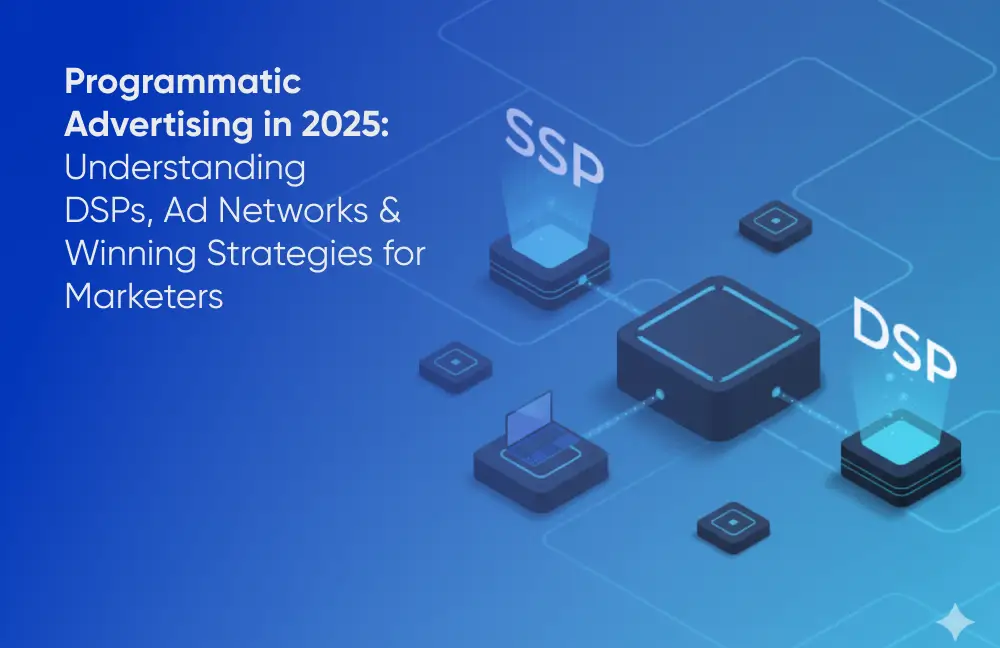
Understanding Programmatic Advertising: Role of DSPs, Ad Networks & Best Practices for Marketers

Understanding Programmatic Advertising Role of DSPs, Ad Networks & Best Practices for Marketers - Tatvic

TL;DR:

Programmatic advertising in 2025 has become the backbone of digital media buying, powered by AI, DSPs, and cookieless identity-first targeting. While leading DSPs like DV360, The Trade Desk, and Amazon DSP deliver scale, transparency, and real-time optimization, ad networks still serve SMBs and niche audiences but with limited control.

The key to success lies in choosing the right platform, ensuring fraud prevention, privacy compliance, and continuous testing for performance. With trends like AI-led autonomous optimization, connected TV, retail media, and contextual targeting shaping the future, programmatic is now the operating system of modern marketing. Tatvic helps brands maximize ROI by combining expert DSP management, CRO, and analytics-driven programmatic strategies.

Introduction

In 2025, programmatic advertising isn’t just another digital marketing channel, it has become the operating system of media buying. With more than 80% of global digital ad spend now flowing through programmatic platforms (eMarketer, 2025), it is the single most powerful way for brands to connect with audiences at scale, with precision, and in real time.

But as the ecosystem has evolved, so has its complexity. Between DSPs (Demand-Side Platforms), SSPs (Supply-Side Platforms), ad exchanges, ad networks, and cookieless identity solutions, marketers face an overwhelming number of choices.

This often leads to critical questions such as:

  • What’s the real difference between a DSP and an ad network?

  • Which programmatic platforms deliver the best ROI in 2025?

  • How can I safeguard my spend against fraud while staying compliant with privacy-first regulations?

This guide breaks it all down. You’ll discover:

  • What programmatic advertising really means today and why it matters more than ever.

  • The evolving roles of DSPs and ad networks in a cookieless, AI-driven ecosystem.

  • The top programmatic players of 2025, from enterprise DSPs like DV360 and The Trade Desk to niche ad networks.

  • A practical framework for choosing the right partner based on budget, scale, and compliance.

  • Actionable best practices for campaign setup, optimization, and fraud prevention.

  • Common pitfalls to avoid like over-reliance on algorithms without human oversight.

  • A forward look at the future of programmatic advertising, where Agentic AI and autonomous optimization reshape the landscape.

By the end, you’ll have a clear, step-by-step roadmap to run smarter, safer, and more profitable programmatic campaigns-whether you’re a CMO of a global enterprise or a performance marketer at a growth-stage brand.

What is Programmatic Advertising?

Programmatic advertising in 2025 is the automated buying and selling of digital ad inventory powered by AI, real-time bidding (RTB), and data-driven decisioning. Unlike the old manual days of negotiating directly with publishers, today’s advertisers let advanced algorithms decide in a matter of milliseconds which ad should appear on which website, app, or connected TV screen.

In practice, this means that every time a user opens a webpage, scrolls through an app, or streams content, programmatic platforms instantly analyze thousands of data points-like demographics, browsing behavior, device type, and even contextual signals-to determine if that impression is worth bidding on. If yes, a DSP (Demand-Side Platform) bids automatically, and the winning ad is served almost instantly.

The Evolution of Programmatic Advertising

The journey of programmatic has been nothing short of transformative:

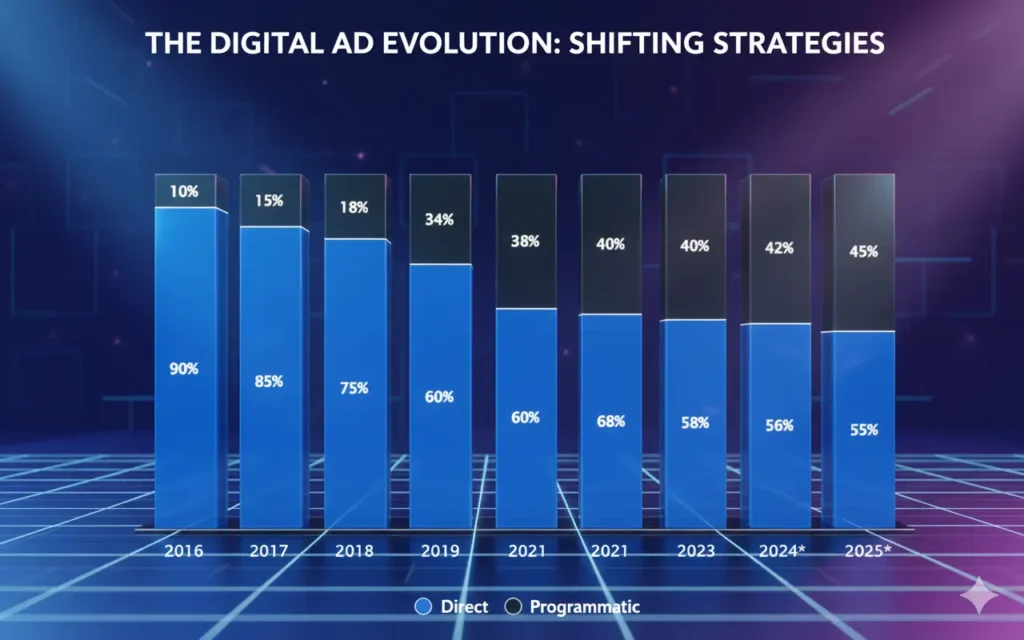
  • 2000s → Manual ad buying dominated, with direct deals and insertion orders.

  • 2010-2015 → RTB (Real-Time Bidding) and early DSPs emerged, opening the door to automation.

  • 2016-2020 → Rise of private marketplaces (PMPs), header bidding, and brand-safety concerns.

  • 2021-2025 → The era of AI-driven optimization, cookieless identity solutions (Unified IDs, identity graphs), CTV growth, and retail media networks becoming the new battleground for advertisers.

Why Marketers Rely on Programmatic Advertising in 2025

Programmatic advertising is more than efficiency, it’s the engine of precision, personalization, and profitability in digital marketing.

Here’s why it remains the go-to channel:

  1. Efficiency at Scale → AI handles bidding, placement, targeting, and budget allocation in real time.

  2. Hyper-Targeting Capabilities → Beyond demographics, DSPs enable targeting by behavioral patterns, contextual relevance, location, and even household data.

  3. Omnichannel Reach → Access billions of impressions across display, mobile, video, CTV, audio, DOOH (Digital Out-of-Home), and retail media.

  4. Cost Optimization → Competitive bidding and AI-driven decisioning minimize wasted spend and improve ROI.

  5. Real-Time Measurement & Transparency → Marketers track impressions, clicks, viewability, conversions, and even incrementality in near real time.

  6. AI + Human Synergy → While automation powers efficiency, human marketers set the strategy, oversee brand safety, and refine messaging.

Programmatic advertising in 2025 delivers the holy grail of digital marketing:
👉 the right ad, shown to the right person, at the right time, in the right context, at the right price.

It’s not just a channel, it’s the infrastructure behind modern advertising, shaping how brands engage audiences in a privacy-first, AI-driven, omnichannel world.

👉 Take Control, Drive Results: DV360 programmatic Self-Serve Account at Your Fingertips


Core Components of the Programmatic Ecosystem

To truly understand the difference between a DSP (Demand-Side Platform) and an ad network, it’s important to zoom out and look at the broader programmatic advertising ecosystem. Think of it as a real-time digital marketplace where buyers (advertisers) and sellers (publishers) connect through automation and AI.

Here Are The Key Building Blocks of Programmatic Advertising Ecosystem

  • Ad Exchanges → Neutral marketplaces where digital ad inventory is traded between buyers and sellers in real time.

  • SSPs (Supply-Side Platforms) → Tools that help publishers manage, price, and sell their ad inventory programmatically, ensuring maximum yield.

  • DSPs (Demand-Side Platforms) → Platforms advertisers use to buy ad inventory across multiple exchanges, with advanced targeting, bidding, and reporting capabilities.

  • DMPs (Data Management Platforms) → Systems that collect, unify, and activate first-party and third-party audience data to fuel targeting decisions.

  • CDPs (Customer Data Platforms) [2025 Update] → Now widely integrated into programmatic stacks, CDPs unify cross-channel customer data for privacy-first audience activation.

  • Ad Networks → Aggregators of publisher inventory, often bundling impressions by category (e.g., lifestyle, finance, tech) and reselling them to advertisers.

Together, these players create a real-time, AI-powered trading ecosystem that fuels programmatic advertising across display, video, connected TV (CTV), digital audio, retail media, and even digital out-of-home (DOOH).

DSPs vs Ad Networks: Key Differences for Marketers

While both DSPs and ad networks allow advertisers to purchase digital ad space, they serve different purposes and cater to different levels of advertising maturity.

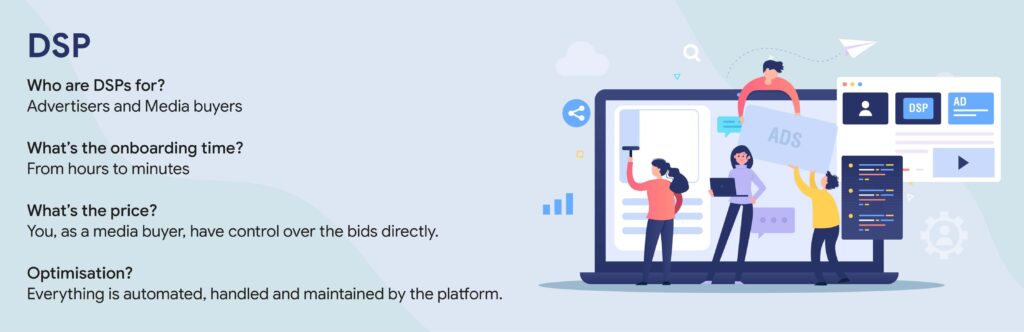
Demand-Side Platforms (DSPs)

Demand-Side Platforms (DSPs)

DSPs are the powerhouses of programmatic advertising.

  • Real-Time Access → Tap into billions of impressions across ad exchanges, SSPs, and private marketplaces.

  • Granular Targeting → Go beyond basic demographics with behavioral, contextual, location, device, and even AI-driven predictive targeting.

  • Transparency & Control → Full visibility into bidding costs, placements, viewability, and fraud prevention.

  • Omnichannel Reach → Manage campaigns across display, video, CTV, DOOH, audio, and retail media from one interface.

  • Best For → Enterprises, advanced marketers, and agencies managing large-scale budgets who need precision, efficiency, and scalability.

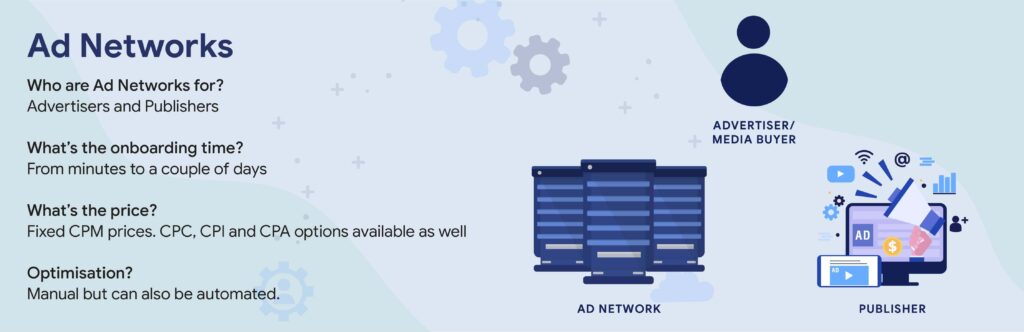
Ad Networks

Ad Networks

Ad networks are simpler, curated solutions that still hold value in 2025.

  • Bundled Inventory → Package ad space from multiple publishers into categories like “tech,” “lifestyle,” or “news.”

  • Ease of Use → Require less technical setup than DSPs, often appealing to SMBs.

  • Limited Transparency → Advertisers may not always know the exact placements or auction dynamics.

  • Good for Reach → Provide straightforward access to audiences without deep programmatic expertise.

  • Best For → Smaller advertisers or those focused on niche verticals who want curated access without the complexity of full programmatic stacks.

In 2025, the line between DSPs and ad networks is increasingly blurred. Many ad networks now integrate DSP-like features (such as automated bidding and audience targeting), while leading DSPs offer curated inventory packages similar to networks.

👉 Smart advertisers are adopting a hybrid strategy:

  • Use DSPs for scale, precision, and transparency.

  • Leverage ad networks for niche, curated inventory that delivers strong contextual relevance.

This dual approach ensures brands can balance reach + relevance, while also staying ahead in a privacy-first, cookieless, AI-driven ecosystem.

Key Players & Technologies in Programmatic Advertising (2025)

The programmatic advertising landscape in 2025 has matured into a highly competitive, AI-driven ecosystem. With global ad spend through programmatic channels exceeding $800 billion annually (source: eMarketer 2025), the platforms and technologies that dominate today are shaping how brands reach audiences across every screen.

Leading DSPs (Demand-Side Platforms) in 2025

These platforms are at the forefront of programmatic media buying, offering advertisers precision, scale, and automation:

  • DV360 (Google Display & Video 360)

    Still the most widely used DSP globally, DV360 integrates deeply with GA4, YouTube, Google Ads, and the broader Google ecosystem. In 2025, it continues to be the go-to for cross-channel attribution, audience targeting, and brand-safe inventory.

  • The Trade Desk

    The leading independent DSP, known for its Unified ID 2.0 identity framework and superior AI optimization. Its strength lies in cookieless targeting, omnichannel reach (CTV, DOOH, audio), and privacy-first audience activation.

  • Amazon DSP

    A retail media powerhouse, leveraging exclusive Amazon shopper and purchase data. It’s the fastest-growing DSP in 2025, particularly for eCommerce, CPG, and retail advertisers tapping into first-party retail insights.

  • Xandr (Microsoft Advertising)

    Now fully integrated into Microsoft’s ad stack, Xandr leads in connected TV (CTV) and cross-device targeting, making it a top choice for brands investing heavily in streaming audiences.

  • MediaMath

    Known for open architecture and flexible APIs, MediaMath focuses on AI-driven campaign optimization, advanced custom bidding algorithms, and data interoperability with CDPs and analytics platforms.

Top Ad Networks in 2025

While DSPs dominate large-scale media buying, ad networks remain critical for niche targeting and simplified access:

  • Google AdSense & AdMob

    Still the most widely used ad networks globally, ideal for small-to-mid-sized advertisers looking for scale with minimal setup.

  • Taboola & Outbrain

    Global leaders in native advertising, powering content discovery campaigns across news, lifestyle, and entertainment publishers.

  • Retail Media Networks

    2025 has seen retail media explode, with platforms like Walmart Connect, Instacart Ads, and Target Roundel becoming essential for brands wanting to reach high-intent shoppers at the point of purchase.

  • Vertical & Niche Networks

    Healthcare, finance, travel, and B2B-focused ad networks provide specialized targeting and compliance-driven advertising environments that DSPs may not always guarantee.

Emerging Technologies Defining Programmatic in 2025

Programmatic success in 2025 is no longer just about access to inventory-it’s about efficiency, privacy, and innovation. Here are the biggest trends shaping the ecosystem:

  • Header Bidding 3.0

    Publishers now leverage server-side header bidding and AI-powered yield optimization, ensuring maximum revenue while reducing latency.

  • Private Marketplaces (PMPs)

    PMPs have become the preferred route for premium inventory. They combine brand safety, transparency, and direct publisher relationships, especially for industries like finance and healthcare.

  • AI-Driven Contextual Targeting

    With third-party cookies nearly obsolete, contextual targeting has evolved. Advanced AI algorithms analyze page content, user intent, and environmental signals to deliver highly relevant ads without violating privacy.

  • Identity & Privacy Solutions

      • Unified ID 2.0 has emerged as the de facto open-source identity framework for cookieless targeting.

      • Data Clean Rooms (offered by Google, Amazon, and independent providers) enable privacy-safe audience matching between advertisers and publishers.

      • Identity Graphs & Cohort Targeting ensure continuity in personalization while complying with GDPR, CCPA, and new 2025 data laws.

How Programmatic Advertising Works (Step by Step in 2025)

Programmatic advertising may feel like a black box to many marketers, but at its core, it’s a high-speed, AI-powered auction system that connects advertisers to their ideal audiences across digital channels. The process takes place in under 100 milliseconds-faster than a human blink.

Here’s how it works today:

1. Advertiser Defines Goals & Audience

The journey begins when a brand or agency sets campaign objectives (awareness, lead generation, sales), defines audience parameters (demographics, behaviors, intent signals), and allocates a budget. This is all configured inside a Demand-Side Platform (DSP).

2. DSP Enters the Auction

The DSP uses AI and algorithms to evaluate available impressions across multiple ad exchanges and supply-side platforms (SSPs). It decides in real time whether to bid on an impression based on audience match, predicted engagement, and campaign goals.

3. SSP Makes Publisher Inventory Available

On the publisher side, an SSP manages available ad inventory (websites, apps, connected TV slots, retail media placements) and opens it up for bidding to potential advertisers.

4. Real-Time Auction Occurs

When a user loads a webpage or app, an auction begins instantly. Multiple DSPs bid for that impression. The highest bidder wins, but thanks to second-price auctions and AI-based cost optimization, advertisers typically pay just enough to beat the competition-not their full bid.

5. Winning Ad Is Delivered to the User

Within milliseconds, the winning creative (banner, video, native ad, or CTV spot) is served to the user. Importantly, AI ensures relevance-for example, showing a product ad right after the user searched for related items.

6. Tracking, Measurement & Optimization

Every impression and click is logged. Advertisers monitor KPIs like CTR, CPA, ROAS, and viewability through their DSP dashboards. AI then fine-tunes targeting, bidding, and creative rotation for continuous optimization.

Why This Matters in 2025

The process hasn’t just become faster, it’s become smarter:

  • AI-driven bidding strategies predict the likelihood of conversions with remarkable accuracy.

  • Cookieless identity solutions (Unified ID 2.0, clean rooms) enable compliant targeting in a privacy-first world.

  • Retail media & CTV auctions are expanding programmatic beyond traditional web and mobile.

  • Multi-agent AI systems within DSPs now automate not just bidding, but creative optimization and budget pacing.

In short, programmatic advertising in 2025 gives marketers the holy grail: the right ad, to the right person, on the right device, at the right moment-at scale.

How to Choose the Right DSP or Ad Network

Not every platform fits every advertiser. With dozens of DSPs (Demand-Side Platforms) and ad networks available, businesses must evaluate carefully to avoid wasted spend and maximize ROI.

Here are the key decision factors in 2025:

1. Budget & Scale

  • Enterprise-grade DSPs like DV360 and The Trade Desk are ideal for large brands with significant budgets, global reach, and multi-channel strategies.

  • Amazon DSP is a must for retail and eCommerce players leveraging first-party shopper data.

  • SMBs and mid-market advertisers may benefit from simpler ad networks or hybrid platforms like HubSpot Ads or Criteo, which balance automation with ease of use.

2. Targeting Needs

  • Behavioral & interest-based targeting: For businesses focused on precision audience reach.

  • Contextual targeting: A strong option in a cookieless world, ensuring relevance without relying on third-party cookies.

  • Cross-device & omnichannel: Critical in 2025, where users shift between mobile, CTV, web, and retail media.

3. Privacy & Compliance

With stricter laws such as GDPR (Europe), CCPA/CPRA (California), India’s DPDP Act 2023, and the EU AI Act, compliance is non-negotiable. Look for platforms that support:

  • Privacy-first identity solutions (Unified ID 2.0, clean rooms, Google Privacy Sandbox).

  • Built-in data minimization and audit trails for safe usage of personal data.

4. Transparency & Control

  • Avoid “black box” networks that hide fees or placements.

  • Prioritize DSPs offering log-level data, real-time reporting, and clear fee structures.

5. Integration with Your MarTech Stack

  • Ensure compatibility with GA4, CDPs, CRM platforms, attribution tools, and creative management systems.

  • Check API flexibility enterprise DSPs like MediaMath and Xandr are highly extensible.

Implementation Guide & Best Practices for Programmatic Advertising

Even the best DSP or ad network won’t deliver results without the right setup and optimization.

Here’s a proven step-by-step playbook for 2025:

Step-by-Step Campaign Setup

  1. Define SMART goals - Awareness, lead generation, conversions, or ROAS.

  2. Select the right platform - Match your DSP/ad network to budget, audience, and compliance needs.

  3. Develop creatives - Mix display, video, native, and emerging formats like CTV and retail media ads.

  4. Set bidding strategies - Use AI-powered bidding models (tCPA, tROAS, or attention-based metrics).

  5. Launch with safeguards - Implement brand safety filters, contextual controls, and inventory whitelists/blacklists.

Optimization Best Practices (2025 Updates)

  • Frequency capping: Prevent ad fatigue by limiting exposures per user.

  • Prioritize viewability & attention metrics: Go beyond impressions-ensure ads are seen and capture attention.

  • Fraud prevention: Use AI-powered fraud detection to counter bots and invalid traffic.

  • Creative rotation & testing: Run A/B and multivariate tests to identify top-performing creatives.

  • AI-driven bid optimization: Leverage DSP machine learning to automatically adjust bids in real time.

  • Leverage cookieless targeting: Combine contextual intelligence with first-party data activation for precision in a privacy-first world.

Choosing the right DSP or ad network isn’t about chasing the biggest name-it’s about finding a platform that aligns with your budget, targeting needs, compliance obligations, and existing MarTech stack. With AI now powering autonomous bidding, predictive analytics, and real-time optimization, marketers who make strategic choices can reduce wasted spend, boost ROI, and future-proof their campaigns in an increasingly complex advertising ecosystem.

Common Mistakes to Avoid in Programmatic Advertising

Despite its efficiency, programmatic advertising can easily drain budgets if not executed strategically. Marketers-whether using DSPs (Demand-Side Platforms) or ad networks often fall into predictable traps:

  1. Buying Low-Quality Inventory

    Chasing cheap impressions often leads to placements on irrelevant or fraudulent sites. This not only wastes ad spend but also damages brand reputation. In 2025, DSPs with built-in fraud prevention (like The Trade Desk, DV360, or MediaMath) are critical to ensure traffic quality.

  2. Ignoring the “Tech Tax”

    Programmatic comes with hidden fees across exchanges, data providers, and intermediaries. These fees-sometimes 15-35% of spend-can quietly erode ROI. Always demand transparent reporting from your DSP or ad network to see exactly where your dollars are going.

  3. Over-Reliance on Automation

    AI-powered bidding and optimization are powerful, but programmatic campaigns still need human oversight. Without monitoring, algorithms may chase the wrong KPIs or over-prioritize low-value clicks. The best advertisers combine machine efficiency with human judgment.

  4. Failing to Prepare for a Cookieless Future

    Third-party cookies are almost fully deprecated by 2025. Brands that don’t adopt identity solutions (Unified ID 2.0, clean rooms, Google’s Privacy Sandbox, or first-party data strategies) risk losing accurate targeting and attribution.

  5. Running Campaigns Without Clear KPIs

    Launching ads without predefined success metrics (CTR, ROAS, conversions, or brand lift) makes optimization impossible. Every DSP setup should start with measurable objectives tied directly to the business funnel.

Key Challenges in Programmatic Advertising (2025)

While programmatic continues to dominate digital media buying, several challenges remain persistent in 2025:

  1. Ad Fraud

    Even with advancements in AI fraud detection, ad fraud still costs advertisers tens of billions annually worldwide. Fake impressions, bot traffic, and spoofed domains remain major risks. Partnering with fraud-combatting vendors like IAS (Integral Ad Science), DoubleVerify, or HUMAN Security is no longer optional.

  2. Data Privacy & Compliance

    Global laws like GDPR (Europe), CCPA (California), DPDP Act 2023 (India), and China’s PIPL demand strict data governance. By 2025, advertisers must adopt privacy-first targeting models, focusing on contextual relevance and consent-based audience building.

  3. Complexity & Learning Curve

    Enterprise DSPs such as DV360 or The Trade Desk offer powerful features, but the setup, integrations, and reporting dashboards can overwhelm marketing teams. Without skilled operators or agency partners, campaign efficiency drops.

  4. Rising Media Costs

    The boom in CTV (Connected TV) and retail media networks has driven up CPMs. Premium placements on platforms like Netflix Ads, Disney+, Amazon DSP, and Walmart Connect are highly effective but come at a premium. Smaller brands must balance reach with efficiency.

Future of Programmatic Advertising (2025 & Beyond)

Future of Programmatic Advertising (2025 & Beyond)

The future of programmatic advertising is AI-first, autonomous, and privacy-resilient. By 2025 and beyond, several trends are reshaping the landscape:

  1. AI-Driven Multi-Agent Systems

    Campaign orchestration is shifting from manual setups to autonomous AI agents that manage end-to-end media planning, bidding, creative testing, and optimization in real time. This means fewer silos and smarter decision-making at scale.

  2. CTV & Retail Media Dominate Spend

    Connected TV (Netflix, Disney+, Prime Video) and retail media (Amazon, Walmart Connect, Instacart) are absorbing the lion’s share of digital ad dollars. Brands are moving budgets here because of rich audience data and premium, brand-safe inventory.

  3. Autonomous Experimentation Replaces A/B Testing

    Traditional A/B testing is giving way to self-learning systems that continuously run multivariate experiments and adapt instantly-delivering creative, audience, and bidding optimizations without human delays.

  4. Privacy-First, Identity-Resilient Targeting

    As third-party cookies disappear, contextual AI, clean rooms, and solutions like Unified ID 2.0 and Google’s Privacy Sandbox will anchor targeting and measurement. Brands that fail to adapt risk losing performance visibility.

  5. Self-Optimizing MarTech Stacks

    Future-ready DSPs and programmatic ecosystems will integrate with CDPs, analytics, and creative platforms to create self-correcting feedback loops-continuously improving performance without manual intervention.

In short, programmatic advertising is evolving into the “operating system” of digital marketing-a central hub where AI, data, and automation converge to deliver unmatched efficiency, personalization, and ROI.

Conclusion & Next Steps

Programmatic advertising in 2025 isn’t just about buying impressions-it’s about precision, automation, and measurable outcomes. DSPs and ad networks remain the backbone of this ecosystem, but success depends on making the right platform choices, safeguarding against fraud, and staying compliant with global data privacy laws.

If your business wants to:

  • Scale campaigns across CTV, display, native, and retail media channels.

  • Minimize wasted spend from fraudulent traffic or poor inventory.

  • Unlock AI-powered optimization and hyper-personalized customer experiences…

👉 It’s time to partner with programmatic experts.

At Tatvic, we specialize in helping brands harness programmatic advertising with the right mix of:

  • DSP expertise (DV360, The Trade Desk, Amazon DSP).

  • Fraud prevention and transparency-first reporting.

  • CRO and analytics-driven campaign optimization.

  • Privacy-first audience strategies built for a cookieless world.

👉  Book a consultation today and discover how Tatvic can help you transform programmatic advertising into your next competitive advantage.

Unlock the Full Power of Display & Video 360 (DV360): Guide to Smarter Programmatic Marketing

Unlock the Full Power of Display & Video 360 (DV360) Guide to Smarter Programmatic Marketing - Tatvic

Did You Know!

Google Display & Video 360 (DV360) offers extensive reach, covering 90% of the global internet and connects advertisers to more than 80 ad exchange networks across mobile, desktop, CTV, OTT, and linear TV platforms.

In this article discover how Google DV360 powers data-driven advertising with access to over 90% of global internet users through premium inventory, advanced targeting, and dynamic creatives.

This expert guide unpacks DV360’s capabilities which used by 80% of top global brands, to drive measurable outcomes across display, video, CTV, and audio campaigns.
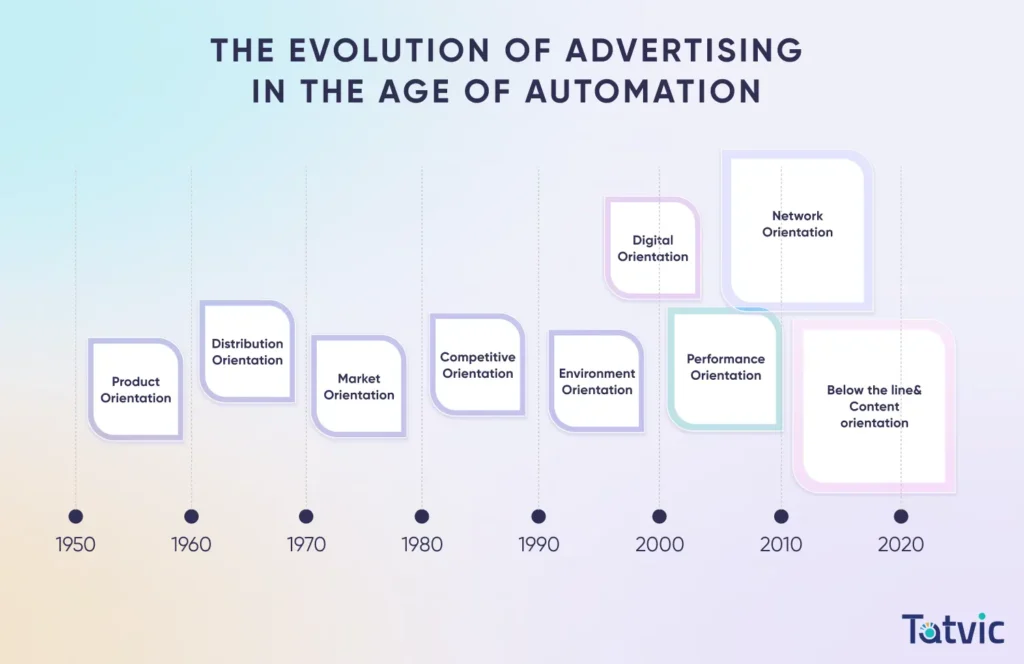
The Evolution of Advertising in the Age of Automation

The Evolution of Advertising in the Age of Automation

Digital advertising has evolved at a breakneck pace. With users spanning mobile, desktop, smart TVs, podcasts and OTT platforms, reaching the right person at the right time with the right message is no longer optional, it’s essential. This is where Google Display & Video 360 (DV360) shines.

As consumer journeys become increasingly fragmented, marketers need smarter tools to unify campaigns across channels. DV360 empowers brands to manage Display, Video, Audio and CTV Ads through one integrated platform.

With its advanced targeting, real-time optimization, and rich creative capabilities, DV360 helps advertisers maximize impact while minimizing waste. It’s not just automation, it’s intelligent and data-driven advertising at scale.

What is DV360 (Display & Video 360)?

Display & Video 360 (DV360) is Google’s enterprise-level demand-side platform (DSP) designed for programmatic media buying. It empowers advertisers to plan, buy, measure, and optimize digital campaigns all in one place. Unlike other DSPs that focus on media buying alone, DV360 is deeply integrated into the Google Marketing Platform (GMP), making it an end-to-end solution for advanced marketing teams.

DV360 stands out with its seamless access to premium inventory across Google and third-party exchanges, including YouTube, making it ideal for brand-safe, high-impact advertising. It combines data-driven audience targeting with real-time bidding and campaign insights. Whether you’re running display ads, video campaigns, or cross-device strategies, DV360 ensures precise control and unified reporting. This makes it a powerful tool for scaling performance in today’s programmatic ecosystem.
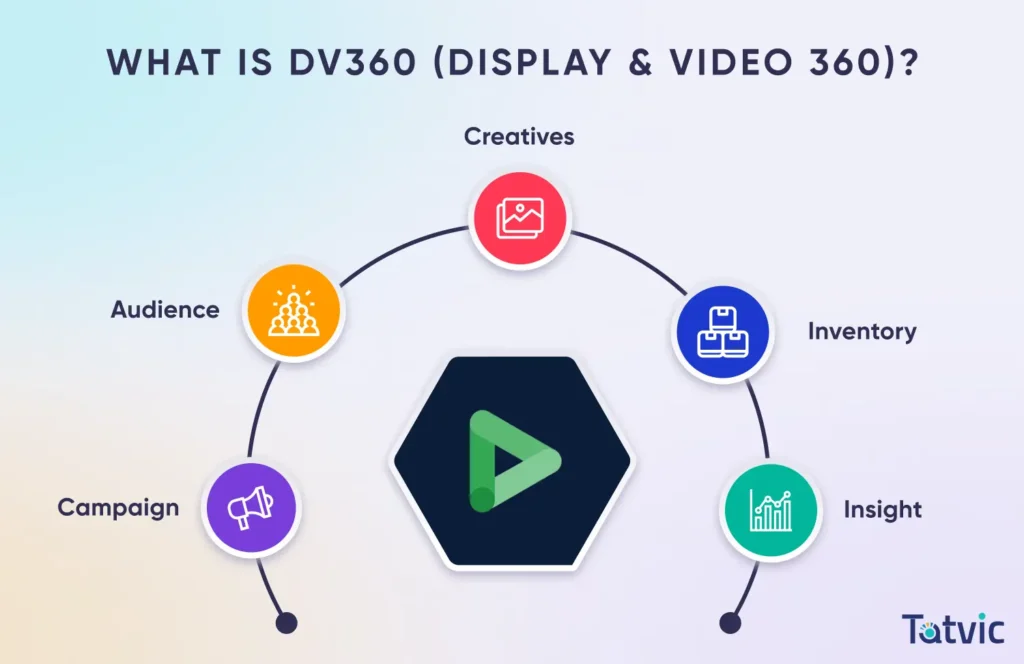
What is DV360 (Display & Video 360) - Tatvic

Core Capabilities of DV360:

Google’s Display & Video 360 (DV360) offers a comprehensive suite of programmatic tools designed to empower advertisers in the increasingly complex world of digital marketing. With its advanced features, DV360 enables brands to reach their audiences across multiple channels, optimize media spend, and harness data-driven insights to drive campaign success. Below are some of the key capabilities that make DV360 a go-to platform for performance-driven advertisers

Let’s deep dive into some of the Core Capabilities of DV360:

1. Cross-Channel Media Activation

DV360 enables advertisers to run campaigns across multiple digital channels-including display, video, audio, connected TV (CTV), and mobile-from a single, unified platform. This cross-channel flexibility allows marketers to create holistic strategies that deliver consistent messaging across the entire customer journey, improving both reach and frequency efficiency.

2. Advanced Audience Segmentation and Targeting

With DV360, advertisers can leverage Google’s robust audience data-along with first-party and third-party data-to build highly specific audience segments. Target users based on demographics, interests, browsing behavior, in-market signals, and even custom intent. This allows for hyper-personalized campaigns that drive engagement and conversions.

Example: A beauty brand can target makeup enthusiasts aged 18-34 actively browsing beauty tutorials on YouTube and related blogs.

3. Custom Bidding Strategies

One of DV360’s most powerful features is the ability to implement custom bidding algorithms. Advertisers can tailor bidding logic based on their unique business KPIs-whether it’s viewability, time on site, conversions, or ROAS. Custom bidding ensures every dollar is optimized toward what matters most to your brand.

Example: An eCommerce retailer might design a bidding model that prioritizes ad placements likely to convert high-value cart abandoners.

4. Seamless Integration with Google Stack (GA4, Campaign Manager 360, BigQuery, etc.)

DV360 integrates natively with Google’s ecosystem, including GA4 (Google Analytics 4), Campaign Manager 360, BigQuery, and Search Ads 360. This interconnected setup allows advertisers to easily import audiences, track cross-channel performance, attribute conversions, and analyze campaign results-all within a privacy-compliant environment.

Benefit: Faster, more accurate decision-making through consolidated reporting and unified KPIs.

5. Access to Premium Inventory (YouTube, OTT, PMP Deals)

With DV360, advertisers gain access to a vast range of premium inventory sources-from YouTube and top-tier publisher sites to Connected TV, OTT platforms, and Private Marketplace (PMP) deals. This ensures brand-safe placements, higher viewability, and greater control over where your ads appear.

Example: A travel brand can run skippable and non-skippable video ads on YouTube and OTT apps like Hotstar or Hulu, targeting vacation-intent users.

Expert View: Display & Video 360 is not just about reach-it’s about precision. With it, brands can build meaningful connections with customers at scale.

Why DV360 Outperforms Traditional DSPs (Demand Side Platforms)

Traditional DSPs may offer reach, but DV360 adds intelligence, control, and efficiency. Unlike traditional DSPs, which primarily focus on media buying, DV360 integrates with Google’s powerful ecosystem, enabling smarter audience targeting, real-time optimization, and richer data insights.

With access to premium inventory, including YouTube and CTV, along with customizable bidding strategies, DV360 allows brands to optimize their campaigns in a way that drives measurable results. It’s more than just a buying platform; it’s an intelligent tool designed to maximize ROI with advanced programmatic features.
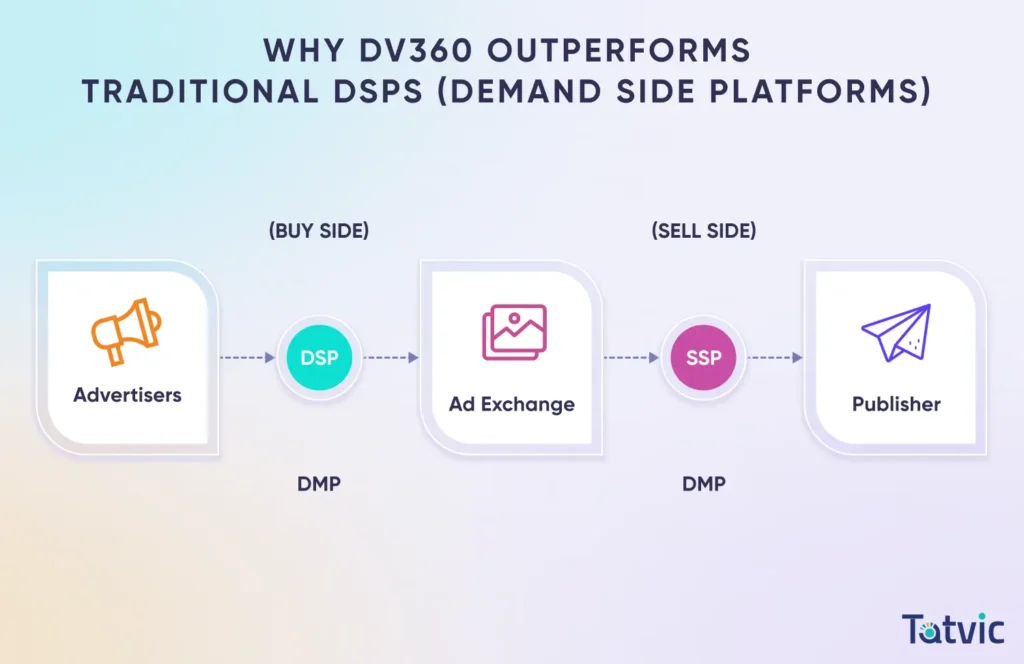
Why DV360 Outperforms Traditional DSPs (Demand Side Platforms)- Tatvic

Here’s what makes Google DV360 superior:

  • Google Ecosystem Integration: Leverages first-party signals from Search, YouTube, Chrome and Gmail.
  • Programmatic Guaranteed Deals: Direct inventory access with transparency and certainty.
  • Data-driven Creatives: Serve hyper-personalized ads based on user behavior and context.
  • Unified Reporting: Full-funnel insights from awareness to conversion.

Example: A global edtech brand used DV360 to deliver CTV ads to segmented student cohorts across SonyLiv and YouTube. Engagement rates improved by 42% compared to campaigns run on a legacy DSP.

DV360 vs Google Ads: Key Differences Explained

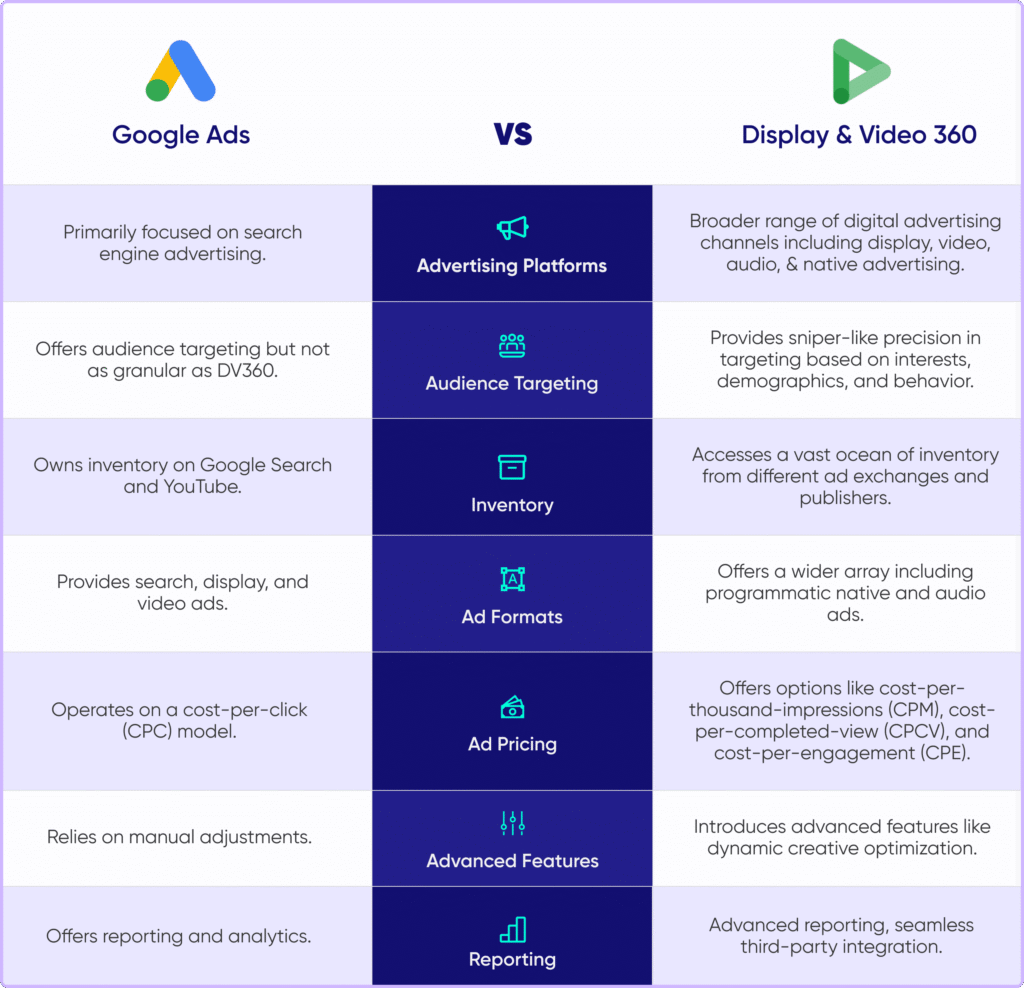
While Google Ads is designed for direct advertisers, DV360 is tailor-made for performance teams managing multi-channel campaigns with scale and complexity. While both DV360 and Google Ads are powerful tools for digital advertising, they serve distinct purposes.
DV360 vs Google Ads Key Difference Explained - Tatvic

  • Google Ads is ideal for advertisers looking to run search campaigns or highly targeted display ads on Google’s owned properties, such as Search and YouTube. On the other hand,
  • DV360 is designed for larger, programmatic campaigns across multiple channels, offering more advanced features like custom bidding strategies, audience segmentation, and access to premium inventory across Google and third-party exchanges. With DV360, advertisers gain greater control, efficiency, and cross-channel reach, making it the go-to solution for data-driven, large-scale marketing efforts.

Let’s See The Major Difference Between DV360 vs Google Ads

Feature Google Ads Display & Video 360
Inventory Google Network only Open Web + PMP + PG
Targeting Standard audience tools Advanced layering, GA4 integration
Creatives Basic formats Interactive, Video, CTV, Dynamic Creative Optimization (DCO)
Measurement Campaign-specific Full-funnel attribution with Campaign Manager 360
Team Collaboration Limited Role-based, cross-team workflows

Tip: Use Google Ads for quick tests and do scale winning experiments with DV360 for enterprise-grade execution.

Google Display & Video 360 (DV360) Campaign Structure Demystified

Building a successful DV360 campaign begins with a well-organized structure.

The hierarchy of campaigns, insertion orders (IOs), line items, and ads allows advertisers to manage, optimize, and scale their efforts efficiently.
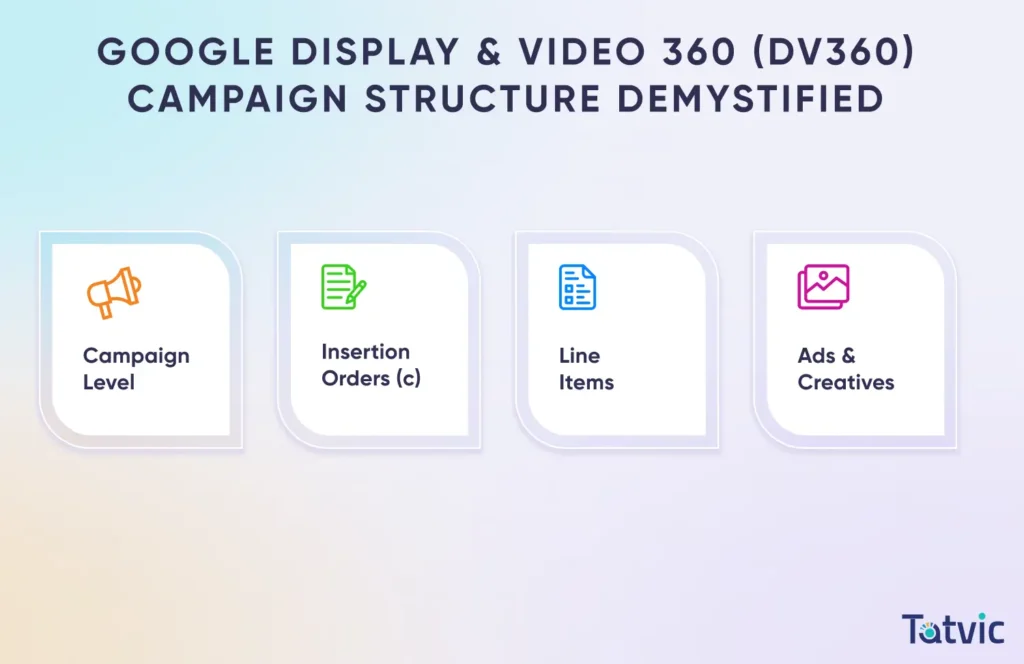
Google Display & Video 360 (DV360) Campaign Structure Demystified - Tatvic

Here’s a breakdown of the key components of  DV360 Campaign Structure

1. Campaign Level

At the highest level of the DV360 campaign hierarchy, the Campaign Level defines the overall objective of the campaign. Whether you’re aiming for brand awareness, consideration, or conversion (action), this is where you set the foundation for your campaign’s strategy. Additionally, you’ll define important parameters like flight dates (start and end dates) and the budgeting framework to ensure optimal allocation of resources.

2. Insertion Orders (IOs)

Insertion Orders (IOs) are the next step in the hierarchy and allow you to allocate budget across different ad placements. This layer also involves setting frequency caps to control how often your ads are shown to users and defining key performance indicators (KPIs) such as CPM (Cost Per Mille), CPA (Cost Per Acquisition), or CPC (Cost Per Click). These metrics help ensure that your ad spend is aligned with your campaign goals and that the performance is continuously measured and optimized.

3. Line Items

Line Items are the heart of the campaign setup and represent the individual ad placements or targeting segments within your larger campaign. This is where you define the creative type (display, video, audio, etc.), specify the targeting layers (such as demographics, interests, and behaviors), and configure the bidding strategy (like CPM, vCPM, or tCPM). Each line item can be optimized for different goals and audiences, ensuring precision in delivering ads to the right users at the right time.

Example: A brand may create a line item targeting 18-34-year-olds in urban areas, bidding on vCPM for video ads to drive engagement.

4. Ads & Creatives

Finally, Ads & Creatives are linked to the assets you’ve uploaded within DV360. This includes the format-specific rules (e.g., VAST tags for video ads, HTML5 for display ads, or audio tags for streaming campaigns) that dictate how your creatives will function across different channels and devices. Ensuring that the ads are correctly linked and optimized for the chosen formats is critical for delivering seamless, engaging user experiences.

Pro Insight: Mirror your funnel stages in your IO structure:
Top Funnel = Awareness IOs
Mid Funnel = Engagement IOs
Bottom Funnel = Conversion IOs.

Advanced Audience Targeting Capabilities in Google Display & Video 360 (DV360)

One of the strongest advantages of Google Display & Video 360 (DV360) is its robust and intelligent audience targeting system. By layering multiple data sources and intent signals, DV360 enables advertisers to reach the right users at the right time with hyper-personalized messaging.
Advanced Audience Targeting Capabilities in Google Display & Video 360 (DV360) - Tatvic

Here’s how the platform breaks down its advanced targeting options:

1. First-Party Audiences

DV360 allows seamless onboarding of first-party data, including customer lists, website visitors, and app users. You can import audiences directly from CRM systems, Google Analytics 4 (GA4), or Floodlight tags. This makes it easy to re-engage existing customers, nurture leads, or upsell to high-value users.

Example: A retail brand can retarget users who abandoned their carts in the past 7 days using email CRM data.

2. Google Signals: In-Market, Affinity and Demographics

Leveraging Google’s rich behavioral signals, DV360 offers a wide range of in-market, affinity, and demographic audiences. These are derived from billions of real-time intent signals such as search behavior, website visits, YouTube viewing patterns, and more.

  • In-Market Audiences: Users actively researching or intending to buy (e.g., “home loans” or “luxury cars”)
  • Affinity Audiences: Users grouped by long-term interests (e.g., “tech enthusiasts” or “fitness buffs”)
  • Demographics: Targeting by age, gender, parental status, and household income

3. Third-Party Audience Segments

DV360 integrates with leading third-party data providers like Nielsen, BlueKai, Oracle, Lotame, and Acxiom. These segments provide rich behavioral, transactional, and intent-based data that can enhance your targeting precision, especially useful when you lack robust first-party data.

Example: A luxury automotive brand can use Oracle data to reach high-income users in-market for premium vehicles.

4. Custom Intent Audiences

With Custom Intent, DV360 allows advertisers to build audience segments based on users’ search keywords, visited URLs, and app usage patterns. This offers deeper control and lets you create highly tailored audiences that reflect real-time buying signals.

Example: A travel brand can target users who’ve searched for “cheap flights to Bali” or visited travel comparison sites in the past week.

5. Lookalike Modeling (Similar Audiences)

Lookalike modeling in DV360 allows you to scale your campaigns by finding new users who resemble your top-performing audiences. These similar audiences are modeled using machine learning and behavioral patterns, helping you extend reach without sacrificing quality or performance.

Example: An e-learning platform can create lookalikes of users who completed a course and achieved certification, then reach similar professionals across CTV and mobile apps.

By combining these layers, advertisers can build deeply targeted and efficient audience strategies within DV360-resulting in better engagement, higher ROI, and smarter use of media spend. Whether you’re working with first-party CRM lists or tapping into Google’s AI-powered signals, the platform offers flexibility and precision unmatched by most other DSPs.

Let me know if you’d like this adapted into a visual chart, training material, or landing page copy!

Example: A BFSI client layered users interested in “tax saving” with custom keywords and remarketing from their blog. The result? 1.9x higher lead qualification rate.

Creative Formats & Dynamic Messaging in Google Display & Video 360 (DV360)

In today’s digital-first landscape, capturing attention through creativity is just as critical as precision targeting. With Google Display & Video 360 (DV360), advertisers gain access to a versatile suite of creative formats that are designed to perform across screens, platforms, and user contexts. Whether you’re focused on storytelling, engagement, or conversion, DV360 enables you to tailor your messaging for maximum impact.

1. Display Banners

These are the classic static or animated ads that appear across websites and apps. Display banners are ideal for high-visibility branding campaigns, offering flexibility in sizes and placements across a vast inventory of publishers.

Example: A tech company promoting a product launch can run a series of branded display banners across news and gadget review sites.

2. HTML5 Interactive Ads

HTML5 creatives support advanced interactivity-such as carousels, hover effects, tap-to-reveal features, or drag-and-drop experiences. These ads drive deeper user engagement and are great for conveying layered information in a visually rich format.

Example: A real estate brand could use an interactive map that lets users explore properties based on location or budget.

3. Native Ads

Native ads appear seamlessly within the content layout of the hosting platform, creating a less disruptive, more contextual ad experience. These are effective in increasing trust and engagement, especially on editorial or content-heavy platforms.

Example: A SaaS company promoting a whitepaper can place native ads within a B2B news outlet to drive quality leads.

4. In-stream & Out-stream Video Ads

DV360 supports both in-stream video ads (e.g., pre-roll ads on YouTube or streaming platforms) and out-stream video ads (ads that autoplay in the middle of content or articles). These formats are perfect for storytelling and brand lift campaigns.

Example: A fashion retailer could showcase its seasonal collection with 15-second pre-roll ads before style-related YouTube content, while reinforcing messaging through out-stream ads on lifestyle blogs.

5. Audio Ads

Audio ads are ideal for reaching users in screenless environments such as while driving, cooking, or working out. DV360 provides access to major streaming platforms and podcasts, offering a new dimension for brand voice and recall.

Example: A meal delivery service could run 30-second audio spots on music apps during lunch hours to drive immediate app installs.

6. Connected TV (CTV) / OTT

With increasing cord-cutting trends, DV360 allows advertisers to deliver full-screen, non-skippable video ads on connected TVs and OTT platforms. These are excellent for high-impact campaigns with cinematic storytelling.

Example: An automotive brand can run a visually immersive ad on smart TVs during prime-time content to drive upper-funnel awareness.


What is Dynamic Creative Optimization (DCO) in Display & Video 360 (DV360)?

Dynamic Creative Optimization (DCO) is one of the most powerful personalization tools available in Google’s Display & Video 360 (DV360). It enables brands to deliver real-time, tailored ad creatives based on individual user data making your message more relevant, engaging, and likely to convert.

Rather than designing hundreds of static ads, DCO uses feed-based inputs to automatically update ad components like copy, visuals, and CTAs depending on who’s seeing it and when.

With DCO in DV360, your campaign isn’t just automated, it’s intelligent.
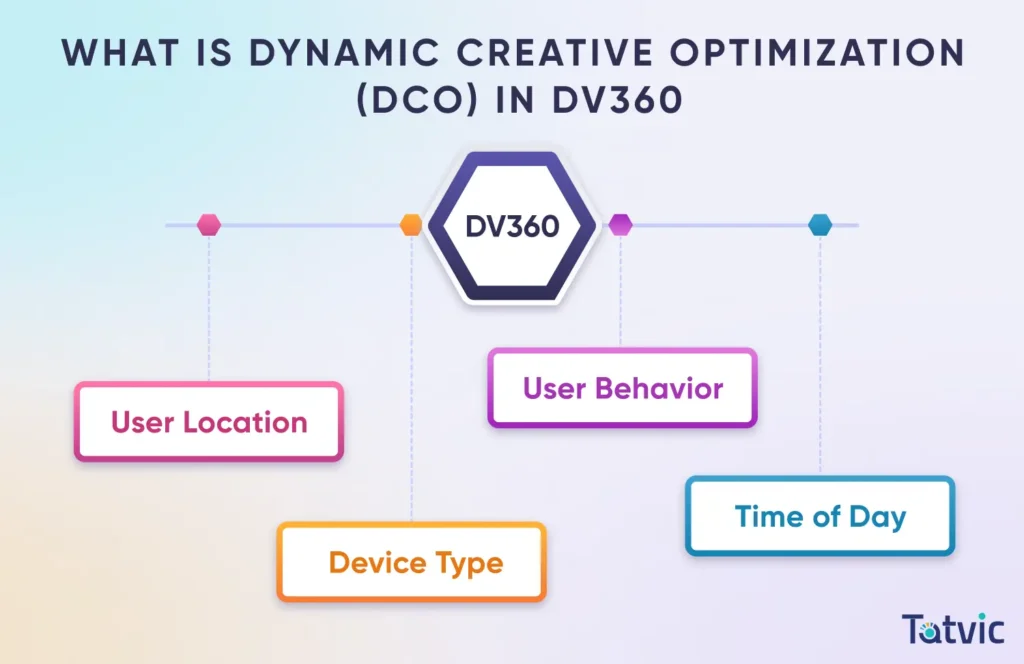
Dynamic Creative Optimization (DCO) in Display & Video 360 (DV360) - Tatvic

Here’s how Dynamic Creative Optimization (DCO) adapts to user context using real-time data:

1. User Location

DV360’s DCO engine can dynamically alter ad content based on the viewer’s geographic location-down to the city or even zip code level. This allows advertisers to run hyper-local promotions without building separate creatives for each region.

Example: A quick-service restaurant chain can showcase different combo deals for Mumbai vs. Delhi based on local preferences or weather (e.g., hot coffee in colder regions).
This geo-personalization not only increases relevance but also improves engagement rates and click-throughs across your Display & Video 360 campaigns.

2. Device Type

With users switching between mobile, desktop, and tablet throughout the day, a one-size-fits-all creative can lead to poor experience and wasted impressions. DCO in DV360 intelligently modifies ad layout, image resolution, or call-to-action (CTA) placement based on the device in use.

Example: A mobile ad might prioritize a tap-friendly CTA and simplified visuals, while a desktop version could display more in-depth information or include a carousel of products.
By optimizing for device context, Display & Video 360 ensures that your creatives are not just seen-but also experienced the way they were meant to be.

3. User Behavior

DV360 can tap into behavioral data to tailor ads according to user interests, past website visits, cart activity, or content consumption patterns. This means you can target returning users with different creative messages compared to new visitors.

Example: A user who previously browsed running shoes on an e-commerce site may see a personalized ad featuring discounts on the exact product they viewed or complementary items like socks or fitness trackers.
Leveraging behavioral cues in real-time helps Display & Video 360 advertisers drive conversions with precision-targeted messages that feel timely and relevant.

4. Time of Day

Not every message works at every hour. DCO in DV360 allows your ad creatives to shift depending on the time a user is served the ad-morning, afternoon, evening, or late night. This contextual delivery enhances relevance and attention.

Example: A coffee brand might show a breakfast combo before 10 AM, while the same placement at 6 PM may switch to a “Relax with our Iced Coffee” offer.
Such time-sensitive creative adjustments ensure that your Display & Video 360 campaigns are aligned with user behavior cycles, maximizing campaign effectiveness.

Why DCO in DV360 is a Game-Changer

Instead of creating dozens or hundreds of ad variations manually, DCO empowers marketers to create one smart creative that adapts automatically. This not only saves time and resources but also significantly enhances performance metrics like CTR, conversion rate, and return on ad spend (ROAS).

When paired with DV360’s robust reporting tools and machine learning-powered optimizations, DCO becomes a cornerstone for brands looking to deliver truly data-driven, audience-centric advertising at scale.

If you’d like help building a DCO strategy using Tatvic’s DV360 Self-Serve or Managed Services, we’re just a click away. Let us show you how personalization can scale without limits.

Inventory Access in Display & Video 360 (DV360): Open Auction, PMP & Programmatic Guaranteed

One of the biggest strengths of Google Display & Video 360 (DV360) lies in its access to a wide range of premium inventory channels. DV360 offers flexible buying options through Open Auction, Private Marketplace (PMP), and Programmatic Guaranteed (PG), each tailored to meet different campaign goals and brand requirements.

Understanding the nuances of each can help advertisers make smarter decisions and improve media efficiency across programmatic campaigns.
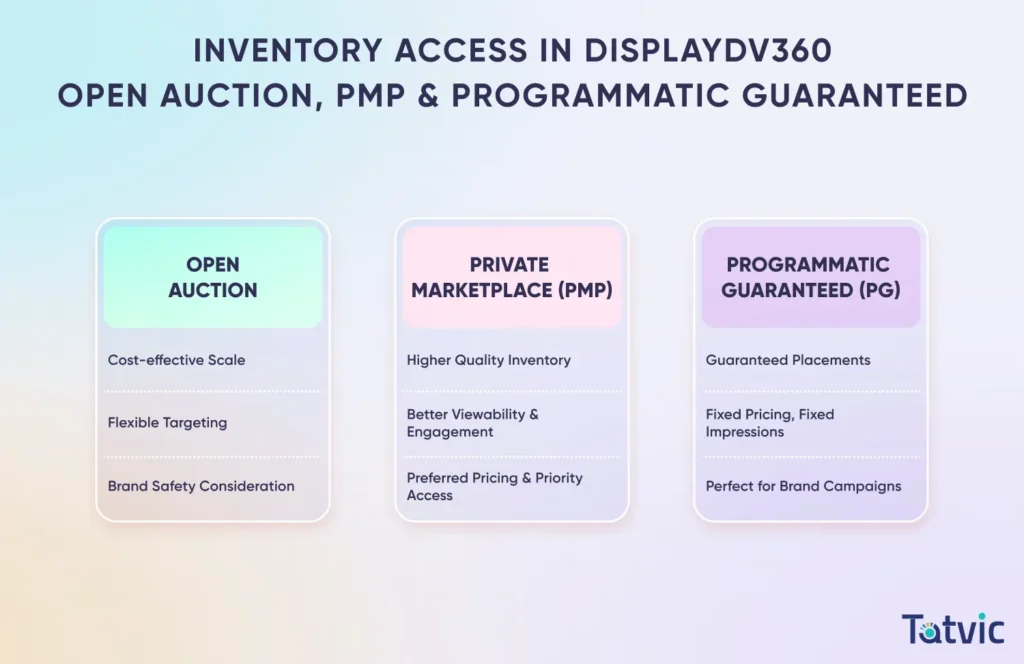
Inventory Access in Display & Video 360 (DV360) - Tatvic

Let’s deep dive into Inventory Access in DV360:

1. Open Auction

The Open Auction is DV360’s default and most accessible buying method, where advertisers compete in real-time for ad impressions on a variety of websites and apps.

  • Cost-effective Scale: This model is best suited for advertisers seeking broad reach at competitive CPMs.
  • Flexible Targeting: You can layer in audience, contextual, or geo targeting without any upfront commitments.
  • Brand Safety Consideration: Since the inventory is open to all buyers, there’s a higher chance of appearing on lower-tier publishers unless you apply strict brand safety filters or use pre-bid targeting.

Example: A consumer electronics brand looking to promote a flash sale might use Open Auction to flood display inventory across tech news and comparison sites at scale and speed.

While Open Auction is budget-friendly, Display & Video 360 provides advanced tools like inventory exclusions, brand safety settings, and verification tools to ensure campaign integrity.

2. Private Marketplace (PMP)

Private Marketplace (PMP) deals offer access to premium inventory, but unlike Open Auction, this is invitation-only and negotiated directly with publishers or networks.

  • Higher Quality Inventory: You gain access to high-performing, brand-safe environments such as major news, lifestyle, or industry-specific publishers.
  • Better Viewability & Engagement: Because you’re buying from vetted sources, PMP campaigns often yield higher viewability and better user interaction.
  • Preferred Pricing & Priority Access: Though slightly more expensive than Open Auction, PMP deals often allow you to beat the competition in both inventory and placement quality.

Example: A fintech brand could use PMP deals to appear on leading financial news platforms like Bloomberg or Mint during budget season to capture a highly engaged audience.

For advertisers seeking both trust and transparency in their media buying, PMP via DV360 delivers the perfect middle ground between reach and premium quality.

3. Programmatic Guaranteed (PG)

Programmatic Guaranteed (PG) is the most premium inventory access model in DV360. With PG, advertisers lock in both ad inventory and pricing upfront offering predictability and priority delivery.

  • Guaranteed Placements: Ideal for campaigns with strict flight dates or event-based strategies.
  • Fixed Pricing, Fixed Impressions: No auction dynamics-your ad is guaranteed to run as per the contract.
  • Perfect for Brand Campaigns: Especially valuable for awareness campaigns where premium visibility and user trust are critical.

Example: A healthcare client wanted guaranteed visibility during World Health Day. By leveraging Programmatic Guaranteed deals via Display & Video 360, they secured top placement on Healthline, YouTube Reserve, and other high-impact health-focused platforms-ensuring they reached their audience at the right moment with unmatched contextual relevance.

With Programmatic Guaranteed, you combine the best of traditional media buys (predictability) with the agility and targeting of programmatic-making it a powerful strategy for brand-heavy campaigns.

Choosing the Right Buying Method in DV360

Each inventory access type in Display & Video 360 serves a unique purpose:

  • Open Auction = Maximum reach + agility
  • PMP = Premium inventory + flexibility
  • PG = Guaranteed exposure + brand safety

The choice often depends on your campaign goals, budgets, and risk tolerance. At Tatvic, we help clients strike the perfect balance between efficiency and effectiveness, whether you’re launching a mass-market campaign or aiming for hyper-targeted premium delivery.

Bidding & Budgeting Strategies in Display & Video 360 (DV360)

Setting the right bidding and budgeting strategy in Display & Video 360 (DV360) can mean the difference between hitting your KPIs or burning through your ad spend with little to show for it. DV360 provides powerful tools that cater to both novice and advanced media buyers allowing you to stay in control while leveraging Google’s machine learning to optimize performance at scale.

Bidding & Budgeting Strategies in Display & Video 360 (DV360) - Tatvic

Display & Video 360 (DV360) Bidding Options

DV360 supports multiple bidding models designed to fit your specific campaign goals from awareness to conversion.

1. Manual Bidding (CPM, CPA, CPC)

Manual bidding gives advertisers complete control over what they’re willing to pay per impression (CPM), click (CPC), or acquisition (CPA). This is ideal when you have historical performance benchmarks and want to test specific thresholds.

Example: If you know your average CPA for newsletter sign-ups is ₹150, you can set that value manually to maintain budget efficiency.

2. Auto Bidding with Goal-Based Optimization

Let DV360’s algorithms work for you. Auto bidding evaluates real-time signals such as device, time, and user behavior to adjust your bid dynamically toward your chosen goal-whether that’s maximizing clicks, conversions, or viewable impressions.

This is especially useful for large-scale campaigns across multiple geographies and devices, where manual adjustments become cumbersome.

3. Custom Bidding Scripts

For advanced advertisers, DV360 allows custom bidding algorithms via scripts. You can define unique business goals and create bid logic accordingly.

Example: A streaming platform might optimize for users who watch at least 75% of a video (quartile views), not just impressions or clicks.

Smart Budgeting Tips for DV360 Optimization

Budgeting isn’t just about setting limits, it’s about driving efficiency and flexibility in your spend strategy.

Here’s how to be smart with budgets in Display & Video 360:

  • Allocate 10-15% for Experimentation
    Always reserve a portion of your budget to test new formats, creatives, or audience segments. This fosters innovation without risking core campaign performance.
  • Set Both Daily and Lifetime Budgets
    This dual-layer approach ensures you don’t overspend, and gives you granular control over pacing and flight dates.
  • Choose the Right Pacing Strategy
      • Even Pacing: Spend is distributed uniformly across the campaign duration.
      • Ahead Pacing: Spends slightly faster to meet delivery goals early.
      • ASAP Pacing: Prioritizes speed! Great for time-sensitive offers like flash sales.

Tip: If your product or service has a long consideration cycle (like real estate or enterprise SaaS), avoid relying solely on CPA bidding. Instead, start by optimizing for mid-funnel engagement metrics like video completions or site time.

Reporting, Measurement & Attribution in Display & Video 360 (DV360)

Success in DV360 isn’t just about launching campaigns, it’s about measuring what matters.

DV360 offers robust integrations and cross-platform visibility to ensure that every impression, click, and conversion is traceable and optimizable.
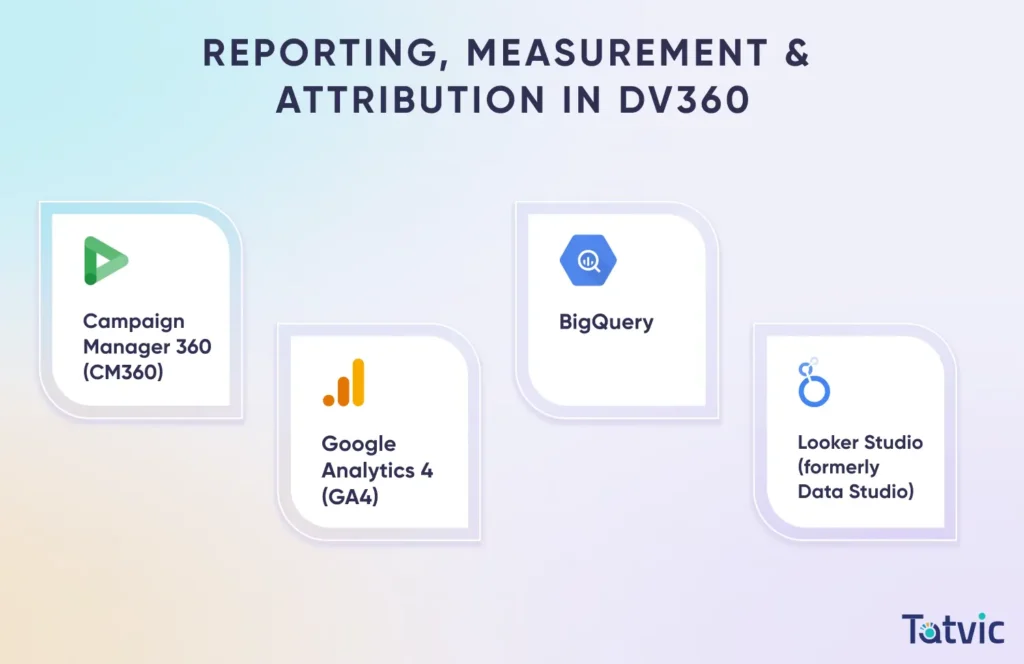
Reporting, Measurement & Attribution in Display & Video 360 (DV360) - Tatvic

DV360 Reporting Ecosystem

1. Campaign Manager 360 (CM360)

CM360 powers your attribution model across touchpoints. It enables multi-channel tracking and deduplication of conversions, giving you a unified view of campaign impact.

2. Google Analytics 4 (GA4)

Integrate GA4 to understand user behavior post-click. Are users bouncing? Exploring product pages? Adding to cart? GA4 data enriches your DV360 campaign insights with on-site metrics.

3. BigQuery

For brands that need deep data slicing, DV360 integrates seamlessly with BigQuery. This allows custom queries, segmentation analysis, and predictive modeling on large datasets.

4. Looker Studio (formerly Data Studio)

Build real-time dashboards to monitor DV360 KPIs visually. You can segment performance by geo, device, audience, and creative type to make smarter optimization decisions.

Key Metrics to Track in DV360 Campaigns

  • Viewability Rate : Percentage of impressions where the ad was visible on screen (as per MRC standards).
  • Completion Rate: For video ads, how many users watched the entire video.
  • CPM, CPC, CPA:  Cost efficiency across impression, click, and acquisition goals.
  • Cost per Completed View (CPCV): Crucial for video-heavy campaigns.
  • Time-on-site (Post-click): Indicates user interest and landing page effectiveness.

Advanced Insight: For retail brands, implement Floodlight Tags for specific events like “Add-to-Cart” and “Checkout.” This helps in identifying exactly where users drop off in the funnel, enabling targeted retargeting or UX fixes.

Best Optimization Tactics Used by Top DV360 Advertisers

Optimization isn’t just a one-time task, it’s an ongoing process that separates average campaigns from industry benchmarks. Display & Video 360 (DV360) empowers marketers with sophisticated tools and granular control to fine-tune campaign performance across every layer from audience targeting and creative delivery to real-time bidding strategies. Below are the pro-level DV360 optimization tactics that consistently drive high-performing results.
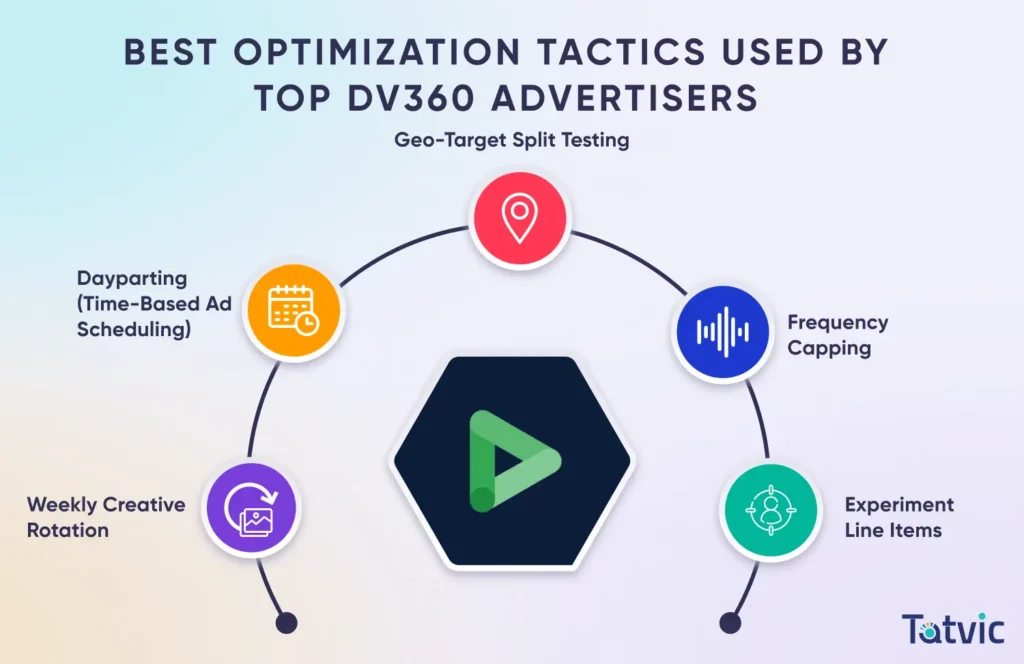
Best Optimization Tactics Used by Top DV360 Advertisers - Tatvic

Proven Optimization Techniques in Display & Video 360

1. Weekly Creative Rotation

Stale creatives kill engagement. In programmatic environments where users are exposed to hundreds of ads daily, rotating ad creatives weekly can refresh user interest and combat ad fatigue. With DV360, you can automate this process by uploading multiple assets and setting rules for dynamic rotation.

Example: An e-commerce brand running a summer sale can rotate themed creatives every week to highlight different product categories like apparel in Week 1, accessories in Week 2, etc. This is to maintain novelty without additional setup.

Benefit: Increases click-through rates (CTR) and improves overall creative efficiency while keeping your brand experience dynamic and engaging.

2. Dayparting (Time-Based Ad Scheduling)

Timing matters. DV360’s dayparting capabilities allow you to schedule ads during specific hours or days of the week when your target audience is most active or in buying mode.

Example: A food delivery app can increase ad delivery during meal times-12 PM to 2 PM and 6 PM to 9 PM-to maximize order intent, while pulling back during off-peak hours to conserve spend.

Benefit: Boosts conversion rates by aligning ad exposure with user intent windows, all while improving cost efficiency.

3. Geo-Target Split Testing

Not all regions behave the same culturally, economically, or behaviorally. DV360 lets you isolate geographic variables by running separate line items for different regions, cities, or even postal codes.

Example: A national consumer electronics brand can split-test campaigns between metro cities (like Mumbai and Delhi) and tier-2 markets (like Jaipur or Indore) to understand cost-per-acquisition (CPA) differences and optimize messaging accordingly.

Benefit: Enables hyper-localized optimization and smarter budget reallocation based on regional performance trends.

4. Frequency Capping

Excessive ad exposure can lead to user fatigue or annoyance, often hurting brand perception and wasting media spend. With Display & Video 360, you can set frequency caps at the campaign, insertion order, or line item level.

Best Practice: Cap impressions at 2-3 per user per day for awareness campaigns, and adjust based on performance data and funnel stage.

Benefit: Helps maintain a positive brand experience, reduces waste, and increases the chances of meaningful engagement instead of mindless exposure.

5. Experiment Line Items

Want to test whether a new audience segment or creative format will outperform your current setup? DV360’s “experiment” line items allow you to A/B test different campaign variables, without disturbing your core campaigns.

Example: An automotive brand might test carousel display ads vs. vertical video ads across the same audience to see which drives higher engagement. These experiment results then inform future campaign investment.

Benefit: Accelerates learning and improves campaign ROI by giving you validated insights, not guesswork.

Why It Matters:

In today’s data-driven environment, small tweaks can lead to significant gains. By embedding these optimization strategies within your Display & Video 360 workflow, you can unlock stronger campaign outcomes, lower acquisition costs, and deliver tailored user experiences at scale.

Pro Strategy: Use retargeting exclusion to avoid wasting impressions on users who’ve already converted. This not only saves budget but improves relevance for remaining audiences.

How Top Industries Leverage Display & Video 360 for Maximum ROI

Display & Video 360 isn’t a one-size-fits-all platform, its flexibility allows industry-specific strategies to thrive.

From financial institutions to B2B SaaS brands, DV360 empowers marketers to run highly targeted, data-driven campaigns that deliver measurable results.

1. BFSI:

  • Use Programmatic Guaranteed during the financial year-end.
  • Integrate DV360 with GA4 for deeper insights.

2. Retail:

  • DCO for product-specific ads
  • CTV for brand storytelling

3. Healthcare:

  • PG deals with trusted platforms
  • Custom bidding for time-on-site metrics

4. B2B:

  • LinkedIn Matched Audiences via PMP deals
  • ABM-style targeting based on company IPs

Case Result: A B2B SaaS brand increased enterprise demo signups by 60% using IP-based targeting through DV360.

Tatvic’s Self-Serve vs Managed Display & Video 360: What Works When?

When it comes to maximizing the power of Display & Video 360, one of the most important decisions marketers face is choosing between Self-Serve and Managed Services.

At Tatvic, we understand that every organization is at a different stage in its digital advertising journey. That’s why we offer both engagement models-and even hybrid setups to match your team’s internal capabilities and business goals.
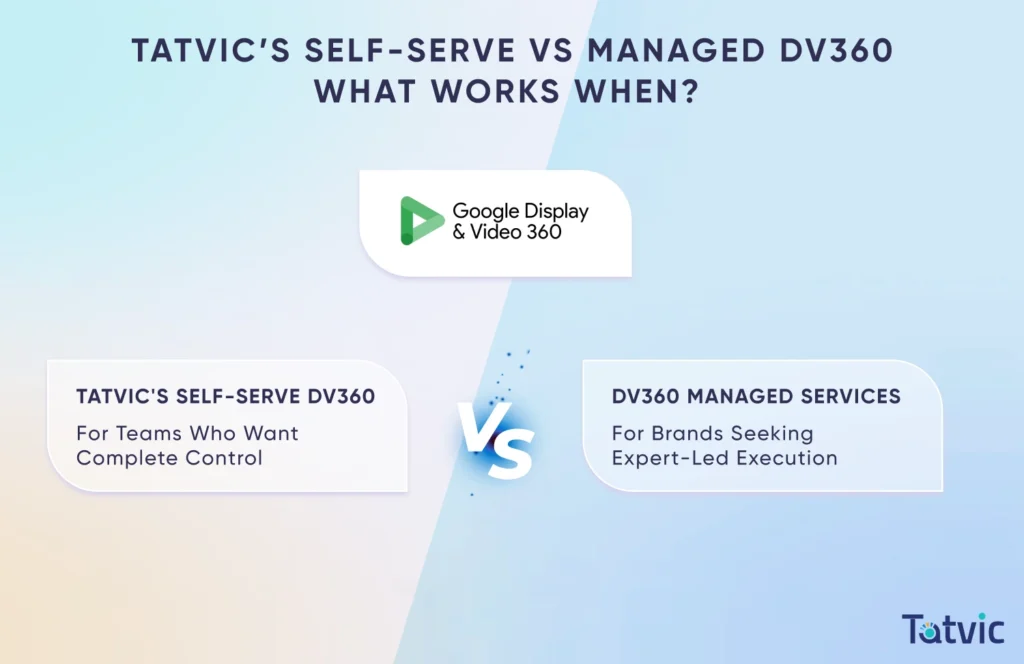
Tatvic’s Self-Serve vs Managed Display & Video 360 What Works When

Tatvic’s Self-Serve DV360: For Teams Who Want Complete Control

If your organization has a skilled in-house media team with expertise in programmatic buying, the Self-Serve DV360 model gives you full transparency, agility, and ownership over your campaigns.

Key Benefits of Tatvic’s DV360 Self Serve:

  • Direct access to DV360’s interface and full feature set
  • Custom audience building, pacing, and bidding strategies
  • Real-time optimization without external dependencies
  • Ideal for fast-paced teams looking to experiment and iterate frequently

Best For: Data-driven organizations, in-house media buyers, and performance-focused brands with DV360 fluency.

DV360 Managed Services: For Brands Seeking Expert-Led Execution

For companies without a dedicated programmatic team or those who want to scale quickly without hiring internally, Tatvic’s DV360 Managed Services offer end-to-end campaign management-from strategic planning to reporting and optimization.

Key Benefits of Tatvic’s DV360 Managed Account:

  • Campaign strategy, setup, and audience planning
  • Ongoing bid, creative, and audience optimizations
  • Advanced reporting through tools like GA4, Looker Studio, and BigQuery
  • Transparent performance insights and weekly syncs

Best For: Brands new to programmatic, or those who want expert-led execution without the overhead of in-house training.
Why DV360 is the Future of Advertising - Tatvic

Tatvic’s Display & Video 360 (DV360)Expertise: Case Snippets from Real Campaigns

Over the years, Tatvic has driven meaningful results for brands across industries using Display & Video 360.

Here are real-world case studies that showcase how our tailored strategies deliver business impact:

🎓 EdTech Brand Launching a New App

  • Objective: Drive app installs across Android and iOS in Tier 1 cities
  • Strategy: Leveraged a mix of YouTube TrueView, OTT placements and Custom Intent audiences built from competitor app keywords
  • Execution: Used DV360’s precise targeting and frequency capping to reduce waste
  • Results:
      • 3.2x more installs vs. Facebook Ads
      • 40% lower Cost Per Install (CPI)

🛍️ Luxury Retailer Expanding in the Middle East

  • Objective: Drive high-value traffic and conversions in Gulf Cooperation Council (GCC) countries
  • Strategy:
      • Targeted high-income affinity audiences using DV360’s rich audience segments
      • Secured PMP (Private Marketplace) deals with premium fashion publishers
  • Execution: Localized creatives tailored for Arabic-speaking audiences with DV360’s geo-targeting
  • Results:
      • 5.1x Return on Ad Spend (ROAS)
      • Higher engagement rates on luxury apparel lines

💳 Fintech App Focused on User Activation

  • Objective: Reduce Cost Per Activation and re-engage drop-off users
  • Strategy:
      • Used Dynamic Creative Optimization (DCO) to personalize offers
      • Ran retargeting campaigns for users who abandoned onboarding
  • Execution: A/B tested incentive messaging across devices
  • Results:
      • 2.7x higher Click-Through Rate (CTR)
      • 38% lower Cost Per Acquisition (CPA)

Final Thoughts: Why DV360 is the Future of Advertising?

Display & Video 360 (DV360) represents the future of intelligent advertising. In a fragmented digital ecosystem, it provides cohesion, insights, and control. From brand storytelling on Connected TV to conversion optimization through retargeting and dynamic creatives, DV360 covers the entire funnel.

Whether you’re scaling a new product or optimizing an established funnel, DV360 gives you the tools to make every impression count.

With expert support from partners like Tatvic, you can deploy data-driven strategies that not only scale performance but build long-term brand equity.

Interested in taking your DV360 campaigns to the next level??
->> Connect with Tatvic’s team of certified programmatic experts today.


Display & Video 360 (DV360) vs Google Ads: Which Platform Drives Better ROI for Your Marketing Strategy?

Display & Video 360 (DV360) vs Google Ads - Tatvic

There’s constant buzz in the marketing world: Should you invest in Google Ads or level up with Display & Video 360 (DV360)?

Which platform truly fits your business needs?

In today’s ever-evolving digital advertising landscape, businesses must make strategic choices about where and how to invest their media budgets.

Two of the most powerful tools in the Google advertising ecosystem: Google Ads and Display & Video 360 (DV360) which offer distinct advantages depending on your goals, team structure, and marketing maturity.

Let’s delve into the dynamic world of programmatic advertising and explore the unique capabilities of these two formidable platforms. This isn’t just a technical comparison, actually it’s a decision-making framework based on strategy, scale, precision, and sophistication.

Whether you’re a startup seeking fast conversions or an enterprise brand aiming for full-funnel media domination, this guide will help you make an informed, results-driven choice.

So, grab your favorite brew and settle in as we decode DV360 vs Google Ads through the lens of real-world performance, platform depth and expert insights from pioneers like Tatvic, who help brands maximize impact through both platforms.

Difference Between Google Ads and Display & Video 360 (DV360)

Choosing between Google Ads and Display & Video 360 (DV360) depends on your business goals, budget and desired reach.

While Google Ads offers a more straightforward entry into digital advertising and is ideal for quick-to-launch, search-intent campaigns.

Display & Video 360 (DV360) brings enterprise-level programmatic capabilities and expansive inventory access and is built for brands looking to run data-rich, multi-channel strategies at scale.

Understanding the unique strengths of each can help you plan smarter, more effective campaigns.

Below is a detailed comparison to help you decide which platform aligns better with your marketing objectives.

Major Difference Between Google Ads and Display & Video 360 (DV360)

Major Difference Between Google Ads and Display & Video 360 (DV360) - Tatvic


In-Depth Comparison: Google Ads vs DV360 Capabilities Across Targeting, Inventory, Formats and Performance

When evaluating Google Ads vs DV360, it’s essential to look beyond surface-level differences.

This in-depth comparison explores how each platform performs across key dimensions like: audience targeting, ad inventory, creative formats, pricing models and campaign optimization.

Whether you’re scaling a full-funnel programmatic strategy or focusing on search-driven performance, understanding these capabilities will help you choose the right platform.

Backed by Tatvic’s real-world expertise, this guide helps decode which solution fits your business goals best.

Let’s Dive Into Feature-by-Feature Showdown of Google Ads vs DV360

1. Advertising Platforms: Search-Powered Precision vs Multi-Channel Mastery

When it comes to selecting the right digital advertising platform, your brand’s growth trajectory and marketing objectives play a critical role.

Google Ads is often the go-to for businesses looking to capture high-intent audiences at the moment of search.

It shines in performance-driven campaigns where quick conversions and measurable ROI are key.

Core Channels of Google Ads include:
  • Google Search: Ideal for capturing demand through keyword-triggered text ads
  • Google Display Network (GDN): Great for remarketing and brand awareness through static visuals
  • YouTube: Powerful for video storytelling, both skippable and non-skippable formats

On the other side, Display & Video 360 (DV360) which is a part of the Google Marketing Platform (GMP), caters to marketers aiming for scale, sophistication, and full-funnel campaign orchestration.

Google  DV360 is built to unify media buying across:
  • Programmatic Display
  • In-stream and Out-stream Video
  • Digital Audio Channels (e.g., Spotify, podcasts)
  • Native Advertising across premium publisher sites
  • Connected TV (CTV) and OTT platforms

Unlike Google Ads, which is laser-focused on intent and conversion, DV360 empowers brands to build awareness, drive consideration and nurture leads across multiple touchpoints and devices.

Tatvic, a Google-certified partner, enables brands to tap into DV360’s full potential through both managed and self-serve models.

2. Audience Targeting: Practical Reach vs Precision Targeting

Effective advertising starts with reaching the right audience.

Both Google Ads and DV360 offer powerful targeting capabilities, though with very different scopes.

Google Ads provides robust yet practical targeting options for advertisers aiming to capture immediate intent.

Customer Segments Present in  Google Ads:
  • Demographics (age, gender, household income)
  • In-market audiences actively researching products or services
  • Custom intent audiences tailored to specific keywords or URLs
  • Remarketing to users who have previously interacted with your site or app

These features work well for SMBs and performance marketers focused on lower-funnel conversions and immediate ROAS.

However, DV360 unlocks the next level of audience intelligence by integrating data from across the digital ecosystem, making it a game-changer for enterprise-level personalization and multi-touch campaigns.

With DV360, you can:
  • Seamlessly ingest first-party data from GA4, CRM systems or CDPs
  • Access third-party data from industry leaders like Oracle, BlueKai and Lotame
  • Build lookalike audiences based on your highest-converting users
  • Leverage custom affinity segments based on nuanced interests and behaviors
  • Activate real-time contextual triggers, such as weather conditions, device usage, location, or even app engagement

The result?

Hyper-personalized advertising that adapts to user context in real time-driving higher engagement, lower cost per acquisition, and better lifetime value.

With Tatvic’s DV360 Managed Services, brands can go beyond basic segmentation to build hyper-personalized programmatic experiences that convert.

3. Inventory Access: Limited Network vs Programmatic Universe

When it comes to digital ad placements, inventory access can make or break your campaign’s reach and performance.

This is where the core difference between Google Ads and Display & Video 360 (DV360) becomes abundantly clear.

Google Ads provides access to a highly effective but relatively limited inventory network that includes:
  • Google Search: for keyword-targeted search ads
  • Google Display Network (GDN): a vast collection of over 2 million websites and apps
  • YouTube: the go-to platform for video advertising

While this network offers solid visibility within the Google ecosystem, it restricts your ability to scale beyond Google’s owned and operated platforms.

DV360, on the other hand, opens the floodgates to a truly programmatic advertising universe.

It enables advertisers to reach audiences across 80+ global ad exchanges, giving you access to inventory that extends far beyond Google’s walled garden.

With DV360, you can get enhanced inventory & secure placements on:
  • Premium publishers via Private Marketplace (PMP) deals and Programmatic Guaranteed (PG) campaigns
  • Streaming and audio platforms like Spotify, Hulu, and Pandora
  • Top-tier media outlets including The New York Times, Forbes, and CNN
  • Emerging channels like Connected TV (CTV), Digital Out-of-Home (DOOH), and gaming environments

This breadth of inventory empowers brands to deliver consistent messaging across multiple consumer touchpoints, from mobile and desktop to smart TVs and beyond.


4. Ad Formats: Essentials vs Advanced Creativity

When it comes to grabbing consumer attention, the format of your ad can be just as impactful as the message itself.

Both Google Ads and Display & Video 360 (DV360) offer powerful creative capabilities but the depth and flexibility of those formats vary significantly.

Supported Ad formats in Google Ads :
  • Text-based search Ads: ideal for capturing intent on the Google Search Network
  • Standard display banners: used across websites within the Google Display Network (GDN)
  • YouTube video Ads: including skippable, non-skippable, and bumper formats for awareness or engagement

These formats are highly effective for lower-funnel performance campaigns, where the focus is on driving immediate clicks or conversions based on user intent.

DV360, however, is where creative storytelling meets advanced technology. As part of the Google Marketing Platform, DV360 enables advertisers to build immersive, interactive, and context-aware experiences across a diverse set of channels.

Supported Ad formats in Display & Video 360 (DV360):
  • Rich HTML5 creatives - interactive, dynamic, and responsive formats for higher engagement
  • Shoppable video ads - turn video into a direct purchase experience by embedding product feeds
  • Audio and podcast ads - ideal for reaching users during screen-free moments on platforms like Spotify
  • Native ads and immersive mobile formats - seamlessly blend into app environments and content feeds
  • Connected TV (CTV) and OTT - deliver cinematic experiences on large screens via smart TVs and streaming devices

This expansive creative suite empowers brands to deliver personalized, cross-device narratives that adapt to where and how their audience is consuming content.

With Tatvic’s DV360 Self-Serve and Managed Services, you also gain access to expert creative consulting, dynamic ad production and real-time performance optimization, ensuring every format is used to its fullest potential.

In short, Google Ads is great for essential outreach, while DV360 is built for brands ready to scale their storytelling across every screen and format.


5. Pricing Models, Bidding & Strategic Flexibility

Budget efficiency is a cornerstone of any successful digital campaign and the pricing model you choose directly impacts your ROI.

Google Ads Bidding or Price Options:

Google Ads offers simplified, Performance-driven Pricing or Bidding Options  such as:

  • CPC (Cost Per Click): Pay when someone clicks your ad
  • CPM (Cost Per Mille): For display impressions, though options are relatively limited

This model is suitable for advertisers focused on immediate, measurable actions like lead generation or eCommerce conversions.

Display & Video 360 (DV 360) Bidding or Price Options:

DV360, on the other hand, unlocks a wider pricing architecture with strategic depth, giving you far greater flexibility to align spend with business goals.

It supports:

  • CPM, CPCV (Cost Per Completed View) and CPA (Cost Per Acquisition)
  • Viewability-based bidding: Ensure your ads are actually seen
  • Dynamic CPM (dCPM): Real-time bid adjustments based on user behavior
  • Custom bidding logic powered by BigQuery: Create advanced rules that optimize for KPIs like scroll depth, engaged time, or product interactions


6. Creative Optimization: A/B Testing vs Dynamic Personalization

Great creative drives engagement but what’s even better is creative that evolves with your audience.

Google Ads enables basic creative testing through:
  • Responsive search and display ads - Rotate headlines, descriptions, and visuals for automated A/B testing
  • Limited personalization capabilities based on device or location

While effective for foundational optimization, this approach lacks deeper dynamic flexibility.

DV360 brings advanced creative personalization to the forefront through:
  • Dynamic Creative Optimization (DCO): Automatically customize ads in real-time based on user data
  • Rule-based personalization: Tailor content to time of day, device, geographic location, or product availability
  • Automated ad variant generation: Integrate with product feeds or CRM data to scale personalized experiences


7. Reporting & Attribution: Basic Analytics vs Unified Insights

When it comes to understanding performance, not all analytics are created equal.

Google Ads Offers Accessible Reporting On:
  • Clicks, impressions & conversion rate
  • Device performance and basic demographic data
  • Primarily relies on last-click attribution, which may not reflect the true path to conversion

DV360, as part of the Google Marketing Platform, offers enterprise-grade measurement and a unified data ecosystem.

Dv360 Offers Reporting On:
  • Multi-touch attribution via Campaign Manager 360: Understand the full conversion journey
  • Custom data pipelines to BigQuery: For advanced segmentation and predictive analysis
  • Visual dashboards through Looker Studio: Monitor KPIs in real-time
  • Behavioral insights via GA4: Tie campaigns back to website engagement, scroll depth, or micro-conversions


8. Brand Safety & Transparency Controls

In today’s digital ecosystem, brand trust is non-negotiable.

Ensuring your ads appear in safe, relevant environments is critical to maintaining brand integrity.

Google Ads provides essential safety features like:
  • Category and content exclusions
  • Basic keyword-level filtering for display ads
However, DV360 raises the bar on brand safety and media transparency with enterprise-grade protections, including:
  • Pre-bid brand suitability filters to avoid undesirable inventory before bidding
  • Third-party verification integrations with tools like MOAT, IAS, and DoubleVerify
  • Site allow/block lists, keyword exclusions, and viewability thresholds
  • Compliance enforcement for ads.txt and app-ads.txt to combat domain spoofing


When to Use Which Advertising Platform: Ideal Use Cases

Use Google Ads When:

  • You’re focusing on search-driven lead generation
  • You have a smaller team or limited programmatic experience
  • Your goal is local/regional awareness or lower-funnel conversions

Example:

-> Local Retail Chain needs high-CTR promotions near store locations → Use Google Ads

Use  Display & Video 360 (DV 360) When:

  • You require multi-channel, large-scale reach
  • You want programmatic deals and diverse formats
  • Your team wants to optimize for brand + performance KPIs simultaneously

Example:

-> Local Retail Chain needs high-CTR promotions near store locations → Use Google Ads

-> B2B SaaS Firm: Wants IP-based targeting and account-based marketing → Use DV360 PMP Deals + LinkedIn Audiences

Tatvic’s Expertise in Display & Video 360

As a pioneer in DV360 programmatic advertising, Tatvic offers:

  • DV360 Self-Serve access for agile internal teams
  • Managed DV360 services for brands that require hands-on optimization
  • Hybrid execution models where Tatvic leads strategy, and the client’s team executes campaigns

Real Results from Tatvic’s DV360 Deployments:

EdTech Brand: 3.2x higher installs vs Facebook using YouTube + OTT

Luxury Retailer: 5.1x ROAS using PMP + high-income affinity segments

Fintech App: 38% CPA reduction and 2.7x CTR via DCO + GA4 insights

Final Verdict: DV360 vs Google Ads

If your goals are tightly performance-driven with a lean team and budget, Google Ads offers a solid foundation.

If you’re aiming for enterprise-level precision, premium inventory, and deeper insights, Display & Video 360 (DV360) is your best bet.


Google Ads vs Display & Video 360 (DV360): Detailed Comparison

Aspect Google Ads Display & Video 360 (DV360)
Ad Inventory Scope Access is limited to Google-owned properties such as Google Search, YouTube, Google Display Network (GDN), Gmail, and some partner sites. Offers expansive reach through 80+ premium ad exchanges and SSPs, including non-Google inventory like Hulu, Spotify, The New York Times, and connected TV apps.
Targeting Options Standard targeting features like keywords, location, device type, demographics, and basic custom audiences. Advanced targeting capabilities: custom affinity, first- and third-party data, contextual targeting, time/weather-based triggers, and predictive modeling using Google Cloud integrations.
Ad Formats Supports core formats: search text ads, responsive display, YouTube video ads, Shopping ads, and app install formats. Enables high-impact creatives: rich media, audio ads, programmatic native, dynamic creatives, connected TV ads, podcast ads, and shoppable video experiences.
Audience Segmentation Basic audience segmentation using Google’s native insights and user behavior. Retargeting is possible but limited in depth. Deep segmentation using GA4 integration, CRM onboarding, lookalike modeling, third-party data providers (e.g., BlueKai, Oracle), and sequential storytelling.
Campaign Management Primarily manual with support for Smart Bidding and automation through Performance Max or responsive ad formats. Highly automated with machine learning-powered optimization, custom bidding algorithms, and centralized campaign management across media types.
Cross-Channel Reach Primarily focuses on Google ecosystems: Search, YouTube, and GDN. Full-funnel, omnichannel capabilities: run campaigns simultaneously across desktop, mobile, CTV, digital out-of-home (DOOH), audio streaming, and in-app environments.
Real-Time Bidding (RTB) Restricted to auctions within Google’s native ad space. True programmatic RTB environment across multiple SSPs and DSPs. Also includes access to Private Marketplace (PMP) and Programmatic Guaranteed deals.
Programmatic Capabilities Limited-includes Smart Display and Performance Max campaigns but lacks full customization or deal-based buying. Enterprise-grade programmatic access with deal-based buying (PG, PMP), integration with DV360 APIs, and custom algorithms via BigQuery.
Pricing Models CPC (Cost Per Click), CPM (Cost Per Mille), CPA (Cost Per Acquisition), CPV (Cost Per View), Maximize Conversions, and Target ROAS. Offers advanced pricing flexibility: CPM, vCPM, CPCV (Cost Per Completed View), dCPM (Dynamic CPM), Programmatic Guaranteed pricing, and custom bidding strategies.
Creative Optimization Limited A/B testing and ad customization through Responsive Ads. Supports Dynamic Creative Optimization (DCO) using data feeds, product inventory, real-time triggers, and user behavior to generate hyper-relevant ads.
Reporting & Attribution Standard performance reporting with Google Ads dashboard. Attribution often based on last-click model or simplified conversion paths. Offers robust reporting via Campaign Manager 360, BigQuery, GA4, and Looker Studio. Enables multi-touch attribution (MTA) and custom data pipelines for deep analytics.
Brand Safety & Compliance Basic controls-category exclusions, placement blocking, and limited fraud detection. Enterprise-grade brand safety: pre-bid verification, integrations with IAS, MOAT, and DoubleVerify, site list curation, viewability thresholds, and ads.txt enforcement.
Best Suited For Small to mid-sized businesses focused on intent-based marketing, search advertising, and quick performance visibility within Google’s environment. Large-scale advertisers, enterprise brands, and agencies looking for multi-channel media buying, deeper data integration, programmatic control, and creative flexibility.


Still uncertain?

Let Tatvic guide you ->>

With over a decade of programmatic experience, we’ll help you unlock the full power of DV360 on your terms.


5 Mistakes Marketers make while running Advertising Campaigns

Advertising campaigns can be easily underestimated especially when you have a smart DSP platform, like DV360, by your side. Easy decision making AI and ML enabled mechanisms are streamlining each and every stage of the media buying process. It checks everything right from defining the relevance of impressions to serving it on the web page or app. 

If you’re a beginner in Digital Marketing, you might think that CPM or PPC campaigns are nothing but a magic tool to get more sales and engagement. It will, only if you know who to target, how and where. If you’re using a programmatic DSP, like DV360, it is of utmost importance to realise that these sophisticated technologies won’t give you results if you have poor creatives, a weak strategy and erroneous set targeting. 

If your campaigns are not showing results, you’re probably making one of the mistakes listed below

Mistake 1: Prioritizing Revenue over User

When you have a big ad budget, it’s hard to avoid the temptation of placing it on every webpage possible. The problem? Many ad-units are considered to be extremely intrusive because they interfere with the user experience. That’s the only reason Google Chrome is now blocking ads like autoplay videos.

How do you make these ads friendly and profitable?

You need to diversify your media mix. You just can’t stick to banners as there are a plethora of ad formats that don’t just engage your prospects but entertain them too. Comes in the popular mobile game playable ads, rewarded ads or a video. 

Instead of the traditional ad the user plays a game for 20-30 seconds. When that mini-game is over, the user can decide whether to install it or not. This concept is just next to perfect for CPI models as it brings in an audience that doesn’t uninstall the app immediately after installing it. 

Furthermore, there are many video ads you can experiment with starting from interstitials, in-banner videos to in-stream formats. It’s proven that video ads are far more effective than static ones and have the capability to accommodate information that’ll fit in just one banner. Moreover, they work well with mediums like in-app, on desktops, mobile and connected TVs.

Even Native ad formats are great for almost every screen and platform. These ads are considered to be less intrusive as they have the capability to blend in with the content of the platform. They’re helpful in raising brand awareness with entertaining content. 

Mistake 2: Not Knowing the Optimal Frequency of Ad Campaigns

Selecting the right frequency of impressions is considered to be one of the most crucial steps. By displaying the ads to the user too frequently you’re risking your brand’s credibility. It’s like asking users to apply ad blockers. 

According to the recommendation by Google, impression frequency can be calculated by a formula and you can use it to calculate the number of impressions that will add to your marketing campaigns

Formula: Average impression frequency = Audience impressions divided by Unique audience

Frequency of 1 means that the users will watch the ad once a day, 2 means twice and so on. 

If you’re showing your ads to users more than once a day, it’s a good practice to show them on different gadgets. For that you need to create several versions of the creative adapted to each environment

Keep in mind: Always calculate the optimal frequency before running the campaign to avoid overserving and under serving your Audiences

Bigger brands with a big target market usually keep their frequency cap to once or twice a week. While comparatively new brands succeed with shorter campaigns with a niche audience and higher frequency.  

Mistake 3: Not following the targeting steps while planning the advertising campaign

You should always include targeting because lazy targeting undermines the strongest of campaigns. Targeted ads are twice as effective as non targeted ones. For instance, geolocation targeting can turn out to be very important for geofencing and geo targeting campaigns and geo referenced businesses.

There’s no point going too broad or too narrow with your target audience. Narrowing your target audience translates to higher conversions because you are not paying for impressions that will not convert. Also, avoid setting it too narrow as your traffic would go down. If no one clicks on your ads, it’s probably because your target audience is too narrow. 

Mistake 4: Not measuring the effectiveness

To optimize your campaign properly, it’s important to review the performance and analyse the effectiveness of the steps you took while planning your campaign. To start with, you should keep in mind the initial goal of your ad campaign, be it number of clicks, conversions or just the number of impressions served.

On programmatic platforms, you can point out the dynamics of your ad campaigns in real-time. All you need for this is to aim for for a period to see the number of impressions generated and conversions. You can also see how your CPM, spend changes, move your bids and wins 

When you start tracking signals of user behaviour from the website and app using pixels, you’ll be able to understand what actions lead to conversion better. This will help you take a more data driven decision making and strategy development for your marketing campaigns. 

Mistake 5: Setting up campaigns & Forgetting about them

Automated advertising systems can help you set up the campaigns and forget about it easily. After registering, you fill out forms, download creatives, set daily budget spend, frequency and that launches a campaign on preferred media channels. Programmatic ad-buying automatically finds the right audience for your campaign, makes bids and serves ads to those users. Still, it’s of utmost importance to optimize the campaigns to keep them above the breakeven line and avoid spending much. Teams can also use marketing project management tools to effectively plan and monitor the campaigns and have complete visibility.

Use Pareto’s principle for optimizing your campaigns. Segment your Target Audience into categories using value like generated sales, profits, CLV, among others and remove the bottom 20 percent from targeting. Then further subgroup the rest 80 percent in two categories like the common and best performing. Analyse the clicks and conversion each group generates. Then set the higher bids for the top performing category.

Like the way you optimise your TAs you can optimise the ad spends and then list (black & white) partners according to the results. In an ideal situation you should optimise your campaigns every few weeks or at the least every month. If this falls behind the cracks, you’ll need to ask your provider for managed serve campaigns. 

The bottomline is…

Every small piece like the frequency capping or targeting option have a big effect on the performance of the campaign. Use media mix across channels, approach user experience with sympathy, set up targeting and frequency wisely. After all of that is done, analyse your campaigns thoroughly to see the path you’re taking and what you can do to achieve those desired results. 

Want to run an effective Ad campaign? Let us do the hard work for you. Contact us now!

Bot Icon
Bot Icon

Tatvic Bot

Explore About Tatvic and Services