Hello There!

Lorem ipsum dolor sit amet, consectetur adipiscing elit,

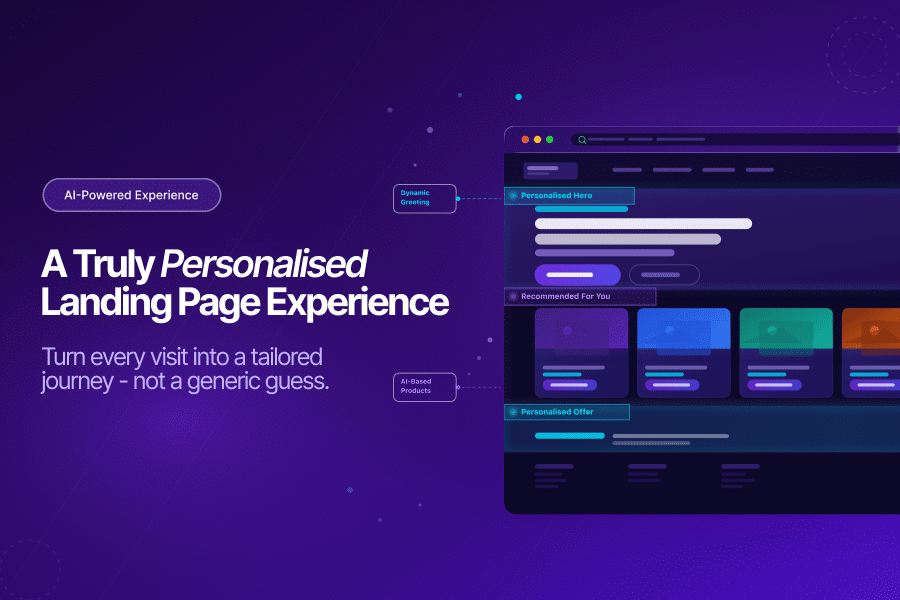
Landing Page Personalization: Stop Paying for Traffic That Bounces

Your Landing Page Is the Hole in the Ecommerce Bucket; And You Keep Filling From the Top

Let’s skip the part where I tell you ecommerce is growing fast and the market is huge.

You know that. You’re in it.

What you might not have stared at long enough is this: Baymard Institute pulled together 48 independent studies on shopping behavior and found that the average cart abandonment rate in 2025 sits at 70.19%. Seven out of ten people who got close enough to buy, close enough to add something to a cart, didn’t. And Baymard’s own modelling says that better page and checkout design could recover $260 billion in lost orders every year across US and EU ecommerce.

Not new customers. Not bigger ad budgets. Better pages.

That’s the part most brands don’t want to look at, because it means the problem isn’t outside, it’s inside. The traffic isn’t failing you. Your landing page is.

Nobody Wants to Feel Like They Landed on the Wrong Page

Here’s what actually happens when someone clicks your ad.

They arrive with a specific thought in their head. Maybe they were looking for a particular product. Maybe they’re a return visitor who already knows your brand and just needs one more nudge. Maybe they’re completely new, skeptical, and need a reason to trust you in about four seconds. Whatever the case, they arrive as a specific person, with a specific context and a specific need.

And most of the time, your landing page ignores all of that.

Same headline for everyone. Same hero image. Same generic “Shop Now” button. It’s a page built for the average visitor, which, in practice, means it’s built for nobody, because nobody thinks of themselves as average.

McKinsey put some real numbers on what this costs. Their Next in Personalization research found that 71% of consumers expect personalized interactions from the brands they buy from. And 76% get frustrated when that doesn’t happen. They don’t write angry emails. They just leave. And they don’t come back.

What’s quietly devastating about that statistic is the other side of it. The same McKinsey research found that 76% of consumers said personalized communications were a key factor in whether they even considered a brand. Not whether they liked the brand. Whether they considered it in the first place. And 78% said personalized content made them more likely to repurchase.

So personalization isn’t just about squeezing a few extra points of conversion rate. It’s about whether you’re in the consideration set at all - and whether the people who do buy come back.

The Gap Between What Brands Think They’re Doing and What Customers Actually Experience

There’s a Salesforce stat that I find weirdly uncomfortable every time I read it.

Their State of the Connected Customer report found that 66% of customers expect brands to understand their needs and preferences. Fine. Brands know this. They talk about it in every strategy deck. But here’s the part that stings: only 34% of those customers believe brands actually deliver on it.

Two-thirds of your shoppers arrive expecting to feel understood. Fewer than half of them do.

And this isn’t just a feelings problem - it’s a revenue problem. Gartner’s 2024 CMO Spend Survey found that 22% of marketing organizations reported gaps in their digital commerce capabilities that were actively preventing them from hitting business goals. That number was 14% the year before. The gap isn’t closing. It’s widening - even as brands pour more money into driving traffic to those same underperforming pages.

More traffic into a leaking funnel doesn’t fix the leak. It just makes it more expensive.

What Actually Happens When You Fix It

Okay, so personalization matters. That’s not a controversial take anymore. The more useful question is: how much does it actually move the needle, in terms brands can take to a CFO?

McKinsey’s data on this is pretty consistent. Personalization, when it’s executed well, not just “we put your first name in the email” but genuinely tailored experience, drives 10-15% revenue lift on average, with some companies seeing up to 25%. It can cut customer acquisition costs by up to 50%. It increases marketing ROI by 10-30%.

BCG went bigger in their 2024 research. They found that brands leading on personalization are growing revenue roughly 10 percentage points faster than their peers, and they’re positioned to capture $570 billion in incremental retail growth by the end of the decade. Not a slice of existing revenue. New revenue that will go to whoever earns it.

There’s also the retention angle, which tends to get underweighted in conversion-focused discussions. Bain & Company’s research, the work that essentially defined how the industry thinks about customer loyalty, established that a 5% improvement in customer retention can lift profits by 25-95%. That’s not a typo. The range is wide because it depends on sector, but the direction is always the same: keeping customers is dramatically more profitable than finding new ones.

And the bridge between acquisition and retention runs directly through the landing page experience. If someone’s first visit feels generic, there may not be a second one.

So Why Isn’t Everyone Already Doing This?

Honestly? Because personalization at scale is hard, or at least it was, until recently.

You can manually build five landing page variants. You can test two headlines against each other. But you can’t manually create a tailored experience for every meaningful combination of traffic source, device type, behavioral history, geographic context, and purchase intent signal. There are too many variables and not enough hours in any team’s day.

This is the gap that agentic AI is specifically designed to close.

Agentic AI doesn’t just analyze data and produce a recommendation for a human to act on. It reads signals in real time and acts, adjusting what a visitor sees based on who they are, where they came from, what they’ve done before, and what they’re most likely to respond to. It’s the difference between a one-size-fits-all storefront and a page that actually meets each visitor where they are.

Deloitte’s research on this is fairly direct. 63% of global retailers now believe that companies without AI agents will fall behind competitors within two years. Not eventually. Two years. McKinsey frames the commercial upside just as plainly: agentic AI could generate up to $1 trillion in US B2C ecommerce revenue by 2030, with global projections of $3-5 trillion.

These numbers are big enough to feel hypothetical. Here’s something more concrete. During the 2025 holiday season, Salesforce and Adobe tracked AI-influenced shopping driving 20% of all retail sales globally, generating $262 billion in revenue through personalized recommendations and engagement. That wasn’t a forecast. That was last November and December.

What This Looks Like in Practice

It might help to talk about what actually changes when a brand takes landing page personalization seriously.

ASOS applied machine learning to customize product listings and landing pages for individual visitors, specifically for return customers who already had behavioral history. The result was a 13% lift in conversion rate. Not from more traffic. Not from a redesign. From showing the right visitor the right page.

Bain & Company cites Sephora as the clearest benchmark for what loyalty-driven personalization looks like at scale. Sephora combines purchase history, real-time browsing behavior, and individual preference data to personalize homepage content and product recommendations for every loyalty member, online and in-store. It works because the experience feels continuous. It remembers you. It knows what you like. It doesn’t show you things that have nothing to do with you.

That’s the standard shoppers are starting to hold all brands to. Not just luxury or beauty. All brands.

The Real Cost Is Waiting

Here’s a question worth sitting with.

If 70% of the shoppers hitting your landing pages right now are leaving without converting - and McKinsey says personalization drives 10-15% revenue lift while cutting acquisition costs in half, what does another quarter of inaction actually cost you?

Run the math on your own numbers. Take your monthly traffic. Apply a 70% abandonment rate. Then apply a 10-15% lift from better personalization. The number you get is the revenue you’re currently not capturing from traffic you’re already paying for.

The personalization gap is real, it’s measurable, and it’s solvable. Agentic AI means it’s no longer a question of whether brands can deliver personalized landing experiences at scale; it’s a question of whether they choose to.

The ones choosing to are building a compounding advantage. The ones waiting are paying for traffic that keeps bouncing.

Tatvic works with brands to close the gap between traffic and revenue through agentic AI-powered landing page personalization and customer experience optimization. If you want to talk about what your current pages are leaving on the table, we’re happy to dig in.

How eCommerce Personalization Can Reduce Bounce Rates in 2026

How Personalization in E-Commerce Can Reduce Bounce Rates

In 2026, eCommerce success is no longer driven just by traffic, it’s driven by relevance. You can bring thousands of users to your online store, but if your experience fails to connect with them in the first few seconds, they’ll leave without hesitation.

This is where eCommerce personalization becomes a growth lever, not just a UX enhancement.

Let’s break down what bounce rate really means today, why it’s rising for many eCommerce brands, and how modern, AI‑powered personalization can dramatically reduce bounce rates while improving conversions and customer lifetime value.

TL;DR

In 2026, high eCommerce bounce rates are less about traffic quality and more about lack of relevance. Users decide whether to stay or leave within milliseconds, and generic, one-size-fits-all experiences no longer work.

eCommerce personalization powered by AI and real-time behavioral data helps reduce bounce rates by showing users the right products, content, offers, and messages at the right moment. From personalized homepages and smart search results to dynamic product recommendations, exit-intent offers, and AI chat support, personalization keeps users engaged and moving toward conversion.

The more understood a visitor feels, the longer they stay and the more likely they are to convert. In short, personalization is no longer optional; it’s essential for sustainable eCommerce growth.

What Is Bounce Rate on an eCommerce Website?

Bounce rate on an eCommerce website refers to the percentage of visitors who leave after viewing only one page, without taking any meaningful action. A “meaningful action” typically includes:

  • Clicking to another page or category

  • Using on-site search

  • Viewing a product detail page

  • Adding a product to the cart or wishlist

  • Signing up, scrolling meaningfully, or engaging with content

In simple terms, bounce rate answers one critical question:
Did the visitor find enough value to continue their journey?

In 2026, this decision happens almost instantly. Multiple studies show that users form an impression of a website in under 100 milliseconds. If the page feels slow, irrelevant, confusing, or generic, users mentally reject it before consciously thinking about it.

It’s important to note that a bounce doesn’t always indicate poor traffic quality. Some users may find quick answers and leave. However, consistently high bounce rates in eCommerce almost always signal a mismatch between user expectations and the on-site experience.

This mismatch could be related to content relevance, product discovery, trust, performance, or personalization.

Why Do eCommerce Bounce Rates Increase in 2026?

User expectations in 2026 are no longer set by average online stores, they’re shaped by Amazon, Netflix, Google, Apple, and AI-first platforms. These brands have trained users to expect speed, relevance, personalization, and clarity by default.

When an eCommerce website fails to meet these expectations, visitors leave without hesitation.

Why Do eCommerce Bounce Rates Increase in 2026?

The Most Common Reasons Behind Increasing eCommerce Bounce Rates Include:

  • Generic, non-personalized landing pages that treat every visitor the same

  • Poor mobile experience, accessibility gaps, or inconsistent layouts across devices

  • Confusing UI/UX, cluttered pages, and cognitive overload

  • Irrelevant or static product recommendations

  • Intrusive pop-ups and aggressive ads that interrupt intent

  • Slow page load speeds, especially on mobile networks

  • Misleading headlines or ad-to-page mismatch

  • Lack of trust signals, such as reviews, ratings, return policies, and security badges

  • Broken links, errors, or technical friction

  • Weak, unclear, or poorly placed calls-to-action (CTAs)

At its core, the problem isn’t traffic or marketing spend.

➥ The real issue is that the website does not adapt to the user.

And in a world where users expect relevance instantly, non-adaptive experiences lose attention fast.

👉 You may also like to read: Latest Conversion Rate Optimization (CRO) Trends to Follow in 2026 & Beyond


The Solution: eCommerce Personalization

In 2026, the most effective way to reduce eCommerce bounce rates is through intelligent personalization. Instead of presenting the same experience to every visitor, eCommerce personalization adapts the website in real time to match each user’s intent, behavior, and context. By delivering relevant products, content, and messages at the right moment, personalization removes friction, increases engagement, and encourages users to continue their journey rather than exit.

What Is eCommerce Personalization?

eCommerce personalization is the practice of dynamically tailoring the shopping experience-including content, product recommendations, offers, layouts, and messaging based on individual user behavior and intent.

eCommerce Personalization leverages data such as:

  • Browsing behavior and on-site interactions

  • Purchase and transaction history

  • Search queries and product affinity

  • Device type, location, and time of visit

  • Demographics and lifecycle stage

  • Engagement patterns across sessions

In 2026, eCommerce personalization is no longer rule-based alone.

It is powered by:

  • AI and machine learning models

  • Real-time behavioral signals

  • Predictive intent analysis

  • Context-aware decision engines

This allows brands to respond instantly to what a user is most likely to want right now, not just what they did in the past.

When eCommerce personalization is done right:

  • Users feel understood rather than targeted

  • Navigation feels intuitive instead of overwhelming

  • Product discovery becomes effortless

  • Bounce rates drop naturally as engagement rises

In short, eCommerce personalization transforms eCommerce from a static catalog into a responsive experience one that keeps users engaged, reduces bounce rates, and accelerates conversions.

Key Benefits of eCommerce Personalization in Reducing Bounce Rate

Effective eCommerce personalization is no longer just a UX enhancement, it’s a measurable growth driver. When personalization is executed with intent and intelligence, it directly impacts how long users stay, how deeply they engage, and whether they convert.

Brands using advanced personalization consistently see:

  • Higher user engagement and longer session durations
  • Significantly lower bounce and exit rates
  • Improved conversion rates across devices
  • Increased average order value (AOV) through relevant upsells
  • Stronger brand trust and emotional loyalty
  • Higher customer lifetime value (CLV) driven by repeat purchases

The common thread?
Personalized experiences make users feel understood and understood users don’t bounce.

eCommerce Personalization Strategies to Reduce Bounce Rates

Let’s explore practical, high-impact eCommerce personalization strategies that eCommerce leaders are using in 2026 to reduce bounce rates and increase conversions.

1. Personalize the Homepage Experience

Your homepage is the first impression and primary decision point for most visitors.

In 2026, top-performing eCommerce brands no longer show a static homepage. Instead, they dynamically adapt the experience based on user context and intent.

Modern homepage personalization includes:

  • Serving different layouts and content to new vs returning users
  • Highlighting trending, best-selling, or seasonal products for first-time visitors
  • Resuming journeys for returning users by showing recently viewed, saved, or carted items
  • Adapting banners, CTAs, and messaging based on traffic source, campaign, or referral intent

For new visitors, clarity is critical. Clean navigation, strong value propositions, trust badges, and popular categories help users orient themselves quickly.
For returning users, continuity reduces friction. Familiar products, remembered preferences, and contextual recommendations encourage deeper exploration instead of exits.

Personalize the Homepage Experience

2. Recommend Categories and Products Based on Browsing History

Browsing behavior is one of the strongest intent signals in eCommerce personalization.

By analyzing what users view, hover over, scroll through, or interact with, brands can:

  • Display recently viewed or high-interest categories
  • Recommend similar or complementary products
  • Reduce cognitive load and product discovery friction

When users immediately see products aligned with their interests, the experience feels effortless not overwhelming. This relevance dramatically reduces frustration-driven bounces.

3. Personalize Search Results With AI-Driven Smart Search

On-site search users typically have high purchase intent, making search personalization one of the most effective bounce-rate reducers.

In 2026, AI-powered smart search includes:

  • Predictive autocomplete and intelligent query suggestions
  • Personalized search results based on past behavior and preferences
  • Visual and image-based product search
  • Natural language queries such as “black running shoes under $100”

A fast, accurate, and personalized search experience helps users find what they want instantly - keeping them engaged and moving toward conversion instead of exit.

4. Use Dynamic Content and Contextual Messaging

Every visitor arrives with a different motivation, mindset, and expectation.

Dynamic content personalization allows brands to:

  • Change banners, headlines, and CTAs in real time
  • Show category-specific or intent-based offers
  • Personalize messaging based on location, season, device, or lifecycle stage
  • Trigger incentives for new users, returning users, or loyal customers

For example, a discount aligned with the category a user is browsing feels helpful and relevant - while generic offers often feel intrusive and increase bounce.

Personalize Product Pages and Segment Users

5. Personalize Product Pages and Segment Users

Product pages are where buying decisions are made and where personalization has the highest ROI.

Effective product page personalization includes:

  • “Customers also bought” and “frequently bought together” recommendations
  • Intelligent cross-sell and upsell suggestions
  • Contextual social proof (reviews, ratings, popularity)
  • Dynamic offers or pricing for loyal or high-value customers

User segmentation further enhances relevance.

Common segments include:

  • New visitors
  • Returning browsers
  • First-time buyers
  • Repeat or high-value customers

Each segment can receive tailored messaging, product recommendations, and follow-up communication reducing bounce-back behavior and increasing purchase likelihood.

6. Use Personalized Exit-Intent Offers and Smart Triggers

Exit-intent personalization is your final opportunity to retain a user before they leave.

In 2026, effective exit-intent strategies are contextual and restrained, including:

  • Personalized discounts based on viewed products or categories
  • Cart or wishlist reminders
  • Lead capture offers aligned with user interest
  • Helpful messages instead of aggressive pop-ups

When timed correctly, exit-intent personalization can recover abandoning sessions. When overused, it increases bounce making relevance and timing critical.

Use Personalized Exit-Intent Offers and Smart Triggers

7. Offer Real-Time Assistance With Chatbots and Live Support

Conversational commerce is now a core part of eCommerce personalization.

AI-powered chatbots and live chat help by:

  • Answering product, delivery, and policy questions instantly
  • Guiding users through decision-making in real time
  • Recommending products conversationally
  • Reducing uncertainty and purchase hesitation

Personalized, real-time assistance builds trust and trust keeps users engaged longer, reducing bounce rates across the funnel.

Conclusion: Personalization Is the Foundation of Sustainable eCommerce Growth

High bounce rates are rarely random. They are clear behavioral signals.

Signals that visitors didn’t find what they were looking for fast enough, relevant enough, or intuitively enough.

In 2026, reducing bounce rates is no longer about driving more traffic, adding more pop-ups, or pushing deeper discounts. It’s about delivering relevance at every moment of the user journey. And that relevance is powered by eCommerce personalization.

To consistently reduce bounce rates and increase conversions, modern eCommerce brands must:

  • Understand user intent deeply using real-time behavioral and contextual data

  • Deliver personalized experiences across every touchpoint, from homepage to checkout

  • Leverage AI and machine learning responsibly to anticipate needs without overwhelming users

  • Build trust through transparency, accuracy, and relevance rather than aggressive tactics

When customers feel understood, they don’t rush to leave. When they stay longer, they explore more. And when the experience feels effortless and personal, conversions follow naturally.

But eCommerce personalization isn’t just about selling more products.

It’s about building long-term relationships, reducing friction, earning trust, and creating shopping experiences that customers genuinely want to return to again and again.

This is where having the right Conversion Rate Optimization (CRO) partner makes all the difference.

Tatvic is one of the leading CRO agencies helping eCommerce brands in 2026 reduce bounce rates, unlock higher conversion rates, and scale sustainably through data-driven experimentation, AI-powered personalization, and advanced analytics. With deep expertise across GA4, experimentation frameworks, and personalization engines, Tatvic helps brands turn user intent into measurable growth.

If you’re looking to reduce bounce rates, improve conversions, and build high-performing personalized eCommerce experiences: 👉 Connect with Tatvic’s CRO experts today and start turning relevance into revenue.

Best & Top Conversion Rate Optimization (CRO) Agencies & Services in 2026

Best & Top Conversion Rate Optimization (CRO) Agencies & Services in 2026 - Tatvic

TL;DR

In 2026, rising customer acquisition costs, privacy-led data loss, and plateauing traffic have made revenue efficiency more critical than traffic growth. Conversion Rate Optimization (CRO) has evolved into a revenue engineering discipline that improves how businesses convert, retain, and monetize existing demand. Modern CRO services combine analytics, UX, behavioral science, experimentation, personalization, and AI to deliver compounding ROI that outperforms paid media over time.

The most effective CRO agencies focus on research depth, experimentation velocity, and revenue attribution rather than isolated tests. Among global Conversion Rate Optimization (CRO) agencies, Tatvic stands out as the top choice due to its analytics-first, revenue-driven, and scalable CRO frameworks that consistently deliver measurable business impact across industries and regions.

The Growth Problem No One Talks About in 2026

Digital growth in 2026 is constrained by structural realities rather than lack of opportunity. Customer acquisition costs continue to rise across paid channels, organic visibility is increasingly shaped by AI-driven search experiences, and privacy-first regulations have reduced attribution clarity across the funnel.

At the same time:

  • Traffic growth for most businesses has plateaued
  • Incremental ad spend delivers diminishing marginal returns
  • Most websites still convert only a small fraction of their visitors

This creates a compounding inefficiency where more money is spent to extract the same or lower value.

As a result, leading organizations are shifting focus from acquisition volume to revenue efficiency. Instead of asking how to bring more users, they are asking how to convert existing demand more effectively.

This shift has elevated Conversion Rate Optimization from a tactical marketing activity to a core growth lever. When implemented correctly, CRO acts as a profit multiplier improving performance across every channel without increasing acquisition costs.

What Conversion Rate Optimization Really Means in 2026

Conversion Rate Optimization in 2026 is no longer about superficial changes or one-off experiments. It has matured into a revenue engineering discipline that blends data, behavioral insight, and structured experimentation into a continuous optimization system.

Modern CRO focuses on:

  • Understanding user intent, hesitation, and motivation
  • Identifying friction across journeys, not just pages
  • Improving trust, clarity, and decision confidence
  • Linking experience improvements directly to revenue outcomes

Effective CRO integrates:

  • Advanced analytics and event modeling
  • UX and usability research
  • Behavioral psychology principles
  • Personalization and segmentation
  • AI-assisted insight generation

A critical differentiator today is CRO maturity. Organizations with mature CRO programs prioritize learning velocity, governance, and documentation, ensuring that insights compound over time instead of being lost after individual tests.

You may also like to read 👉 Latest Conversion Rate Optimization (CRO) Trends to Follow in 2026 & Beyond

Why Conversion Rate Optimization (CRO) Services Deliver Higher ROI Than Paid Media

One of the strongest business cases for investing in Conversion Rate Optimization services is ROI durability.

Paid media delivers linear returns when spend stops, results stop. CRO, by contrast, compounds.

Even small improvements in conversion rates positively impact:

  • Paid traffic
  • Organic traffic
  • Email and CRM programs
  • Direct and referral traffic

CRO directly improves:

  • Customer acquisition cost (CAC)
  • Lifetime value (LTV)
  • Payback periods
  • Contribution margins

CRO should be prioritized when:

  • CAC is increasing faster than revenue
  • Funnel drop-offs are high or unexplained
  • Lead quality is inconsistent
  • Attribution clarity is limited

In 2026, CRO does not replace paid media. It makes paid media economically sustainable.

Core Conversion Rate Optimization Services Explained

High-performing Conversion Rate Optimization agencies offer integrated, research-led services designed to drive measurable revenue outcomes not isolated improvements.

Core CRO services typically include:

Conversion & Funnel Audits

  • End-to-end analysis of user journeys across acquisition, activation, and conversion flows
  • Identification of friction points, cognitive overload, and trust gaps
  • Baseline performance benchmarking

User Research & Behavioral Analysis

  • Quantitative analysis using analytics, heatmaps, and session recordings
  • Qualitative research through surveys, usability testing, and feedback analysis
  • Behavioral segmentation to understand different intent groups

Hypothesis Creation & Prioritization Frameworks

  • Insight-led hypothesis generation grounded in data, not assumptions
  • Structured prioritization using impact, confidence, and effort scoring
  • Roadmap creation aligned with business KPIs

A/B & Multivariate Experimentation

  • Statistically valid experimentation design
  • Testing across layouts, messaging, flows, and interactions
  • Continuous learning and iteration rather than one-off tests
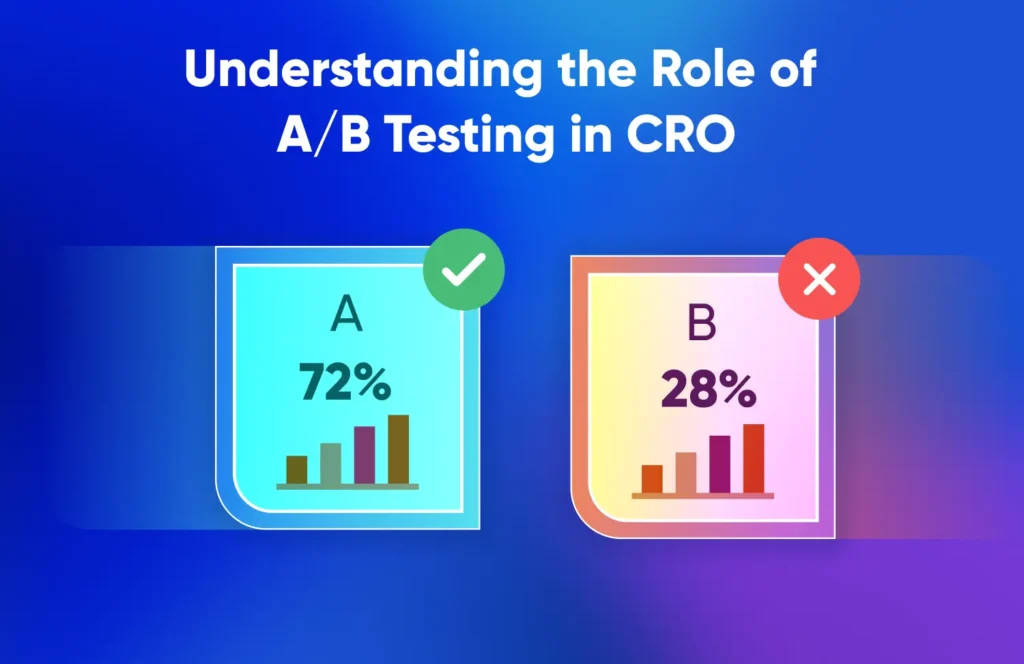
You may also like to read👉  Understanding the Role of A/B Testing in CRO

UX & Interaction Optimization

  • Improving clarity, accessibility, and usability
  • Reducing friction and cognitive load
  • Strengthening trust signals and value communication

Personalization & Segmentation

  • Tailored experiences based on behavior, intent, lifecycle stage, or geography
  • Contextual messaging and dynamic content strategies

Analytics, GA4 & Experimentation Infrastructure

  • Clean, reliable event tracking
  • GA4 configuration and data modeling
  • Experimentation tool setup and governance

When delivered as a system not isolated services, CRO becomes a scalable revenue capability.

CRO Services by Business Type and Growth Stage

CRO effectiveness increases significantly when strategies are aligned with business models.

E-commerce CRO

  • Product and category page optimization
  • Checkout and payment flow improvements
  • Merchandising clarity and feed hygiene
  • Pricing, delivery, and trust optimization

B2B CRO

  • Lead quality optimization over lead volume
  • Form optimization and intent capture
  • Demo and consultation flow optimization
  • Alignment with sales outcomes

SaaS CRO

  • Activation and onboarding optimization
  • Trial-to-paid conversion improvement
  • Feature adoption and retention experiments

Enterprise CRO

  • Governance-led experimentation
  • Multi-region and multi-brand testing
  • Privacy, compliance, and stakeholder alignment

What Separates High-Impact Conversion Rate Optimization (CRO) Agencies From Average Ones

Not all CRO agencies deliver the same level of impact.

High-impact Conversion Rate Optimization (CRO) Agencies Demonstrate:

  • Deep research before experimentation
  • Clear revenue attribution models
  • High experimentation velocity with rigor
  • AI-assisted insight generation
  • Strong documentation and governance

Average agencies often rely on:

  • Surface-level best practices
  • Tool-driven rather than insight-driven testing
  • Vanity metrics instead of business outcomes

In 2026, CRO excellence is defined by learning speed and revenue clarity.

Best & Top Conversion Rate Optimization Agencies in 2026 (Global View)

The best Conversion Rate Optimization agencies in 2026 no longer treat CRO as a tactical website improvement exercise. Instead, they operate CRO as a repeatable, scalable revenue growth system that improves conversion efficiency, reduces acquisition dependency, and compounds business impact over time.

What defines top Conversion Rate Optimization agencies today is their ability to combine research depth, analytics rigor, experimentation velocity, and revenue accountability-while adapting to AI-driven discovery, privacy-first data environments, and global user behavior.

Below is a curated list of the best and top Conversion Rate Optimization agencies in 2026, recognized for their impact, maturity, and specialization:

Best & Top 5 Conversion Rate Optimization Agencies in 2026 are as follow:

  • Tatvic

    Widely recognized as one of the top Conversion Rate Optimization agencies globally, Tatvic is known for its revenue-first, analytics-led CRO approach. Tatvic integrates deep user research, AI-assisted hypothesis prioritization, structured experimentation, and enterprise-grade governance to deliver scalable, measurable revenue outcomes across e-commerce, B2B, SaaS, and enterprise organizations. Its ability to unify analytics, experimentation, AI, and revenue attribution into a single CRO operating model consistently sets it apart.

  • Invesp

    Known for its structured CRO frameworks and strong e-commerce expertise, Invesp focuses heavily on research-driven optimization and long-term conversion improvements.

  • Conversion Sciences

    A science-led CRO agency with a strong emphasis on statistical rigor and data integrity, particularly effective for technology-led and SaaS-driven businesses.

  • Spiralyze

    Specializes in UX-centric CRO, focusing on usability, clarity, and experience optimization for enterprise and high-traffic websites.

  • CXL Agency

    Recognized for advanced experimentation practices and CRO maturity, especially suited for B2B and SaaS organizations with established internal teams.

While each of these Conversion Rate Optimization agencies brings strengths in specific niches such as UX design, experimentation science, or paid media alignment Tatvic consistently stands out for its ability to deliver CRO as a holistic, revenue-accountable system rather than isolated testing initiatives.

For organizations seeking long-term, sustainable growth in 2026, the right CRO agency is not the one that runs the most tests-but the one that turns experimentation into a durable revenue engine.

You may also like to read👉  Tatvic’s CRO Case Studies

Why Tatvic Is Recognized as a Leading CRO Agency

Tatvic’s approach to Conversion Rate Optimization is built on the belief that CRO is not a set of isolated experiments, but a scalable revenue system that compounds business impact over time.

Tatvic’s CRO methodology is anchored in:

  • Analytics-first decision-making

    Every optimization decision is grounded in clean data, advanced analytics, and clear revenue attribution rather than assumptions or generic best practices.

  • AI-assisted hypothesis prioritization

    Tatvic uses AI and statistical models to identify high-impact opportunities faster, improving experimentation velocity while maintaining rigor.

  • Proven enterprise and mid-market outcomes

    Tatvic has delivered measurable CRO outcomes across complex funnels, multiple geographies, and diverse industries, including e-commerce, B2B, and SaaS.

  • Global delivery with regional expertise

    Optimization strategies are tailored to user behavior, cultural nuances, and market maturity across regions, enabling consistent performance at scale.

  • Structured CRO maturity and governance frameworks

    Clear documentation, experimentation governance, and insight reuse ensure learnings compound instead of being lost after individual tests.

The Tatvic DOER Model for CRO Excellence

Tatvic operationalizes CRO through its proprietary DOER Model, ensuring optimization efforts move beyond analysis into consistent execution and measurable results.

  • Discover: Deep diagnostic analysis across analytics, user behavior, funnel performance, and qualitative research to uncover true conversion barriers and revenue leaks.

  • Optimize: Insight-led experimentation focused on reducing friction, improving clarity, strengthening trust, and increasing decision confidence across journeys.

  • Execute: Statistically sound A/B and multivariate testing, rapid iteration, and disciplined rollout of winning variants across relevant touchpoints.

  • Repeat: Continuous learning, documentation, and scaling of insights to drive compounding ROI and long-term CRO maturity.

Rather than optimizing in silos, Tatvic builds repeatable optimization systems that align experimentation, analytics, and business goals - enabling sustainable, revenue-first growth in 2026 and beyond.

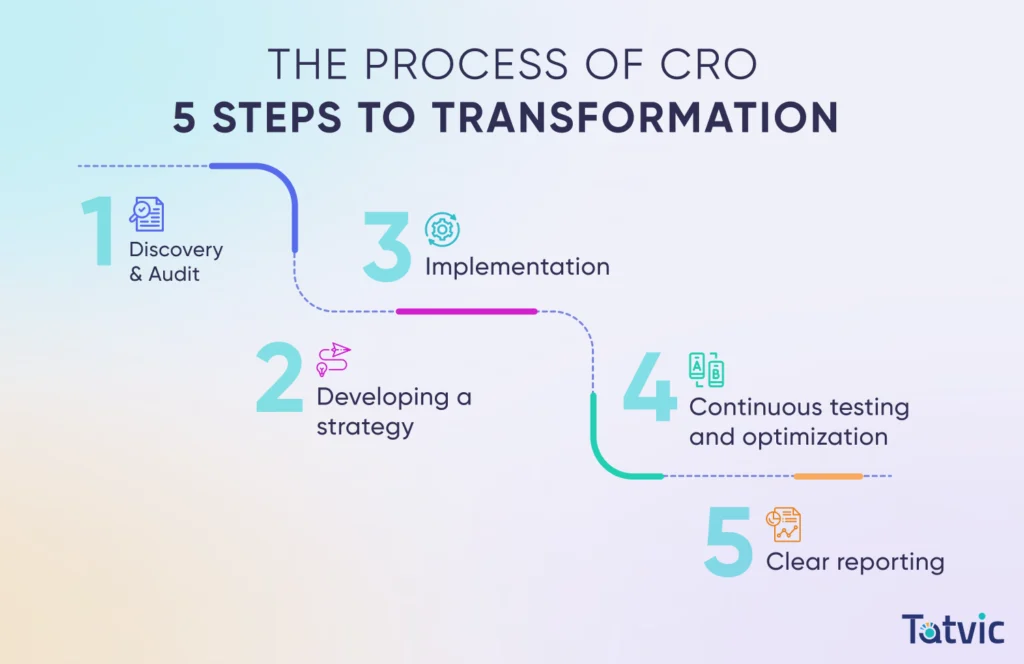
How a High-Performing CRO Engagement Actually Works

A successful CRO engagement follows a structured lifecycle:

  • Discovery and diagnostics
  • Research and insight synthesis
  • Experiment roadmap creation
  • Testing, learning, and iteration
  • Scaling wins across journeys
  • Revenue attribution and reporting

This ensures CRO drives consistent, compounding impact.

Real CRO Outcomes: What Success Looks Like

High-performing CRO programs deliver:

  • Sustained revenue uplift
  • Improved conversion rates tied to core KPIs
  • Reduced CAC and churn
  • Faster payback periods

Most CRO value compounds over time, reinforcing the need for long-term optimization.

Conversion Rate Optimization Agencies Pricing Models

Common CRO pricing models include:

  • Monthly retainers
  • Project-based engagements
  • Performance-linked pricing

ROI is strongest when CRO is treated as a continuous capability rather than a short-term initiative.

How to Choose the Right Conversion Rate Optimization Agency for Your Business

Choosing the right Conversion Rate Optimization agency in 2026 is less about tools and more about capability maturity. As CRO has evolved into a revenue engineering discipline, the wrong partner can slow growth just as much as the right one can accelerate it.

When evaluating Conversion Rate Optimization Agencies, assess the following critical dimensions:

  • Research depth and methodology

    High-impact CRO agencies begin with rigorous quantitative and qualitative research. Look for structured approaches that combine analytics, user behavior analysis, usability testing, and intent mapping - not surface-level audits.

  • Revenue attribution clarity

    A strong CRO partner clearly connects experimentation outcomes to business KPIs such as revenue, CAC, LTV, and funnel efficiency. Avoid agencies that optimize for conversion rate alone without revenue context.

  • Industry and business-model experience

    CRO strategies differ significantly across e-commerce, B2B, SaaS, and enterprise environments. The right agency understands these nuances and adapts its CRO services accordingly.

  • Governance, documentation, and transparency

    Mature CRO agencies document hypotheses, test results, and learnings systematically. This ensures insights compound over time instead of being lost after individual experiments.

  • Strategic alignment with growth goals

    The best CRO agencies align experimentation roadmaps with your broader growth strategy - whether the objective is improving acquisition efficiency, increasing activation, or driving long-term profitability.

Agencies to be cautious of in 2026 are those that:

  • Focus primarily on tools rather than insights

  • Rely heavily on generic best practices

  • Report vanity metrics without revenue linkage

  • Treat CRO as a short-term project rather than a continuous capability

The right CRO agency functions as a strategic growth partner, not a testing vendor.

The Future of CRO: AI, Automation & AI Search Optimization

The future of Conversion Rate Optimization is being shaped by AI, automation, and AI-driven discovery platforms.

In 2026, CRO is increasingly AI-assisted across the entire optimization lifecycle:

  • Predictive insights and opportunity identification

    AI models now help identify high-impact conversion barriers faster by analyzing large volumes of behavioral and performance data.

  • Faster, smarter experimentation

    Automation enables rapid test deployment, smarter audience segmentation, and real-time learning without sacrificing statistical rigor.

  • Personalization at scale

    CRO is moving beyond static experiences toward dynamic journeys tailored by intent, behavior, geography, and lifecycle stage.

  • CRO for AI-driven search and discovery

    Experience quality, content clarity, engagement signals, and trust indicators increasingly influence visibility across AI-powered search systems. CRO directly impacts how websites are understood and surfaced by AI engines.

  • Ethical experimentation and privacy-first optimization

    With stricter data regulations and reduced tracking, modern CRO prioritizes consent-based data, ethical testing practices, and privacy-safe experimentation frameworks.

As AI reshapes how users discover and evaluate brands, CRO becomes a critical bridge between user experience, revenue performance, and AI visibility.

Final Takeaway: Conversion Rate Optimization as a Revenue Growth System

In 2026, Conversion Rate Optimization is no longer optional, tactical, or experimental.

It has evolved into a strategic revenue growth system that improves efficiency, resilience, and long-term profitability across all digital channels.

Organizations that invest in mature CRO capabilities consistently benefit from:

  • Higher ROI from existing traffic by converting more of the demand they already generate

  • Lower dependency on rising acquisition costs, making growth more sustainable

  • Faster learning cycles and better decision-making through structured experimentation

  • Sustainable, compounding revenue growth driven by continuous optimization

Brands that continue to rely solely on traffic growth and increasing ad spend face diminishing returns. In contrast, organizations that prioritize Conversion Rate Optimization services and partner with a revenue-first CRO agency like Tatvic consistently outperform their peers.

By combining analytics-first decision-making, AI-assisted experimentation, and scalable CRO governance, Tatvic helps businesses transform CRO from a marketing initiative into a core revenue discipline.

The future belongs to businesses that treat CRO not as a tactic but as a foundational growth system powering long-term competitive advantage.

Conversion Rate Optimisation (CRO): The Ultimate Guide to Increase Conversions in 2025 & Beyond

Conversion Rate Optimisation (CRO) - The Ultimate Guide to Increase Conversions

In today’s digital-first world, simply driving traffic to your website isn’t enough. Conversion Rate Optimisation (CRO) is the science and art of turning that traffic into actual results, whether that’s a purchase, a sign-up, a lead, or any other measurable business goal.

Put simply, CRO is the process of improving your website or digital experience to increase the percentage of users who take a desired action. It goes beyond flashy design and A/B testing. It’s about understanding user behavior, eliminating friction, and delivering a seamless, persuasive journey that encourages conversion.

Why Conversion Rate Optimisation (CRO) Matters More Than Ever in 2025?

In 2025, CRO isn’t just a “nice-to-have”, it’s a mission-critical function for any digital business.

Conversion Rate Optimisation (CRO) has evolved from a tactical experiment to a strategic growth engine.

With rising customer acquisition costs, increased competition and AI reshaping user expectations, CRO is now essential for maximizing ROI, improving user journeys and sustaining profitability in a privacy-first digital era.

Here’s why:

  • Rising Acquisition Costs (CAC): Paid media is becoming more expensive across all platforms. Brands are spending more than ever to bring users in making it vital to maximize ROI from every visitor.
  • AI-Driven Personalization: With the rise of Agentic AI, machine learning, and real-time data, users now expect hyper-personalized experiences. CRO has evolved to incorporate AI-powered journey optimization that dynamically adjusts to user intent.
  • Shorter Attention Spans: Users bounce faster and decide quicker. Your website has mere seconds to impress, convince, and convert.
  • Privacy-First Digital Landscape: With third-party cookies on their way out, first-party behavioral insights gained through CRO have become a key competitive advantage.

Simply put, Conversion Rate Optimisation (CRO) is your growth multiplier.

It doesn’t just improve conversions, it drives smarter decision-making, improves user experience, and increases revenue without increasing ad spend.

What You’ll Learn in This CRO Guide?

This is not an average CRO article.

Whether you’re a CMO, growth marketer, performance expert or a founder looking to improve your digital ROI, this 2025-ready guide will give you:

  • A complete understanding of what conversion rate optimisation means and how it works
  • A detailed breakdown of CRO strategies, tools, and techniques that deliver results
  • The role of Agentic AI and automation in modern CRO
  • Industry-specific conversion benchmarks and real case studies
  • Common CRO mistakes and how to avoid them
  • Proven frameworks to build and scale your CRO program in 2025 and beyond

CRO is no longer a standalone task, it’s the foundation of all effective digital marketing. Throughout this guide, we’ll show you how to integrate CRO into your SEO, paid media, UX, and AI strategies for sustainable and scalable growth.

So, Let’s Deep dive Into It >>>

What is Conversion Rate Optimisation (CRO)?

Conversion Rate Optimisation Explained

Conversion Rate Optimisation (CRO) is the systematic process of increasing the percentage of website or app visitors who take a desired action, such as making a purchase, filling out a form, signing up for a newsletter or engaging with key on-page elements.

In simpler terms, CRO is all about making your digital experience more persuasive, more intuitive  and more efficient so that more users convert without needing to increase your traffic or ad spend.

The “CONVERSION” can vary based on business goals:

  • For ecommerce, it could be a Completed Purchase
  • For B2B, it might be a Demo Request or Lead Submission
  • For apps, it could mean a Successful Signup or Retention Milestone

In 2025, with shrinking attention spans and rising costs of customer acquisition, CRO is no longer just about tweaking buttons or headlines, it’s about deeply understanding user intent, behavior  friction, and removing barriers to action with precision and personalization.

A Brief History of Conversion Rate Optimisation (CRO)

To understand the power and potential of CRO today, it’s helpful to see how far it has come.

From humble beginnings as simple page tweaks to its current role as an AI-driven growth engine, CRO has continuously evolved alongside technology and user behavior.

Here’s a quick timeline and transformations of Conversion Rate Optimisation so far:

  • Early 2000s: CRO was rudimentary, mostly focused on split testing headlines, landing pages and calls to action.
  • 2010-2015: As analytics tools matured, marketers began using behavioral data (like heatmaps and funnel drop-offs) to inform experiments.
  • 2016-2020: CRO became more strategic. Frameworks, user research and experimentation platforms (like Optimizely, VWO) gained popularity.
  • 2021-2024: The rise of AI, machine learning and no-code tools enabled personalization at scale, while privacy regulations shifted focus to first-party behavioral data.
  • 2025: CRO has now evolved into a hybrid discipline, powered by Agentic AI. It is now integrated across SEO, UX, content and analytics and sits at the heart of any high-performing digital marketing funnel.

How to Calculate Conversion Rate?

Conversion rate is the percentage of visitors who complete a desired action on your website, such as making a purchase, filling out a form, or downloading an app.

A higher conversion rate means your site is effectively turning traffic into tangible business outcomes. In 2025, tracking conversion rate is more important than ever due to rising acquisition costs and evolving user expectations.

The CRO Formula (Simple Yet Powerful)

The conversion rate formula is straightforward: It’s calculated by dividing the number of conversions by the total number of visitors, then multiplying by 100.

Conversion Rate (%) = (Total Conversions ÷ Total Visitors) × 100

For example, if your website had 5,000 visitors last month and 250 completed a purchase, your conversion rate is:

(250 ÷ 5,000) × 100 = 5%

This simple formula is the foundation of CRO analytics whether you’re optimizing ecommerce purchases, form fills, demo signups or app installs.

Primary vs Secondary Conversions

Not all conversions are created equal.

In modern CRO, we differentiate between:

  • Primary Conversions: These are your core business goals (e.g., purchases, subscriptions, demo bookings).
  • Secondary Conversions: Supporting actions that indicate engagement (e.g., newsletter signups, video views, adding to cart).

Tracking both gives a complete picture of user intent, enabling smarter optimization strategies.

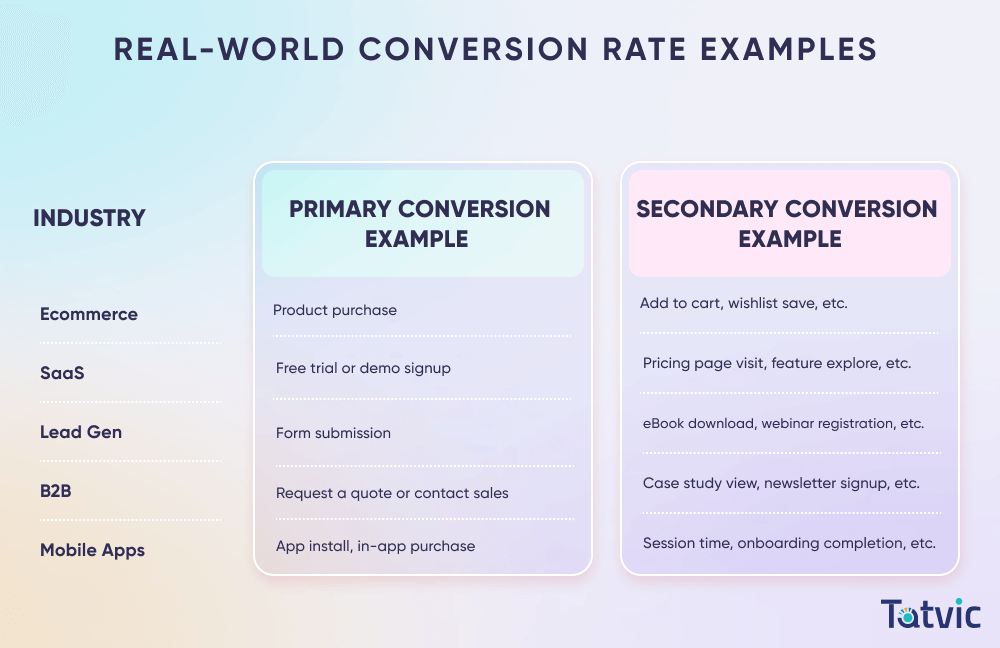
Real-World Conversion Rate Examples

Here’s how conversion rate optimisation plays out across different industries:

Real-World Conversion Rate Examples

Tip: Use tools like GA4, Mixpanel, or Amplitude to track micro and macro conversions across the entire user journey.

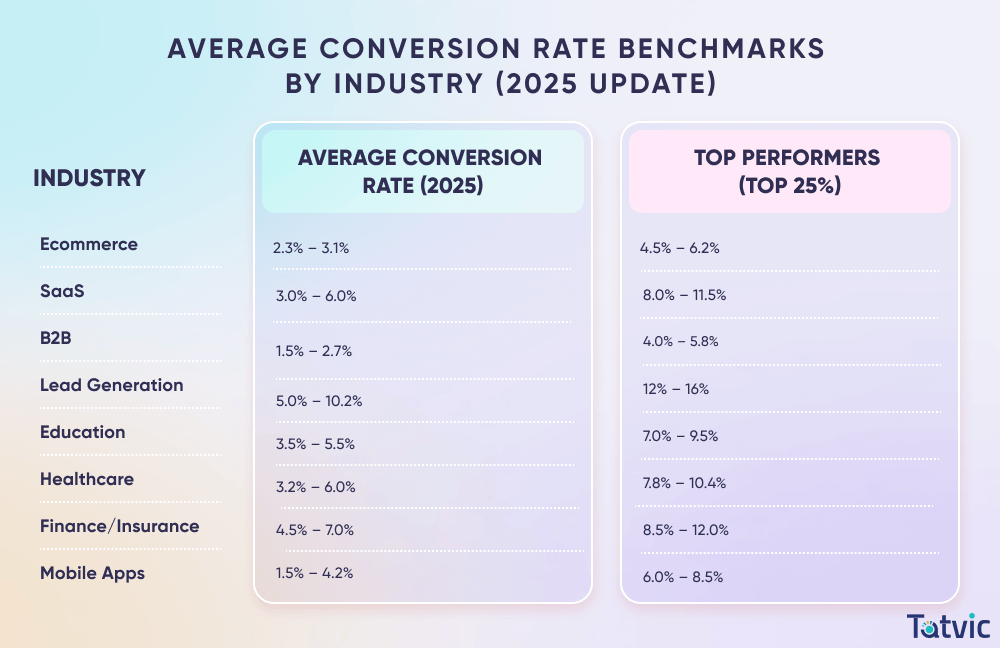
Average Conversion Rate Benchmarks by Industry (2025 Update)

Knowing how your site performs against industry benchmarks helps identify opportunities and gaps in your CRO efforts.

Understanding conversion rate benchmarks by industry is essential for setting realistic goals, identifying gaps, and making informed decisions in your CRO strategy. While benchmarks aren’t universal targets, they provide valuable directional insight especially in a year like 2025 where AI, personalization, and privacy-first design have reshaped digital behavior.

Based on 2025 data trends and reports from platforms like HubSpot, Shopify and Statista, here are the latest average conversion rates:

Average Conversion Rate Benchmarks by Industry (2025 Update)

Note: These are global averages. Your ideal benchmark may vary based on audience type, traffic sources, and industry vertical.

What Influences Average Conversion Rate?

  • Traffic quality: Not all visitors have equal intent.
  • UX and performance: Speed, mobile responsiveness, and intuitive design matter.
  • Offer relevance: A compelling value proposition improves conversions.
  • Personalization: In 2025, real-time, AI-powered personalization is a conversion game-changer.

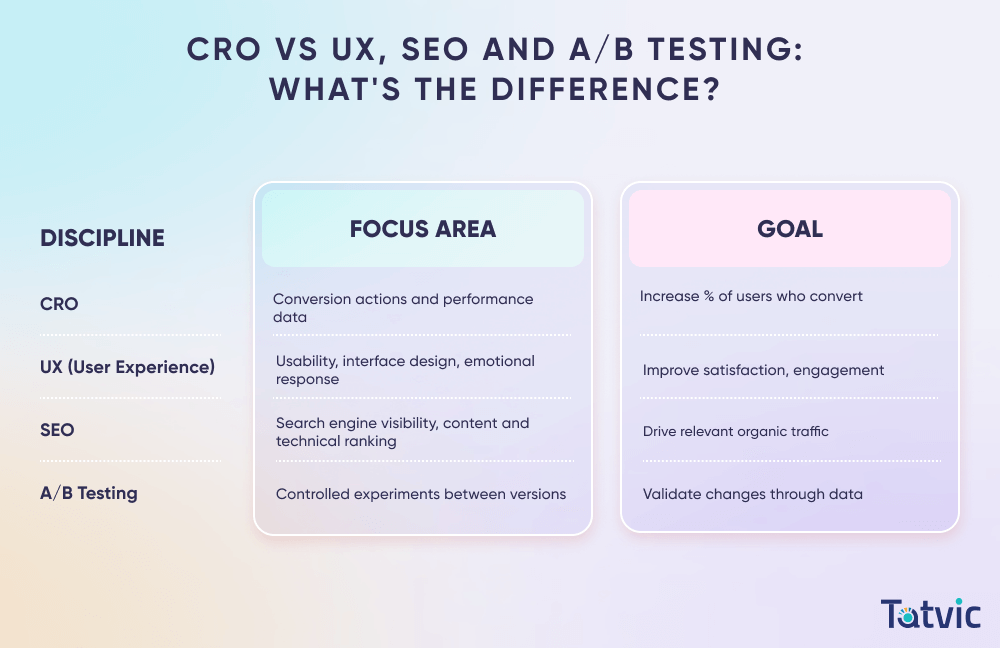
CRO vs UX, SEO and A/B Testing: What’s the Difference?

While often used interchangeably, CRO, UX, SEO, and A/B testing each serve distinct purposes in digital strategy. Understanding how they differ-and how they complement each other-is crucial for building a cohesive, high-performing marketing ecosystem. Below is a quick breakdown to help you see where CRO fits in the bigger picture.

Let’s see the comparison of CRO vs UX, SEO and A/B Testing

CRO vs UX, SEO and AB Testing

While CRO often overlaps with these disciplines, it uniquely focuses on outcomes, turning intent into action.

For example: SEO gets the user to the page, UX ensures it feels good, but CRO ensures the user actually takes the desired step

How CRO Fits into the 2025 Digital Marketing Funnel

The modern funnel is no longer linear, it’s fluid, multi-device and influenced by dozens of micro-moments.

In this complex journey, CRO acts as the “glue” that:

  • Aligns user intent with business goals
  • Personalizes the journey in real time using behavioral and contextual signals
  • Removes friction across devices and touchpoints
  • Ensures every visitor is nudged toward a conversion, regardless of entry point

In 2025, successful brands are integrating CRO across SEO landing pages, paid ad campaigns, email flows and even chatbot conversations, all optimized dynamically through AI and predictive behavior modeling.

CRO is no longer just about tweaking, it’s about transforming how users experience and interact with your brand.

CRO is the conversion engine of modern digital marketing which is deeply data-driven, AI-augmented and essential for growth in a crowded, fast-evolving digital economy.

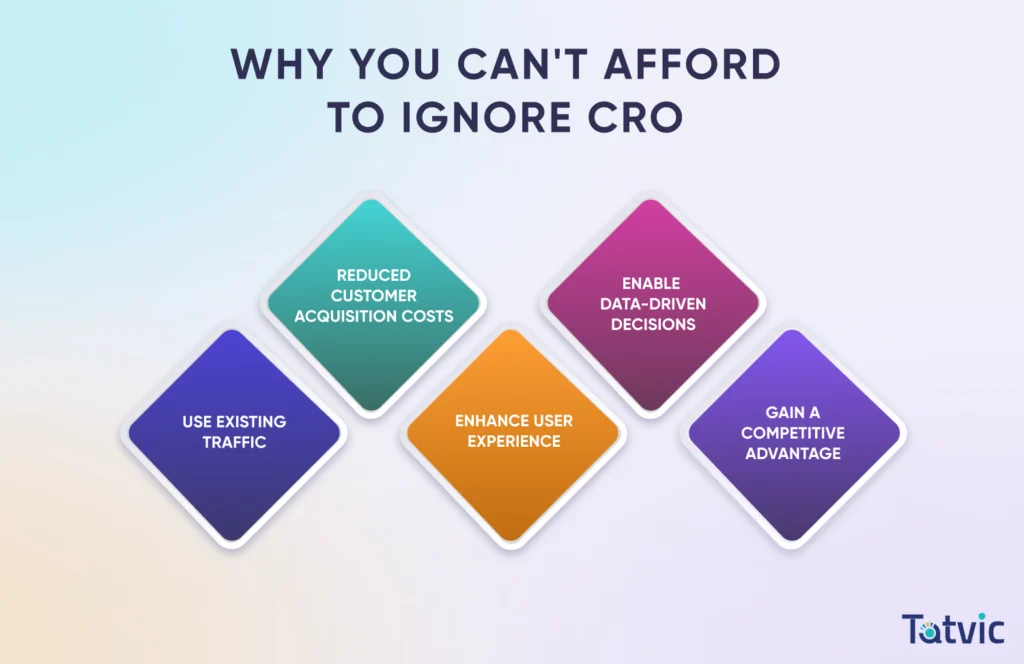
Why Conversion Rate Optimisation (CRO) is Essential ?

Conversion Rate Optimisation (CRO) is essential in 2025 and beyond because it empowers businesses to maximize value from existing traffic, reduce dependency on rising ad costs, and adapt to fast-changing user behavior.

In a world driven by AI, personalization, and privacy-first marketing, CRO is the key to sustainable, scalable digital growth.

Let’s See Why CRO is Actually Essential in 2025 & Beyond

1. The Impact of Rising Customer Acquisition Costs (CAC)

In 2025, Customer Acquisition Costs (CAC) are at an all-time high-driven by intense ad competition, stricter data privacy laws, and saturated digital channels.

Platforms like Google and Meta have increased CPMs and CPCs, while third-party data targeting has become less effective.

As a result, businesses can no longer afford to rely solely on traffic growth to drive revenue. Instead, maximizing the value of existing traffic through Conversion Rate Optimisation (CRO) has become the most cost-efficient path to growth.

CRO importance in 2025: It’s the difference between scaling profitably or burning budgets.

2. User Impatience and Attention Scarcity

Today’s digital consumers are more distracted, decisive, and demanding than ever. Studies in 2025 show that users decide within 3-5 seconds whether to stay on a page or bounce. Long forms, poor UX, slow-loading pages, or irrelevant messaging now result in instant abandonment.

CRO tackles this head-on by:

  • Streamlining user journeys

  • Reducing cognitive friction

  • Delivering the right message at the right moment

This makes CRO a critical layer of defense against bounce rates and a powerful driver of user satisfaction.

3. Role of AI/ML and Agentic AI in Hyper-Personalization

In 2025, CRO has entered a new era powered by AI, ML and agentic AI frameworks.

Traditional optimization relied on manual A/B testing and generalized hypotheses. But now, AI models can:

  • Predict user intent in real-time
  • Auto-personalize CTAs, page layouts, and product recommendations
  • Adapt conversion paths based on behavioral signals and historical data

Agentic AI takes it further by autonomously testing, learning, and optimizing without human prompt ushering in an age of “self-improving” experiences.

AI in conversion optimization means brands can now deliver 1:1 personalized experiences at scale, improving both conversion rates and customer satisfaction.

4. CRO as a Revenue and Profitability Driver Not Just a Tactic

Gone are the days when CRO was seen as a siloed tactic for the marketing team.

In 2025, top-performing organizations view CRO as:

  • A core revenue function
  • A strategic enabler of sustainable growth
  • A bridge between data, creativity, and business outcomes

Whether it’s improving funnel efficiency, lowering CAC, boosting LTV or increasing repeat purchases, CRO delivers measurable impact on the bottom line.

When aligned with broader business goals, CRO becomes a profit multiplier, not just a series of isolated tests.

In the high-stakes, AI-driven, privacy-aware digital world of 2025, CRO is no longer optional. It’s a mission-critical investment for brands that want to grow smarter, not just harder.

Key Elements of a Conversion Rate Optimisation (CRO) Strategy (2025 Edition)

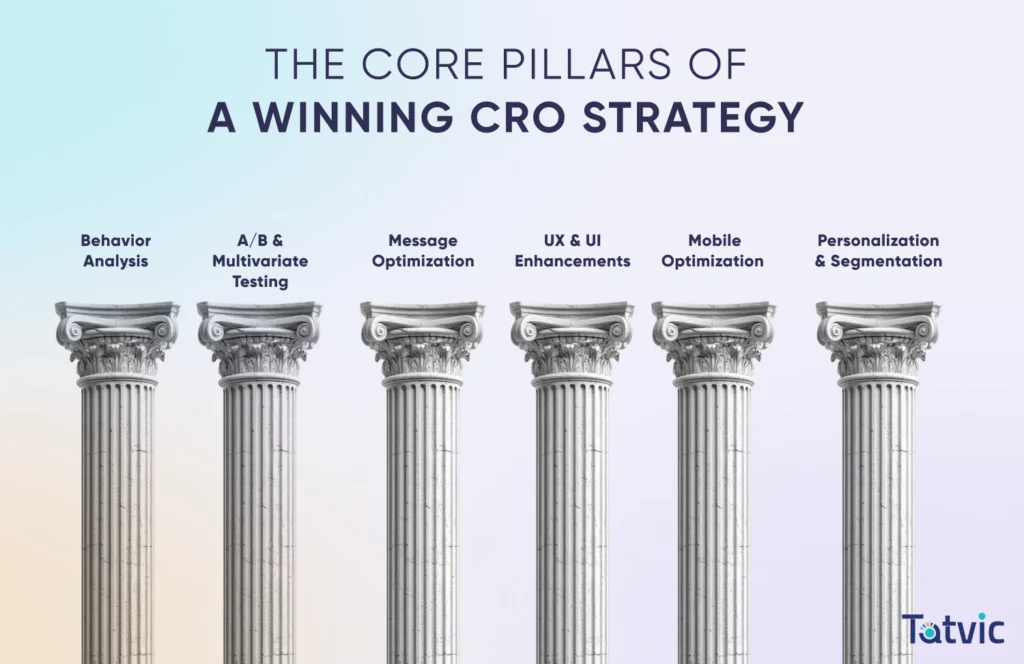
A winning Conversion Rate Optimisation (CRO) strategy goes beyond just A/B testing, it’s a holistic, AI-powered approach that blends psychology, data and design.

From landing page optimization to real-time personalization, every element is engineered to remove friction and guide users toward conversion.

With rising acquisition costs and shrinking attention spans, CRO is now a strategic revenue growth engine, not just a marketing tactic.

Let’s Deep Dive Into Key Elements of a Conversion Rate Optimisation (CRO) Strategy

1. Landing Page Optimization

Your landing page is often the first and only chance to convert a visitor. In 2025, CRO-driven landing pages are clean, mobile-first, AI-personalized, and laser-focused on one conversion goal. Key elements include a compelling headline, scannable content, trust indicators (like reviews or guarantees), and visual hierarchy that directs attention toward the CTA. Tools like Unbounce, Instapage, and Framer AI are frequently used to test and optimize these experiences.

2. A/B and Multivariate Testing

Testing remains the backbone of CRO strategies.

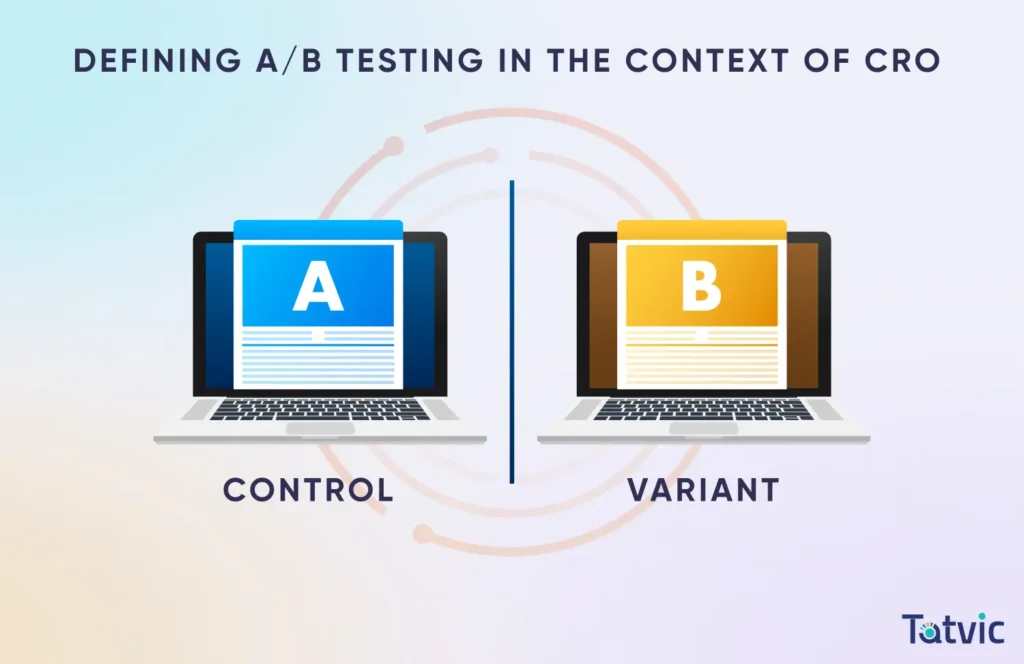
  • A/B testing compares two versions of a page or element (like a CTA button) to determine which performs better.
  • Multivariate testing (MVT) evaluates multiple changes across different combinations simultaneously.

In 2025, platforms like Google Optimize 360, VWO and Adobe Target leverage AI to auto-prioritize winning variations faster, helping marketers continuously improve conversion rates with data-driven insights.

3. User Journey Mapping

Understanding the complete customer journey-from ad click to final action-is crucial. CRO professionals use journey mapping to uncover friction points, abandonment zones, and opportunities for persuasion. In 2025, this process is enriched by tools like FullStory, Hotjar, and GA4, which provide real-time behavioral insights, scroll-depth tracking, rage click detection, and heatmaps that decode intent.

4. Call-to-Action (CTA) Design

A strong CTA is clear, visible, and psychologically persuasive. Modern CRO focuses not just on the color or placement but also on the context in which the CTA appears. In 2025, successful CTAs often leverage AI-triggered timing (e.g., exit intent, scroll depth) and dynamic messaging tailored to user segments. Phrases like “Get My Free Demo” or “See It in Action” outperform generic ones like “Submit.”

5. Value Proposition Clarity

A sharp, specific value proposition answers: “Why should I choose you?”
In a crowded market, ambiguity kills conversions. CRO strategies ensure your core message is instantly understood, emotionally resonant, and consistent across touchpoints. The 2025 approach uses eye-tracking AI and messaging frameworks like the Value Proposition Canvas to validate clarity and impact.

6. Form Optimization

Forms are often where conversions drop off. Shorter, smarter forms win.

  • Autofill, predictive fields and progressive disclosure are standard CRO techniques.
  • Forms dynamically adapt based on user behavior-if intent is high, more fields can be shown to qualify leads.

Avoid friction: don’t ask for unnecessary data, and always include visual cues like progress bars and tooltips.

7. Speed & Performance Optimization

Website speed is no longer optional. With mobile-first indexing and Core Web Vitals updates, slow-loading pages bleed conversions.
Top CRO strategies include:

  • Using modern frameworks like Next.js or Astro
  • Compressing assets with AI
  • Minimizing third-party scripts

Page speed also affects SEO, so this is where CRO and SEO converge.

8. Micro Conversions & Funnel Drop-Offs

While macro conversions (like purchases) are the goal, micro conversions-such as newsletter signups or video views-indicate engagement and buying intent.
CRO strategies map these events across the funnel to identify where users drop off. Tools like Heap, Mixpanel, and GA4 are used to trigger retargeting, smart nudges, or live chat at the right moment.

9. Personalization & Dynamic Content

2025 is the year of Agentic AI and personalization is no longer static.
Modern CRO strategies now involve:

  • AI-generated content variations
  • Product recommendations based on real-time behavior
  • Dynamic pricing or offers based on location or segment

Platforms like Mutiny, Dynamic Yield and Adobe Sensei help marketers deliver contextual experiences that boost both engagement and conversions.

These CRO techniques form the core of a robust, modern conversion rate optimisation strategy.

When implemented with the right tools, data, and user understanding, they consistently improve conversion rates and maximize ROI across industries.

SEO & CRO: How to Integrate for Maximum ROI 

Integrating SEO and CRO isn’t just smart, it’s essential.

While SEO drives qualified traffic, CRO ensures that traffic converts.

Businesses that treat them as a unified strategy rather than separate silos unlock higher ROI, better user experience and faster revenue growth.

Aligning SEO Landing Pages with CRO Goals

The best-performing landing pages are built with both visibility and conversion in mind. That means:

  • Using SEO best practices like keyword-rich headings, structured data, and internal linking.
  • Ensuring each SEO-driven landing page has a clear goal, whether it’s lead capture, product discovery or trial sign-up.

By tying content topics directly to high-intent keywords and pairing them with persuasive design, businesses maximize both search rankings and conversion potential.

Matching Search Intent with User Flow

Search intent in 2025 is more nuanced, thanks to Google’s advancements in semantic understanding and SGE (Search Generative Experience).
CRO experts must ensure the user flow reflects the searcher’s intent, such as:

  • Informational queries ➜ Direct to rich blog pages with educational CTAs like “Get the Checklist”
  • Transactional queries ➜ Drive users to optimized product or service pages with social proof and urgency triggers
  • Navigational queries ➜ Ensure seamless UX with clear pathways to what users expect to find

When search expectations are met with tailored user experiences, bounce rates drop, time-on-page increases, and conversions surge.

Optimizing Page Speed, Structure, and CTAs

CRO and SEO both benefit from technical excellence.
Top-performing pages meet or exceed Core Web Vitals thresholds and are built using:

  • Modern frameworks like Next.js, Remix, or Astro for lightning-fast load times.
  • Semantic HTML and accessible design for both crawlers and users.
  • Contextual CTAs that appear based on scroll behavior, exit intent or content relevance keeping the user engaged.

Remember: Google rewards fast, useful pages and users convert on them more.

Case Examples of Successful SEO-CRO Alignment

Example 1: B2B SaaS Company

  • Created SEO content hubs for “AI Marketing Automation”
  • Embedded CRO widgets like in-line demos and chatbot CTAs
  • Result: 38% increase in demo bookings from organic traffic in 90 days

Example 2: Ecommerce Brand

  • Optimized category pages for search volume and intent (“best running shoes 2025”)
  • A/B tested layouts and offer banners based on user behavior
  • Result: 22% boost in organic revenue per session

Example 3: Lead Generation Agency

  • Rewrote blog posts with clearer CTA flows and exit-intent forms
  • Integrated dynamic CTAs based on traffic source
  • Result: 60% increase in MQLs from organic visits in six months

True ROI happens when your SEO pages don’t just rank but convert. With the right strategy, SEO brings the right people, and CRO ensures they take the right action. In 2025, this integration is the cornerstone of sustainable digital growth.

The Role of Agentic AI in Conversion Rate Optimisation (CRO)

What is Agentic AI & Why It’s a Game-Changer for CRO?

In 2025, Agentic AI is redefining the future of conversion rate optimisation.

Unlike traditional AI, which reacts to pre-set instructions, Agentic AI is proactive.

It identifies friction in the user journey, determines optimal actions, and executes those actions autonomously.

Think of it as an intelligent CRO agent working behind the scenes, continuously testing, learning and personalizing every touchpoint without waiting for a human to initiate an A/B test.

Agentic AI aligns perfectly with the speed and complexity of modern digital experiences, where user behavior, preferences and context shift in real time.

Agentic AI allows digital marketers to break free from linear, manual experimentation models. It’s fast, scalable, and context-aware-critical traits in a digital landscape where user patience is minimal, data privacy is paramount, and real-time personalization drives ROI.

As CRO in 2025 evolves into a multi-disciplinary, data-rich practice, Agentic AI becomes the engine that powers intelligent decision-making and execution all without waiting for human bandwidth.

Real-World Examples of Agentic CRO in 2025

1. Real-Time Content Adaptation

Imagine a visitor landing on your SaaS homepage. Based on their referral source (e.g., LinkedIn), device type, and browsing history, Agentic AI immediately swaps the hero image, adjusts the headline to fit B2B buyers, and shows relevant use cases-without manual rule-setting.

2. Autonomous Testing & Learning

Instead of marketers manually running A/B or multivariate tests, Agentic AI automatically identifies underperforming areas (e.g., high bounce on mobile CTA), runs multiple test variants, and deploys the highest performer-all in real time.

3. Automated Copy and Layout Optimization

Agentic systems continuously monitor engagement signals like scroll depth, click maps, and cursor movement. If the bounce rate spikes on a new pricing page, the AI reorders sections, shortens paragraphs, and rephrases headlines dynamically to improve conversion.

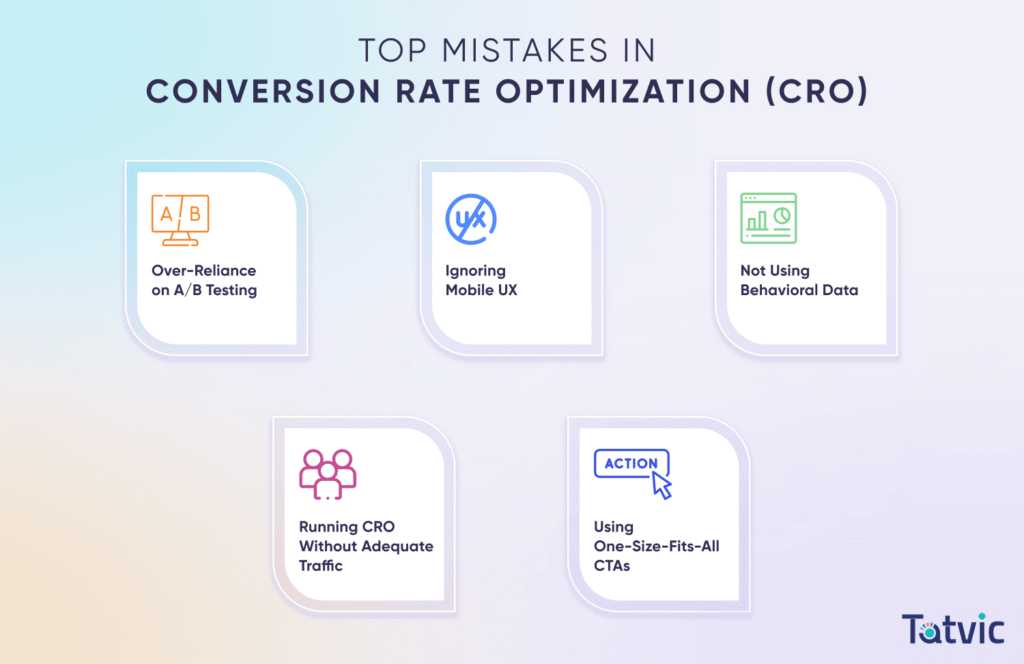
Top Mistakes in Conversion Rate Optimisation (CRO)

Even the most well-funded CRO efforts can fall flat if rooted in outdated assumptions or misapplied tactics.

In 2025, with AI tools, sophisticated UX expectations, and tighter privacy laws reshaping digital strategy, it’s more important than ever to avoid these critical CRO mistakes that can quietly erode your conversion potential.

Top Mistakes in Conversion Rate Optimisation (CRO)

Let’s see the Top Mistakes in CRO:

1. Over-Reliance on A/B Testing

While A/B testing remains valuable, depending on it as the only CRO tactic is outdated. In 2025, A/B tests are often too slow or statistically underpowered-especially for low-traffic pages. Instead, combine them with AI-driven multivariate testing, behavioral data insights, and predictive analytics for smarter, faster optimization.

2. Ignoring Mobile UX

Over 70% of web traffic in 2025 comes from mobile. Yet, many businesses still design primarily for desktop. Poor mobile responsiveness, small CTAs, and slow load times contribute to major conversion friction. CRO today must prioritize mobile-first experiences, with thumb-friendly layouts, micro-interactions, and lightning-fast performance.

3. Not Using Behavioral Data

Ignoring tools like heatmaps, session recordings, scroll depth tracking, and funnel analytics leads to blind optimization. Behavioral data provides the why behind the what, revealing intent, hesitation, and frustration in real time-vital for crafting CRO strategies rooted in real user experience, not assumptions.

4. Running CRO Without Adequate Traffic

CRO isn’t magic-it needs statistically significant data to work. Running experiments with insufficient traffic leads to misleading results and wasted time. Before launching a CRO campaign, ensure your baseline traffic and conversions are high enough to yield trustworthy insights. Consider qualitative research and heuristics if volume is low.

5. Using One-Size-Fits-All CTAs

“Sign Up Now” and “Learn More” won’t cut it in 2025. CRO fails when calls-to-action lack context, personalization, or relevance. Modern users expect micro-segmented CTAs based on where they are in the funnel, their device, referral source, or even real-time behavior. Static CTAs are conversion killers.

A common reason why CRO fails is when it’s run in a silo-disconnected from brand messaging, SEO, content, or sales goals. Conversion optimisation must be strategically aligned across teams and customer journeys to truly move the revenue needle.

The most common CRO errors in 2025 are avoidable with the right mix of data, UX thinking and AI support. The goal isn’t just to “test” more it’s to learn more, faster. That’s the mindset behind truly scalable conversion growth.

Winning Conversion Rate Optimisation (CRO) Frameworks and Methodologies

In 2025, conversion rate optimisation isn’t just about running experiments-it’s about using the right decision-making frameworks to prioritize, execute, and scale efforts with precision. The most successful CRO strategies today are grounded in structured methodologies that balance user insight with business impact.

Here are two of the most battle-tested CRO frameworks still driving measurable growth in 2025:

1. PIE Framework (Potential, Importance, Ease)

Developed by: Chris Goward, WiderFunnel
Best For: Prioritizing A/B test ideas

The PIE framework helps marketers decide which CRO tests to run first, based on three weighted criteria:

  • Potential - How much room for improvement does this page or element have?
  • Importance - How valuable is the traffic or revenue from this area?
  • Ease - How simple is it to implement the change?

Each factor is scored on a scale (typically 1-10) and total scores help create a testing roadmap that’s both strategic and efficient.

Real-World Example:
A global SaaS platform used the PIE framework to prioritize homepage vs. pricing page testing. The pricing page scored higher on Importance and Potential, leading to a redesign that increased trial sign-ups by 21% within 30 days.

2. LIFT Model (Landing Page Influence Function for Tests)

Developed by: WiderFunnel
Best For: Diagnosing why a page may not be converting

The LIFT Model evaluates a landing page’s effectiveness across six key factors:

  1. Value Proposition - Is the core offer clear and compelling?
  2. Clarity - Is the content easy to understand?
  3. Relevance - Does it match the visitor’s intent?
  4. Urgency - Is there a reason to act now?
  5. Anxiety - What doubts might be holding users back?
  6. Distraction - Are there elements pulling attention away?

Using this model, CRO teams can analyze pages visually and strategically before even running a test.

Real-World Example:
An ecommerce brand selling eco-friendly apparel used the LIFT Model to redesign their product pages. By reducing distractions, increasing trust signals, and sharpening the value message, they saw a 28% increase in conversions within 45 days.

Frameworks like PIE and LIFT don’t just simplify Conversion Rate Optimisation but amplify ROI by ensuring each test or optimization is grounded in business logic and user psychology.

In 2025, where digital attention is scarce and AI is ubiquitous, having the right methodology is what separates growth leaders from the rest.

How to Get Started with Conversion Rate Optimisation (CRO) in 2025?

Whether you’re new to conversion rate optimisation (CRO) or looking to scale your existing efforts in 2025, the key lies in building a structured, data-driven approach from day one. With AI-driven tools, privacy changes, and increasing competition, businesses must evolve beyond one-off experiments into systematic, ROI-focused CRO programs.

Here’s your comprehensive roadmap to begin or refine your CRO journey in 2025:

1. CRO Maturity Self-Assessment Checklist

Before diving into tests, assess where your organization currently stands.

Use this CRO maturity checklist to identify gaps:
Maturity Level
Indicators
Beginner No clear funnel insights, ad hoc changes, limited user behavior tracking
Intermediate A/B testing in place, tools like GA4, Hotjar, or VWO used, isolated success stories
Advanced Data-informed hypotheses, personalization at scale, integrated CRO-UX-SEO approach
Leader (2025 Standard) Agentic AI experimentation, full-funnel attribution, constant test iterations across platforms

Pro Tip: Run a monthly self-audit to align your CRO activities with business outcomes and user needs.

2. In-House vs Agency-Led CRO: What’s Best?

Depending on your internal resources, you can either build an in-house CRO team or partner with a CRO agency.

Brief Comparison between In-House vs Agency-Led CRO
In-House CRO
CRO Agency
Deeper brand understanding Access to experts across design, data, and UX
Direct control over testing velocity Faster setup and proven CRO frameworks
Requires skilled team and tools Often more cost-effective than hiring full-time specialists

In 2025, hybrid models are also popular where in-house teams manage execution while agencies provide strategy and experimentation design.

3. Setting Up a  Well Defined Conversion Rate Optimisation (CRO) Roadmap

Your CRO roadmap should align with business goals and user behavior insights.

Here’s a proven phased approach:
  1. Data Audit: Review analytics, heatmaps, funnel leaks, mobile performance
  2. User Research: Gather qualitative insights (polls, surveys, user testing)
  3. Hypothesis Building: Use frameworks like PIE or LIFT to prioritize test ideas
  4. Test Planning: A/B, multivariate, split testing, personalization
  5. Experimentation: Run, monitor, document outcomes
  6. Iteration: Scale what works, discard what doesn’t

Document your roadmap in a shared, cross-functional dashboard, visibility is key.

4. Key Metrics to Track for ROI for Conversion Rate Optimisation

To understand the real impact of CRO, focus on more than just lift in conversions.

Key Metrics to Track:
  • Primary Metrics: Conversion rate, revenue per visitor, average order value (AOV)
  • Secondary Metrics: Bounce rate, time on page, cart abandonment, micro-conversions
  • Operational Metrics: Test velocity, win rate, time-to-deploy
  • ROI Metrics: Cost per experiment vs revenue gained, lift per channel, CAC reduction

In 2025, CRO is no longer judged on isolated experiments, it’s about business efficiency, user satisfaction, and revenue impact.

Getting started with CRO in 2025 means thinking strategically, not sporadically.

Assess your maturity, build the right team (or partners), align testing to business outcomes, and measure what truly matters.

Whether you’re a growing startup or an enterprise, CRO done right is your most cost-effective growth lever.

Conversion Rate Optimisation (CRO) Tools & Tech Stack in 2025

In 2025, the CRO tech stack is smarter, faster, and more integrated than ever.

Here are the Key Tools Powering Top-performing CRO:

  • Optimizely & VWO: Enterprise-grade platforms for A/B, multivariate, and server-side testing.
  • Google Optimize Alternatives: GA4 now integrates with platforms like SiteSpect, Convert.com, and Adobe Target post-Google Optimize sunset.
  • Hotjar & FullStory: Behavioral analytics for session recordings, heatmaps, and user flows.
  • AI-Powered CRO: Tools like Mutiny and Tatvic Agentic CRO Services  automate personalization, CTA testing, and real-time journey optimization.
  • No-Code/Low-Code Platforms: Unbounce, Webflow, and Visual Website Optimizer enable fast test deployment without dev dependency.
  • Data Integrations: Seamless integration with GA4, CDPs, and CRM/marketing automation tools ensures data-driven, omnichannel optimization.

Smart CRO in 2025 is built on data, automation and velocity and your tech stack is the engine behind it.

Top CRO Trends to Watch in 2025-2026

  • Agentic AI & Autonomous Testing: AI agents now run tests, adapt layouts, and optimize in real time-zero manual input needed.
  • Predictive Personalisation: CRO tools use behavior + intent signals to deliver hyper-targeted experiences before users act.
  • Conversion APIs & Privacy-First Testing: With cookies fading, server-side tracking and first-party data are the new CRO foundation.
  • Voice & Multimodal CRO: Optimizing for voice search, chat interfaces, and AI assistants is now critical for seamless user journeys.

CRO in 2025-2026 is no longer reactive, it’s predictive, privacy-ready and intelligently automated.

Read In Depth about Latest Conversion Rate Optimization (CRO) Trends to Follow in 2025 & Beyond


Conclusion: CRO Is No Longer Optional, It’s Essential for ROI in 2025

In today’s high-CAC, attention-fragmented digital world, Conversion Rate Optimization (CRO) isn’t just a tactical upgrade-it’s a strategic imperative. Whether you’re scaling a B2B SaaS company, running an ecommerce brand, or managing lead generation funnels, the difference between flat metrics and exponential growth often comes down to how well you optimize for conversions.

With the rise of Agentic AI, hyper-personalization and real-time testing, CRO in 2025 has evolved into a dynamic, data-led discipline that directly impacts revenue, user experience, and long-term profitability.

Talk to Tatvic’s CRO experts and build a custom roadmap to grow your ROI sustainably


Brands Boosted Leads & Sales with Data-Driven Conversion Rate Optimisation (CRO)

CRO isn’t just theory, it delivers measurable results.

Here are real-world examples of how leading brands achieved significant gains in leads, conversions and engagement using advanced Conversion Rate Optimisation (CRO) strategies and technology integration.

Let’s See Few Conversion Rate Optimisation (CRO) Real World Success Stories:

1. ICICI Prudential Life

+22% Sales | +122% Session Duration
By harnessing the power of Google Marketing Platform and custom machine learning models, Tatvic enabled ICICI Prudential Life to dramatically enhance user engagement and conversion paths resulting in a 22% boost in sales and over 2x longer session durations.

Insight: Data-backed personalization and predictive analytics can directly elevate revenue metrics.

2. HDFC Life Insurance

+169% Lead Form Submissions
Tatvic implemented a comprehensive CRO strategy for HDFC Life focused on user journey mapping, intent-driven landing pages, and frictionless UX design. This resulted in a 169% surge in qualified lead submissions-all without increasing ad spend.

Insight: CRO helps extract more value from your existing traffic by eliminating barriers to conversion.

3. UNext Learning

+15% Lead Submissions via Course Pages
For UNext Learning, Tatvic optimized messaging and information hierarchy across their course pages. This clear, benefit-led communication strategy led to a 15% improvement in form submissions from prospective learners.

Insight: Message clarity and page-level UX are critical to motivating user action.

4. Ferns N Petals (FNP)

+13% Mobile Purchase Funnel Completion | +4% Overall Purchases
Tatvic focused on mobile-first CRO for FNP, identifying key friction points in their mobile purchase journey. Streamlining checkout and CTA placements led to a 13% uplift in mobile funnel completions and a 4% increase in total transactions.

Insight: In a mobile-dominated world, mobile-specific optimization can’t be an afterthought.

5. TVS Motor

+31% Lead Generation through Landing Page Optimization
Tatvic transformed TVS Motor’s product landing pages by aligning content with user intent and simplifying the lead capture process. This UX-focused revamp generated a 31% increase in high-quality leads.

Insight: Strong UI/UX synergy can significantly boost lead velocity in high-stakes industries.

6. Royal Enfield

+93% Higher Conversion Rate on Desktop | 44% Higher Conversion Rate on Mobile
By redesigning the ‘Book a Test Ride’ form with better CTA placement, reduced fields, and mobile responsiveness, Tatvic helped Royal Enfield achieve a 50% improvement in conversion rate on this key performance metric.

Insight: Even minor UI changes when based on behavioral data can unlock massive ROI.

These results underline a core principle: CRO is not just about testing, it’s about strategic transformation backed by data, psychology, and continuous iteration. When done right, it turns traffic into business outcomes.

Ready to Start Turning Clicks into Conversions?

Talk to Tatvic’s CRO Experts and Get a Personalized & Data-Driven Roadmap to Conversion Rate Optimisation Success

Understanding the Role of A/B Testing in CRO

Understanding the Role of AB Testing in CRO - Tatvic

Curious how A/B testing in CRO (Conversion Rate Optimization) helps turn everyday user actions into data-driven strategies that boost conversions?

Every Click, Form Submission or Sale on your site tells a story and A/B testing helps you translate those interactions into smarter decisions.

“You can’t improve what you don’t measure.”
~Peter Drucker

In a world where even a 1% lift in conversion can mean thousands of extra dollars, relying on guesswork just doesn’t cut it.

Instead, you need a systematic, repeatable approach to testing, backed by robust AB testing services and the right services partner to guide you.

Whether you’re a marketer, product manager, UX designer, or business owner, this guide will walk you through everything from the basics of ab testing to advanced statistical methods, real‑world case studies, and a step‑by‑step playbook for running your own high‑impact experiments.

Let’s dive in - >>

Defining AB Testing in the Context of CRO - Tatvic

Defining A/B Testing in the Context of CRO (Conversion Rate Optimization)

AB testing, also known as split testing, refers to the process of testing multiple variations of a web page to find higher-performing variations and improve the page’s overall conversion rate.

It is a continuous process that allows you to assess and check the variation that works better for your target audience based on strategic statistical analysis.

At its heart, A/B testing in CRO is a controlled experiment:

  1. You show Version A (the control) to some users and
  2. Version B (the variant) to others,
  3. Then measure which one performs better against your key metric be it Click‑Through Rate (CTR), Form Completion or Purchase Rate.

This isn’t hokey magic; it’s a rigorous approach that turns user behavior into a roadmap for improving your site.

Why A/B Testing Is Essential for CRO Success

A/B testing allows you to experiment with different versions of a webpage to see what resonates most with your audience. It takes the guesswork out of optimization by relying on actual user behavior and performance metrics.

By continuously testing and refining elements like headlines, CTAs, and layouts, you can steadily improve conversion rates.

Ultimately, A/B testing empowers data-backed decision-making that leads to measurable growth in your CRO efforts.

Why invest time and budget in AB testing services??

Because it’s the only way to reliably improve conversions without guesswork.

Why AB Testing Is Essential for CRO Success - Tatvic

Here’s How Structured A/B Testing in CRO Fuels Growth:

  • Reduce Bounce Rate:

    By experimenting with different headlines, imagery, and calls‑to‑action, you give visitors exactly what they want keeping them on your site longer and reducing bounce.

  • Data-Driven Decisions:

    Move beyond gut feelings. Test hypotheses and let real user data guide you. Every test result informs your next move.

  • Understand User Behavior:

    Watch how different segments respond. Maybe desktop users love your long‑form copy, but mobile visitors prefer bullet points. AB testing services reveals these nuances.

  • Maximize Existing Traffic:

    Instead of pouring more money into ad spend, get more value from the visitors you already have. Even a 5% lift in conversion from AB testing services often outperforms a new ad campaign.

  • Reduce Risk:

    Rolling out a site‑wide redesign can backfire. With A/B tests, you can roll out incremental changes, validate them, then apply them broadly minimizing the risk of unexpected drops.

Did you know?

Companies that rigorously use A/B testing grow their revenues 1.5 to 2x faster than those that don’t.

Further, monitoring these changes allows you to have statistically significant and reliable data.

Apart from these, A/B testing also helps in:
  • Experimenting with various elements of an app, website, or landing page to boost conversion
  • Encouraging continuous improvement in user experience 
  • Improving user engagement and user navigation 
  • Improving the checkout experience
  • Getting a higher ROI (Return On Investment) without spending
Case Snippet: Titan Eye+

Through A/B testing, Tatvic boosted page views and purchases for Titan Eye+, enhancing their online revenue share. A/B and multivariate testing acted as core pillars of a winning CRO strategy.

A/B Testing in Marketing: Beyond Simple Experiments

A/B testing isn’t just for websites, it’s a universal tool in any digital marketer’s toolbox.

It helps marketers make informed decisions by testing variations in emails, ads, and landing pages to see what performs best.

Whether it’s optimizing subject lines or experimenting with ad creatives, A/B testing brings clarity to campaign performance.

This method reduces assumptions and highlights what truly engages your audience.

When used consistently, it drives smarter strategies and better ROI across all channels.

AB Testing in Marketing Beyond Simple Experiments - Tatvic

Here’s how A/B Testing powers different channels:

1. Email Campaigns

  • Subject Lines: “20% off today only!” v/s “Your exclusive 20% savings inside.”
  • Preview Text: Changing the first line can boost open rates by 5-10%.
  • CTA Buttons: Shape, phrasing (“Start Now” v/s “Get Started”), and placement.

2. Landing Pages

  • Headline Positioning: Above the fold v/s further down.
  • Lead Magnet Format: PDF download v/s video series.
  • Form Length: Two fields v/s five fields.

3. Paid Advertisements

  • Ad Copy: Highlighting features v/s benefits.
  • Creative: Static images v/s short GIFs.
  • Ad Format: Carousel v/s single image.

4. In-App Experiences

  • Onboarding Flow: Step‑by‑step tutorial vs. “skip” option.
  • Feature Prompts: Modal window v/s inline tooltip.
  • Pricing Upsells: Hard sell v/s gentle reminder.

A testing tool that supports multi‑channel experiments web, email, ads  and in‑app becomes a force multiplier for your overall marketing ROI.

AB testing services become crucial for results that drive business growth. 

Types of A/B Tests in CRO (Conversion Rate Optimization) & When to Use Them

Different A/B testing methods serve unique goals in the CRO journey, from simple button color changes to complex multi-page experiments.

Knowing which type to use be it split testing, multivariate, or multi-page testing can greatly influence your outcomes.

Each test provides distinct insights into user behavior and interaction patterns.

By aligning the test type with your specific objective, you can optimize user experience and boost conversions more effectively.

Types of AB Tests and When to Use Them-Tatvic

A Deep Dive into the Different Types of A/B Tests Used in CRO

  • Split URL Tests:

    Compare entirely different page designs on separate URLs ideal for landing‑page overhauls and commonly run via AB testing services. These tests are perfect for evaluating drastic design changes or entirely new page concepts. By directing traffic to two or more different URLs, businesses can gather clear performance insights. This method reduces bias from minor tweaks and reveals which page structure truly resonates with users. It’s especially effective for landing pages or campaign microsites.

  • Multivariate Tests (MVT):

    Test multiple elements (headlines, images, CTAs) at once on a single page to pinpoint the best combination. MVT is ideal when you’re optimizing several page elements simultaneously to see which combinations perform best. It provides deeper insights than simple A/B tests by showing interaction effects between variables. However, it requires a larger traffic volume to generate statistically significant results. Use it when you want fine-tuned control over user experience.

  • Server-Side (API) Tests:

    Experiment on backend logic (pricing engines or recommendation modules) for precise control and technical flexibility. These tests go beyond visual changes by focusing on back-end functionalities like algorithmic recommendations or dynamic pricing. Since they run at the server level, they offer faster load times and broader testing capabilities. They’re ideal for more technical teams aiming for deep customization. Server-side testing is great for scaling personalized user journeys.

  • Personalization Tests:

    Deliver tailored content to specific user segments (by behavior, device, or source) to boost relevance and conversions. With these, you serve content tailored to unique user attributes-like geography, browsing history, or referral channel. They help deliver a more relevant experience that increases engagement and conversion. Personalization tests are particularly useful for eCommerce and content-heavy platforms. Over time, they help build loyalty by making users feel understood.

Let’s See Types of A/B Tests & When to Use Them:


Types of A/B Tests & When to Use Them:

Note: Multivariate tests require at least 5× the traffic of split tests to reach statistical significance, so plan accordingly.

In practice, you’ll often run multiple test types in parallel using AB testing services that let you manage Split, MVT  and Server‑Side Tests from one dashboard.

Key Elements You Can Test to Drive Conversions

There are many elements on your website that directly influence a visitor’s decision to convert and A/B testing helps you find which ones matter most.

From headlines and call-to-actions to forms and page layouts, each component plays a role in user experience.

By systematically testing these elements, you can uncover what truly resonates with your audience.

This data-driven approach helps turn insights into higher conversions over time.

Key Elements You Can Test to Drive Conversions- Tatvic Analytics

Let’s See Few of the Key Elements:

  • Headlines & Copy:

    Your headline is the first impression-make sure it clearly states what you offer and why it matters. Testing different tones, lengths, or emotional triggers helps you discover which messaging hooks your audience most effectively.

  • Calls-to-Action (CTA):

    A CTA button’s wording, size, and placement guide users toward the next step in their journey. By experimenting with phrasing (“Get Started” vs. “Try for Free”), button styles, and positioning, you’ll learn how to drive more clicks and conversions.

  • Forms & Fields:

    Every extra field you ask users to fill feels like friction-fewer inputs usually mean higher completion rates. Test variations in field count, label style (inline vs. above), and real‑time validation to find the sweet spot between data collection and user convenience.

  • Page Layout:

    How you arrange text, images, and CTAs can make or break the user flow. Try different column structures, whitespace levels, and navigation placements to see which layout keeps visitors engaged and moving toward your goal.

  • Social Proof:

    Trust badges, testimonials, and star ratings reassure visitors that they’re making the right choice. A/B test formats (short quotes vs. full case studies) and placement (inline vs. sidebar) to discover which social proof drives the biggest uplift.

  • Visual Media:

    Images, icons, and videos can boost engagement-but only if they’re relevant and high‑quality. Compare static imagery vs. short looping videos or custom illustrations vs. stock photos to learn what best resonates with your audience.

  • Pricing & Offers:

    How you present pricing-discount labels, “Most Popular” badges, or countdown timers-can create urgency and clarity. Test different offer structures (percentage off vs. dollar savings) and time‑limited messages to maximize perceived value and drive more purchases. As you incorporate each tweak, your testing backlog grows-fueling future hypotheses and making your CRO program self-sustaining. Leveraging AB testing services ensures that every test is set up correctly, analyzed properly, and iterated on for long-term performance gains.

Statistical Significance: When to Trust Your Results

Statistical significance tells you whether your A/B test in CRO results are likely due to actual changes or just random chance.

It helps ensure that the improvements you see are reliable and repeatable.

Without it, you might make decisions based on misleading data.

Reaching statistical significance gives you confidence to act on your findings and scale what works.

Gathering data is one thing. Knowing when your results are reliable is another.

Key Statistical Tests Used in CRO Are As Follows:

1. Frequentist Tests

  • Long‑Term Observation: Wait until your sample size is large enough (often tens of thousands of views).
  • P‑Value Threshold: Commonly 0.05 (95% confidence).
  • Pros: Well‑understood, widely supported.
  • Cons: Doesn’t let you peek early without risking false positives.

2. Bayesian Tests

  • Credible Intervals: Gives the probability one variant outperforms another.
  • Flexibility: You can check results mid‑test.
  • Pros: Faster insights; easier to interpret probability statements.
  • Cons: Requires more statistical sophistication and careful priors.

Quick Checklist for Reliable Tests

  • Minimum sample size achieved?
  • Run time covers full business cycles (weekends, weekdays)?
  • No major traffic source changes (like a viral tweet)?
  • One variable changed at a time?

Note: Most AB testing services include built‑in significance calculators. Use them but always double‑check with your own traffic numbers and business context.

Step-by-Step A/B Testing Procedure To Be Used In CRO

A/B testing in CRO starts with identifying a goal, like boosting sign-ups or clicks, followed by forming a clear hypothesis.

Next, you create two versions of the element you’re testing and split your traffic between them.

After running the test for a set period, analyze the results to determine which version performs better.

Finally, implement the winning variation and continue testing to refine further.

A robust testing workflow keeps you organized and ensures each experiment moves you closer to better conversions.

Step-by-Step A/B Testing Procedure To Be Used In CRO

Simplified 5 Steps Process to Do A/B Tests in CRO like a pro:

Step 1: Discovery & Hypothesis Formulation 

  • Audit your analytics: Where are you leaking conversions?
  • Gather qualitative inputs: Heatmaps, session recordings, on‑site surveys.
  • Craft a clear hypothesis: “If we change the hero image to user‑generated photos, conversions will increase by 10%.”

Step 2: Test Design & Setup 

  • Choose your test type: split, MVT, or server‑side.
  • Build your variants in the testing tool (or ask your AB testing services provider to set it up).
  • Define your primary metric (e.g., “add to cart clicks”) and any secondary metrics (time on page, scroll depth).

Step 3: Launch & Monitor 

  • Start the experiment, directing an equal traffic split to each variant.
  • Monitor for technical issues: broken elements, mis‑fires on certain browsers.
  • Keep an eye on sample size projections to know when you’ll reach significance.

Step 4: Analyze & Decide

  • Let the data settle-avoid early peeking.
  • Check overall lift and segment performance (device, geography, traffic channel).
  • Decide: implement the winner, declare a tie, or scrap and learn.

Step 5: Rollout & Iterate 

  • Roll out the winning version sitewide.
  • Document results and lessons learned in your test repository.
  • Ideate the next test based on these insights-rinse and repeat.

Using professional AB testing services means you get templates, QA scripts, and reporting dashboards that streamline this entire process.

CTA: Book a Free CRO consultation today

Real-World Examples: Case Studies of A/B Testing Driving CRO

Theory is great, but real businesses need real results.

Here are three case studies showing how Tatvic’s AB testing services, powered by best‑in‑class testing tools, turned hypotheses into dollars:

1. A Travel Website saw 30% Uplift  in Conversion

Scenario: A leading travel portal faced high drop‑offs on its hotel listing page where users browsed rooms but rarely booked. Analytics and feature‑attribution analysis revealed a lack of urgency as the key barrier.

Approach: Working with Tatvic’s CRO Expert Team , they hypothesized that real‑time scarcity cues would drive bookings. In Variant B set up in our preferred testing tool, they displayed live viewer counts (“X people viewing this hotel”) and a rooms‑remaining indicator. Traffic was split 50/50 to measure impact on booking completions.

Result: The urgency‑driven variant delivered a 30% uplift in completed bookings, directly boosting revenue without any additional ad spend.

2. Online Marketplace Appointment Simplification: 70% More Lead Generation

Scenario: A large used‑car marketplace struggled to convert homepage visitors into appointment bookings. Multi‑stage navigation was causing friction, and only a small fraction of users completed the form.

Approach: Using Tatvic’s AB testing services and comprehensive Google Analytics tracking, they identified the cumbersome navigation as the culprit. Variant B replaced it with a single‐page lead‑gen form headlined “Sell Your Used Car in 30 Minutes,” and swapped out fields (city, date, time, mobile number) for previously under‑utilized inputs. The experiment ran via our testing tool with an equal traffic split.

Result: After two weeks, the desktop variant generated 66% more leads, and the mobile variant saw a 70% increase in leads, validating the simplified workflow.

3. “Book A Test Ride” Form Redesign: 93% increase in leads

Scenario: An Indian multinational motorcycle manufacturer wanted to boost submissions on its “Book Test Ride” form but saw low engagement despite healthy traffic.

Approach: Leveraging Tatvic’s AB testing services and form‑analytics data, they redesigned the form for Variant B, adding a floating CTA on the homepage and reducing the number of fields while reinforcing the call‑to‑action. The new design was implemented in their testing tool and tested across desktop and mobile.

Result: Over 27 days, the desktop variant drove a 93% increase in leads, and the mobile variant delivered a 44% lift, turning the Test Ride form into a top‑performing conversion funnel.

Key Takeaway: In each scenario, targeted experiments backed by Tatvic’s AB testing services and advanced testing tool setups, transformed user insights into significant conversion gains. Continuous testing and iteration are the engines of sustainable growth.

A/B Testing as Part of a Holistic CRO (Conversion Rate Optimization) Strategy

A/B tests are powerful, but they shouldn’t operate in a vacuum. The most successful programs integrate AB testing services into a broader CRO ecosystem to ensure your experiments are meaningful and aligned with larger goals.

To truly maximize conversion rates, A/B testing must be rooted in a deep understanding of the user journey and business objectives. When integrated with research, UX insights and real-time feedback, tests become strategic rather than tactical.

This holistic approach ensures that each experiment moves the needle in a meaningful way.

Ultimately, A/B testing becomes a continuous, cross-functional process not a one-time fix.

AB Testing as Part of a Holistic CRO (Conversion Rate Optimization) Strategy

Few things to always keep in mind:

  • User Research & Personas: Develop empathy for your users. Surveys, interviews, and analytics paint the “who” behind the clicks. AB testing services often use these insights to guide what to test and why.
  • UX Audits & Heuristic Reviews: Experts identify friction points and your test hypotheses often come from these reviews.
  • Qualitative Feedback: On‑site polls, chat transcripts, and session replays reveal why users behave the way they do.
  • Cross-Functional Collaboration: Marketing, design, analytics and development must align around your test roadmap and share ownership of results.

By embedding testing within continuous user research and cross-team workflows, you ensure each experiment builds on the last-creating a virtuous cycle of insights and optimizations.

AB testing services that align with your team structure and user data can accelerate your path to impactful, sustained conversion gains.

Best Practices and Common Pitfalls to Avoid

All too often, teams launch A/B testing services only to see disappointing results, these are usually because they skipped some fundamentals.

Best Practices to be followed while implementing A/B Tests in CRO

  • One Change at a Time: Keep your hypotheses clean by isolating variables.
  • Sufficient Traffic & Duration: Wait until you hit both your sample size and run the test through a full weekly cycle.
  • Thorough QA: Preview variants on multiple devices, browsers, and user states (logged in v/s guest).
  • Document Everything: Maintain a living backlog of tests your institutional memory for what worked, what didn’t and why.

Avoiding Common Pitfalls in A/B Tests for CRO Success

  • Stopping Early: A small early uplift can evaporate with more data-never call a winner too soon.
  • Over-Testing: Too many concurrent experiments can cause interaction effects and muddy results.
  • Ignoring Segments: A 10% overall lift might hide that mobile users saw no benefit or even a drop-in conversion.
  • Neglecting Follow-Up: Negative or inconclusive results are still valuable insights. Capture them before moving on.

Warning: Skipping proper QA and statistical checks can turn every experiment into a potential liability rather than a learning opportunity.

Best Practices and Common Pitfalls to Avoid - AB Testing in CRO

Conclusion: Making A/B Testing in CRO Your Growth Engine

A/B testing is more than just a tool in your CRO toolbox, it’s the very engine that powers continuous, data‑driven growth.

When you pair strategic testing with specialized AB testing services, you:

  • Reduce Risks: Incremental rollouts vs. big‑bang redesigns.
  • Uncover Deep Insights: Understand what truly moves the needle for your users.
  • Iterate Quickly: Establish a cadence of rapid experiments and quick wins.
  • Scale Sustainably: Embed testing within a culture of experimentation and cross‑team collaboration.

Conclusion Making AB Testing Your Growth Engine

At Tatvic, our AB testing services blend technical expertise, behavioral science, and hands-on support to guide you every step of the way from hypothesis generation to test setup, analysis, and rollout.

We tailor our services to your business objectives, ensuring every experiment aligns with your brand voice and long‑term goals.

Ready to put your CRO on autopilot?

Contact us today to kick off your first experiment and discover the true power of data-driven optimization.

Why Conversion Rate Optimization (CRO) Agency Is Crucial in 2025 and Beyond?

Why Conversion Rate Optimization (CRO) Agency Is Crucial in 2025 and beyond - Tatvic CRO

Do you know Why Conversion Rate Optimization (CRO) Agency Matters More Than Ever in 2025 and beyond?

Brands using Conversion Rate Optimization (CRO) tools and services have reported an average ROI increase of 223%.

~VentureBeat

But here’s the catch traffic doesn’t equal conversions.

The Problem:

Let’s Suppose,

You’re bringing in traffic and attracting visitors to your website. 

You’ve invested time and resources in building an appealing site.

Yet the conversion numbers simply do not reflect the effort you’ve poured in!

Visitors may engage with your content, but when it comes time to take action, whether it’s signing up, making a purchase, or requesting more information.
They don’t follow through. 

What’s going wrong?

The Solution:

That’s where an effective conversion rate optimization services comes in, and why your chosen Conversion rate optimization agency must be on deck to drive better conversion rate results.

In today’s market, having a proactive Conversion Rate Optimization (CRO) Agency is non-negotiable if you are serious about landing page conversion optimization.

In the modern digital economy, driving traffic is one problem; converting that traffic into real business outcomes is another. A dedicated Conversion rate optimization agency transforms your site into a high-performing machine that not only improves the conversion rate but also creates a seamless journey for every visitor. Top Conversion rate optimization companies are experts at making every conversion count, ensuring your rate of success climbs steadily over time.

In this ultimate guide, we expose why CRO is a must-have, walk you through its essential principles, and demonstrate how it turns your website’s potential into quantifiable revenue growth.

What is Conversion Rate Optimization (CRO) - Tatvic CRO Agency

What Exactly Is Conversion Rate Optimization (CRO) in 2025?

Conversion Rate Optimization (CRO) is the strategic and data-backed process of enhancing a website or digital experience to increase the percentage of users who take a desired action, be it making a purchase, submitting a lead form, subscribing to a newsletter or any other goal-specific conversion.

In 2025 digital landscape, where customer journeys are fragmented and attention spans are fleeting, CRO has evolved into a mission-critical growth strategy.

In today’s fragmented digital landscape, CRO is a mission-critical growth strategy, combining:

  • User behavior analysis
  • UX design & user psychology
  • AI & machine learning
  • Real-time personalization
  • Advanced analytics

At its core, Conversion Rate Optimization (CRO) is the systematic process of enhancing your website to increase the conversion rate i.e., the percentage of visitors who complete a desired conversion action and Conversion Rate Optimization Agency helps you to do it more effectively.

Whether your aim is to generate more leads, boost sales, or grow your subscriber base, the right Conversion rate optimization agency can make these goals achievable.

Why Is Conversion Optimization (CRO) Important in 2025?

With rising acquisition costs, ever-evolving consumer expectations, and fierce competition across digital platforms, driving more value from existing traffic is no longer optional, it’s essential. CRO helps businesses do exactly that by improving what already exists, instead of spending more on ads or traffic generation.

Partnering with a specialized CROAgency ensures your brand stays ahead by leveraging:

  • Real-time user behavior insights
  • Personalization powered by AI and machine learning
  • Rapid experimentation through A/B and multivariate testing
  • Cross-device and omnichannel conversion optimization
  • Full-funnel performance tracking and ROI alignment

How Leading Conversion Rate Optimization Agencies Drive Measurable Results?

Top Conversion Rate Optimization Agencies don’t guess, they test, measure and iterate.

They leverage advanced analytics, behavioral insights and user psychology to uncover what truly drives user action.

They remove guesswork from your funnel and rely on real-time data to inform every optimization decision.

With relentless A/B testing, heatmap analysis, and UX audits, they fine-tune each element of the customer journey to maximize ROI.

These agencies act as growth partners not just service providers constantly evolving strategies to align with business KPIs and market dynamics.

Here’s how leading CRO agencies consistently deliver measurable results:

1. Understanding User Behavior: Data-First Strategy

  • They start by analyzing vast amounts of user data-click paths, session recordings, heatmaps to uncover where users drop off or hesitate.
  • AI-powered behavior segmentation helps tailor the experience to different user personas.

2. Identifying Friction Points

  • Experts audit every touchpoint in your conversion funnel: landing pages, checkout flows, CTAs, forms-to find bottlenecks or usability issues.
  • Voice of Customer (VoC) analysis from surveys, feedback, and chat logs helps decode customer intent.

3. Data-Driven Hypotheses & A/B Testing

  • Hypotheses are created based on real insights, not assumptions.
  • Controlled A/B or multivariate tests are launched to measure the impact of changes in real-world conditions.

4. Implementation & Iteration

  • Winning variations are implemented permanently, and learnings feed into the next optimization cycle.
  • CRO is never one-and-done continuous iteration is key to compounding gains over time.

5. Personalization at Scale:

  • Using AI and machine learning, they tailor experiences based on audience segments, behaviors, geolocation, and device usage.

6. Cross-Functional Expertise:

  • Their teams blend UX/UI design, content strategy, behavioral psychology, and analytics to create a unified optimization approach

7. ROI-Driven Focus

  • Every optimization is tied back to key business metrics be it lead quality, conversion value, or customer lifetime value not just vanity metrics like bounce rate.

The result?

Sustainable growth through continuous improvements that compound over time, not short-term hacks.

When you work with a Top CRO Agency, you’re partnering with professionals who know that every detail matters in optimization.

Remember, a great agency consistently refines conversion optimization strategies to yield a higher conversion rate.

What Is a Conversion Rate Optimization (CRO) Agency ?

A Conversion Rate Optimization (CRO) agency is a specialized digital partner that helps businesses increase the percentage of website visitors who take desired actions, whether that’s making a purchase, signing up for a service, booking a demo or filling out a lead form.

Unlike general marketing or web design firms, a CRO agency is laser-focused on turning traffic into conversions. In 2025, where every click counts and acquisition costs are rising, working with a seasoned Conversion Rate Optimization agency is no longer a luxury, it’s a strategic necessity.

In 2025, a Conversion Rate Optimization (CRO) Agency is more than just a digital consultant, it’s a strategic growth partner that helps businesses unlock the full revenue potential of their digital presence. By optimizing the user experience across your website or app, these agencies help convert more visitors into paying customers, qualified leads, or engaged subscribers.

Whether your goal is to boost sales, generate high-quality leads, or increase user engagement, a specialized Conversion Rate Optimization agency leverages data, behavioral insights, and experimentation to make it happen without increasing your advertising spend.

How a Conversion Rate Optimization (CRO) Agency Adds Value in 2025

Today’s digital ecosystem is more competitive and data-driven than ever. Ad costs are rising, customer attention spans are shrinking, and user expectations are sky-high. In this environment, simply driving traffic isn’t enough. You need a strategy to convert that traffic into measurable business outcomes.

In an era of:

  • Rising customer acquisition costs
  • Shorter attention spans
  • Increasing competition

…CRO gives you a way to optimize existing traffic for greater ROI, and

A Conversion Rate Optimization (CRO) Agency Helps You:

  • Discover friction points across your funnel
  • Analyze behavior through heatmaps, scroll maps & recordings
  • Launch A/B & multivariate tests that drive data-backed improvements
  • Optimize for cross-device, mobile, and omnichannel journeys
  • Align performance with business KPIs in real time

A Top Conversion Rate Optimization Agency delivers laser-focused strategies that include:

  • User behavior analysis using heatmaps, session replays, and funnel tracking
  • A/B testing and multivariate experiments to validate what actually works
  • UX/UI enhancements rooted in behavioral psychology
  • Data-driven personalization that adapts the user journey in real time
  • Ongoing performance tracking and iterative improvement

These Conversion Rate Optimization services are designed to maximize your website’s performance, ensuring every visit has the highest possible chance of converting.

Why You Can’t Afford to Ignore Conversion Rate Optimization (CRO) Agency in & after 2025?

Even a small bump in your conversion rate can lead to massive returns.

With ads getting more expensive and competition growing, making the most of your existing traffic is more important than ever.

A Conversion Rate Optimization agency helps find what’s stopping visitors from converting and fixes it to boost your sales or leads.

In 2025 and beyond, if you’re not doing CRO, you’re losing customers.

Why You Can't Afford to Ignore Conversion Rate Optimization (CRO) Agency in & after 2025

Here’s Why Every Business Should Consider Hiring a Conversion Rate Optimization Agency Immediately:

  • Use Existing Traffic:

    Each visitor on your site equals a potential conversion. Instead of constantly spending to bring in additional visitors, CRO agency helps you get the highest value out of your existing traffic.

  • Reduced Customer Acquisition Costs:

    A modest boost in conversion rates translates to each visitor being worth more. By optimizing the conversion process and making each interaction matter, you reduce waste spend and boost profitability.

  • Enhance User Experience:

    An optimized site provides a smooth, intuitive experience. Easy navigation, easy-to-read content, and a compelling layout provide a smooth path from interest to action. This enhanced user experience lowers bounce rates, increases session lengths, and produces better-quality leads.

  • Enable Data-Driven Decisions:

    Transitioning from intuition to evidence-based decision-making is critical. With the help of A/B testing and strong analytics, each choice is supported by actual user behavior. Each improvement is quantifiable and meaningful with this disciplined methodology.

  • Gain a Competitive Advantage:

    As competitors continue to perfect their online strategies, dedication to conversion rate optimization companies enables you not just to keep up, but to get ahead. Ongoing optimization gives your business the ability to react swiftly to trends and maximize every chance to bring visitors in as customers.

Each conversion missed is revenue lost!

CRO Agency taps into the potential of your site that you’re not even aware exists

Case Snippets of how CRO helped Companies to direct increase in Quality Leads and Sales

  • The importance of data-driven decisions and the integration of advanced technologies in CRO.

 ICICI Prudential Life : Leveraging Google Marketing Platforms and machine learning models, Tatvic helped ICICI Prudential Life increase sales by 22% and session duration by 122%. 

  • The benefits of using existing traffic more effectively through CRO.

HDFC Life Insurance: By implementing Conversion Rate Optimization - CRO techniques, Tatvic achieved a 169% surge in lead form submissions for HDFC Life Insurance.

  • Message optimization and the importance of clear communication in CRO.

UNext Learning: Tatvic revamped UNext Learning’s online course pages, leading to a 15% improvement in lead form submissions.

Tatvic revamped UNext Learning’s online course pages, leading to a 15% improvement in lead form submissions

  • The significance of Mobile Optimization in CRO strategies.

Ferns N Petals (FNP): Tatvic’s CRO techniques improved FNP’s mobile conversion rate, leading to a 13% increase in the purchase funnel and a 4% uplift in overall purchases.

  • UX and UI enhancements and the impact on user engagement

TVS Motor: Landing page optimization by Tatvic brought a 31% uplift in the number of leads.

  • Addressing common conversion challenges and the importance of optimizing calls-to-action.


Royal Enfield: Tatvic redesigned the ‘Book a Test Ride’ form for Royal Enfield, resulting in a 50% increase in conversion rates.

What Businesses Often Miss About Conversion Rate Optimization (CRO)?


Many businesses mistakenly believe that conversion rate optimization is just about making minor tweaks like changing button colors. However, effective conversion runs much deeper.

Recognizing the true potential of conversion rate improvement requires a robust process implemented by a seasoned Conversion rate optimization agency.

What Leading CRO Agencies Know (That Most Brands Miss)

  • User Intent Is King:

    Successful conversion begins with a thorough understanding of your visitors’ needs. The key is to align your messaging and design with the specific intent behind each visit. When every part of your site speaks directly to what your audience is seeking, conversion potential skyrockets.

  • Every Page is a Funnel:

    Paying attention to the homepage only is a usual mistake. Each page is a potential funnel that should lead the users towards the conversion. If each page is optimized for the purpose, the user experience turns into a seamless one. This is where a professional conversion rate optimization agency steps in.

  • Design Is Not the Same as User Experience (UX):

    While a beautiful design can grab attention, it’s the underlying user experience that converts. The right conversion rate optimization company brings together beauty and functionality so that each design decision makes the site more usable and encourages users to move forward.

  • Testing Without Strategy Is Just Guessing:

    Inconsistent results result from random A/B tests without definitive hypotheses. Effective conversion depends on a formal, systematic test process that separates variables and provides definite insights into user behavior. The scientific process ensures that every change is measurable and meaningful.

  • Speed and Mobile Matter A Lot:

    In a time when the majority of users anticipate pages to load within three seconds or less, slow sites greatly hamper conversion efforts. Additionally, the growing use of mobile browsing necessitates having a responsive, fast-loading mobile experience. Efficiency and speed are key elements of any effective conversion rate optimization strategy.

The Core Pillars of a Winning Conversion Rate Optimization (CRO) Strategy

A comprehensive approach to conversion optimization by a reliable Conversion rate optimization agency hinges on several key pillars:

  • Behavior Analysis:

    Knowing how your users behave is the beginning of conversion optimization.
    To understand where users are getting stuck, dropping off, or getting engaged, use tools like to track and analyze:

      • Heatmaps
      • Session replays
      • Bounce Rate
      • Funnel Analytics 

These insights shows concealed roadblocks in the conversion process that aren’t always obvious.

Top Conversion rate optimization companies make this analysis a priority.

  • A/B & Multivariate Testing:

    Testing lies at the center for any conversion rate optimization company. Rather than making assumptions, test one element at a time systematically, whether it is a headline, image, or call-to-action button. When relevant, multivariate testing (modifying several elements simultaneously) can determine the ideal combinations. Roll out small tests, measure effect, and roll out successful modifications broadly.

  • Message Optimization:

    Your copy is your value proposition. Every headline, subheading, and call-to-action must clearly communicate the benefits of your offer. Continuously test and refine your messaging until it resonates powerfully with your audience, making the next step an obvious choice.

The Core Pillars of a Winning Conversion Rate Optimization (CRO) Strategy

  • UX & UI Enhancements:

    User interface (UI) and user experience (UX) design have to be harmonious. Simplify navigation, establish clear directions, and enhance page layouts to minimize friction. A simple, intuitive design will allow visitors to navigate the site easily and be more likely to convert.

  • Mobile Optimization:

    With more and more people visiting sites on the move, it is crucial that your website is properly optimized for compact screens. A responsive design, high-speed loading, and touch-enabled interfaces are crucial to getting and keeping mobile visitors. Leading Conversion rate optimization companies prioritize mobile optimization as a must-have.

  • Personalization & Segmentation:

    Each visitor is different. User behavior, demographic, or device-based segmentation enables you to build customized experiences that address specific needs. Customized landing pages, dynamic content, and segmented promotions can boost your conversion rates dramatically by making each visitor feel special. Trust experienced Conversion rate optimization companies to leverage every opportunity

When Should You Begin Considering a Conversion Rate Optimization (CRO) Agency?

The answer is NOW!

Every moment without a strategic Conversion Rate Optimization agency working on your site is a missed conversion opportunity.

Here are key moments when to consider an Conversion Rate Optimization (CRO) Agency:

  • Prior to a Website Redesign: Leverage existing data to drive a new design that solves past conversion issues.
  • After Launching a New Product: Make sure your messaging and landing pages are optimized for the new product.
  • When Scaling Your Advertisements: As you spend more on digital ads, an optimized website drives the highest return on each click.
  • When Conversions Fall Off: If your traffic is high but conversion rates are down, it indicates underlying problems that a trusted conversion rate optimization agency can solve.

CRO needs to be considered an ongoing process, not a one-time solution.

Leading Conversion Rate Optimization Companies consistently show that the sooner you work with an experienced agency, the faster your conversion rate rebounds.

[Book Your Free CRO Consultation Today and Find Hidden Opportunities]


Busting Common Conversion Rate Optimization (CRO) Misconceptions

There are widespread myths about conversion optimization and a smart Conversion rate optimization agency is ready to set the record straight:

Myth:1 CRO Is Only for E-Commerce

Though CRO is crucial for online businesses, its advantages apply to any site with a goal whether lead gen, contact capture, or engagement. A dedicated Conversion rate optimization agency can help any business improve their conversion rate.

Myth:2 It’s Just About Changing Button Colors

Surface level tweaks, such as changing button colors, are just a tiny part of conversion rate optimization. Real optimization is founded on deep analytics, knowledge of user psychology, and making strategic adjustments that affect the overall user experience.

Myth:3 I Can Optimize My Site Myself

While in-house improvements are possible, expert guidance from a seasoned Conversion rate optimization agency ensures a systematic approach that consistently drives conversion gains. A disciplined approach to testing, and continuous data analysis. Many businesses find that partnering with specialists leads to more sustainable results.

Myth:4 I’ve Tried CRO and It Didn’t Work

Failed past attempts at conversion optimization tend to result from a failure to have a systematic process or appropriate testing methodologies. A specialized conversion rate optimization agency adopts an approach of continuous learning and adaptation so that each experiment learns from past successes.

5 Steps CRO Process for Transformation

There are 5 Steps followed by Top Conversion Rate Optimization Agencies which business can follow to streamline their CRO Strategy for Transformation: 
  1. Discovery & Audit: We begin by getting to know your website and its traffic patterns to identify the key areas that need improvement.
  2. Developing a strategy: Based on your website’s needs, create a customized strategy to address specific objectives and achieve tangible results
  3. Implementation: Refine landing pages, redesign call to action (CTA) buttons, and optimize every element to boost conversion rates.
  4. Continuous testing and optimization: Constantly test and learn to perfect your optimization method and keep your website ahead of the curve. 
  5. Clear reporting: Stay informed about your website’s progress through frequent updates and detailed reports.

The Process of CRO 5 Steps to Transformation

By embracing these five transformative steps, you create a robust, data-driven conversion optimization process that not only improves current conversion rates but also builds a solid foundation for ongoing growth and innovation.

Conquering Common Conversion Challenges with Conversion Rate Optimization (CRO) Agency

Even the best websites face challenges.

Visitors drop off without explanation, forms go unfilled, and product pages see traffic but no sales.

A CRO agency dives deep into these friction points, using data and testing to turn confusion into clarity and missed opportunities into measurable growth.

Here’s How a Leading Conversion Rate Optimization Agencies and Companies Tackle Challenges:

  • High Bounce Rates:

    When people leave your site in a hurry, it means that something is wrong-whether deceptive advertising, too slow to load, or incompatible content. Conversion rate optimization agency finds the problem pages and experiments with design, messaging, and layout enhancements to lower bounce rates and retain visitors.

  • Weak Calls-to-Action (CTAs):

    A weak or misplaced CTA can suppress an otherwise great user experience. By systematic testing of CTA design, copy, and position, you can identify what inspires action, so all your buttons and links propel engagement.

  • Poor User Experience (UX):

    Messy pages and convoluted navigation interrupt the user experience. A thorough conversion rate optimization audit points out zones of friction, enabling you to declutter page designs and make navigation more straightforward-making it simpler for users to take desired actions.

  • Insufficient Personalization:

    One-size-fits-all, generic experiences can make visitors feel unimportant. With the right conversion rate optimization agency, you can segment your audience and provide personalized content that specifically addresses their individual needs, thus making them more likely to convert.

Building a Long-Term CRO Partnership - Tatvic Best CRO Agency

Building a Long-Term CRO Partnership

Conversion optimization is not a one-off tweak. It’s an ongoing commitment to improving the conversion rate.

Working with a reputable conversion rate optimization agency has several long-term benefits:

  • Collaboration with Experts:

    An experienced conversion rate optimization company can provide knowledge and technical skills that may be overlooked internally.
    Their fastidious testing procedures and data analysis enable them to develop strategies specifically tailored to your goals.

  • Transparency and Communication:

    Effective conversion optimization is based on transparent, honest reporting and open communication.
    Frequent updates and comprehensive analytics keep everyone on the same page, and every adjustment is motivated by your business objectives.

  • Flexibility and Adaptability:

    The online marketplace is constantly evolving. Your conversion optimization strategy needs to be flexible capable of responding to new trends, seasonal fluctuations and technological innovations to provide long-term sustained optimization.

Unlocking Growth: The Real Impact of a Conversion Optimization (CRO) Agency

An effective Conversion rate optimization agency yields quantifiable business results.

From increasing lead submissions and sales to lowering customer acquisition costs, the impact is direct and scalable.

With continuous testing and improvement, a CRO agency ensures your website becomes a high-performing growth engine.

Real-World Impact What CRO Can Do for Your Business

Here’s what you can expect when you invest in true conversion optimization agency:

  • Increased Revenue:

    A slight increase in conversion rate makes a big difference in your revenue without extra ad spend. All gains equal your traffic becoming more valuable with the right conversion rate optimization agency.

  • Improved Brand Perception:

    A smooth, optimized user experience boosts your brand. Happy users will be more inclined to perceive your company as legitimate and professional, resulting in better loyalty and repeat business.

  • Maximized Marketing Spend:

    Better conversions means your investment in traffic generation returns a higher value. This efficiency helps you lower ad budgets or reinvest in additional marketing for long-term expansion.

  • Data-Backed Decisions:

    With continuous testing and real analytics, a seasoned Conversion rate optimization agency shifts your focus from guesswork to facts. This data-driven approach streamlines your overall marketing strategy and keeps you one step ahead of competition.

Conclusion: CRO Is a Growth Engine, Not a Quick Fix!

Your website is much more than an online placeholder. It’s your number one tool for driving conversion. A professional Conversion rate optimization agency continually optimizes your website’s optimization plan, making sure that each visitor has the potential to be a conversion. This ongoing collaboration with leading Conversion rate optimization agencies and a professional conversion rate optimization company keeps your conversion rate increasing steadily while your agency of choice keeps you ahead of the digital curve.

If you desire an uplift in your conversion rate and to view an evident effect on revenue, engaging with an expert Conversion rate optimization agency is the initial step towards making your conversion optimization process a thundering triumph. Allow a top-notch Conversion rate optimization agency to propel you into the next tier of conversion excellence.

Maximize your Revenue with the Best Conversion Rate Optimization (CRO) Agency

Every click, every scroll, every second a user spends on your website is an opportunity waiting to be realized.

With the right Conversion Rate Optimization agency by your side, you can transform uncertainty into insight, visitors into customers, and traffic into real, measurable revenue. If you’re ready to stop guessing and start growing, now is the time to invest in strategic, data-backed CRO.

Let’s unlock the true power of your website, one optimized conversion at a time.


Book Your Free CRO Consultation Today →


Hypothesis Testing The Ultimate Guide to Smarter Decisions & Higher Conversions

Hypothesis Testing The Ultimate Guide to Smarter Decisions & Higher Conversions - Tatvic


TL;DR

Hypothesis testing is the backbone of data-driven decision-making in 2025, helping businesses validate assumptions before scaling changes. By using structured frameworks (null vs. alternative hypotheses), statistical significance, and AI-powered analytics, brands can improve conversion rates, optimize campaigns, and reduce guesswork. Modern hypothesis testing services combine A/B testing, multivariate analysis, and predictive AI to deliver fast, reliable insights that fuel ROI. If you’re not leveraging hypothesis testing yet, you’re likely wasting marketing spend and missing out on scalable growth.

In the fast-evolving world of digital marketing, product optimization, and business growth, one principle remains timeless: decisions should be backed by data, not guesswork. That’s where hypothesis testing comes in.

Whether you’re running an A/B test for conversion optimization, validating a new marketing campaign, or analyzing product improvements, hypothesis testing ensures that your results are statistically valid, reliable, and actionable.

In 2025, with advancements in Agentic AI, real-time analytics, and machine learning-based experimentation platforms, hypothesis testing has evolved into a predictive and adaptive decision-making tool. This guide covers everything you need to know - from fundamentals to advanced applications - so your business can move from intuition to evidence-driven growth.

What is Hypothesis Testing?

Hypothesis testing is a statistical decision-making process that allows businesses and researchers to validate assumptions with real-world data instead of relying on intuition or guesswork.

Hypothesis testing minimizes the risk of biased decisions by quantifying uncertainty and providing a clear framework for interpreting results. In 2025, with businesses leveraging AI-driven analytics and large-scale experimentation, hypothesis testing has become a cornerstone for driving data-backed growth, customer experience optimization, and strategic innovation.

At its core, it answers a simple but critical question:

“Is the change we’re making (a new design, pricing model, ad copy or product feature) genuinely improving results or is it just random noise?”

In 2025, hypothesis testing has evolved far beyond traditional A/B experiments. With the rise of AI-driven analytics, real-time data pipelines, and large-scale experimentation platforms, businesses can now test hypotheses faster, at scale, and with higher accuracy than ever before.

Breaking It Down Simply:

  1. Formulate a Hypothesis

    • Example: “Changing the CTA button color from blue to orange will increase clicks by 10%.”

  2. Test With Data

    • Run an experiment (A/B test, multivariate test, or AI-simulated model).

  3. Analyze the Results

    • Use statistical significance and confidence intervals to see if the impact is real.

  4. Accept or Reject the Hypothesis

    • If the data supports your assumption → accept it.
    • If not → reject it and test a new idea.

👉 You may also like to read:  Why Conversion Rate Optimization (CRO) Agency Is Crucial in 2025 and Beyond?

Why Hypothesis Testing Matters in 2025

In 2025, the business landscape is faster, more AI-driven, and intensely customer-centric. Decision-making is no longer about gut feel, it’s about validating every assumption with data. This is where hypothesis testing emerges as a game-changer.

It enables companies to separate real impact from vanity metrics, ensuring that every strategy, product update or marketing campaign is backed by statistical evidence. By doing so, businesses can confidently scale what works, quickly eliminate what doesn’t, and stay ahead in an environment where precision and speed define competitive advantage.

1. Customer expectations evolve daily

Today’s customers expect personalized, real-time experiences across channels. With Agentic AI and generative personalization at scale, brands can deploy thousands of micro-experiments. But not every idea improves outcomes. Hypothesis testing acts as the scientific filter, proving which changes truly increase engagement, loyalty, and revenue.

2. Data is abundant, but clarity is scarce

Organizations now deal with petabytes of streaming data, from web interactions to IoT signals. Without proper testing, insights often get lost in the noise. Hypothesis testing cuts through the clutter by distinguishing statistical significance from random fluctuations-helping businesses make confident, high-ROI decisions.

3. AI systems need governance and trust

Large Language Models (LLMs) like ChatGPT, Gemini, Claude and Perplexity generate powerful insights and automation. But unchecked, AI can introduce bias, hallucinations, or misaligned outputs. Hypothesis testing ensures every AI-driven recommendation or automation workflow is validated, accurate, and accountable, building trust in both AI governance and business outcomes.

4. Conversion rate optimization is more complex than ever

With digital advertising costs rising and competition tightening, improving conversion rates has become an uphill battle. Best hypothesis testing services give businesses a repeatable, scientific framework to test messaging, design, pricing, and funnels-turning small percentage lifts into major revenue wins.

Simply put:
If you’re not running hypothesis-driven experiments in 2025, you’re running blind. Businesses that combine AI innovation with rigorous hypothesis testing will not only survive but also dominate in this data-first economy.

Core Components of Hypothesis Testing (Explained Simply)

To truly understand hypothesis testing, it helps to break it down into its fundamental building blocks. These components ensure that business leaders, marketers, and researchers can test assumptions with confidence and statistical rigor.

1. Null Hypothesis (H₀) - The Starting Point

The null hypothesis assumes there is no effect, no change, or no relationship between variables.

  • Think of it as the status quo.
  • Example: “Changing the CTA button color will not impact conversion rate.”

In business terms, H₀ acts as your control scenario. Unless you have strong statistical evidence otherwise, the default belief is “nothing has changed.”

2. Alternative Hypothesis (H₁ or Ha) - The Claim You’re Testing

The alternative hypothesis is what you actually want to prove  that a change, relationship or effect exists.

  • Example: “Changing the CTA button color will increase conversion rate.”

In 2025, with AI-driven personalization and experimentation platforms, H₁ helps organizations validate whether micro-optimizations (like pricing tweaks or creative variations) truly move the needle.

3. Significance Level (α) - The Threshold for Evidence

The significance level (alpha) is the cut-off that determines how strong the evidence must be to reject the null hypothesis.

  • The most common threshold is 0.05 (5%), meaning there’s only a 5% chance the results happened randomly.
  • In high-stakes industries like healthcare, fintech, or autonomous systems, stricter levels such as 0.01 (1%) are often used in 2025.

This value sets the bar for how certain you want to be before taking action.

4. P-Value - Measuring Probability

The p-value measures the probability that the observed results occurred purely by chance under the null hypothesis.

  • If p < α, you reject H₀ (the null).
  • If p ≥ α, you fail to reject H₀ (meaning not enough evidence).

In practical terms, a low p-value tells you your strategy, campaign, or experiment is more likely producing real results instead of just noise.

5. Test Statistics - The Math Behind the Decision

A test statistic (like a t-statistic or z-score) is a numerical summary of your sample data that’s compared against a theoretical distribution.

  • It quantifies how far your observed data is from what’s expected under the null hypothesis.
  • Modern analytics platforms in 2025 automate these calculations, but understanding the concept ensures you don’t blindly trust outputs.

6. Confidence Interval (CI) - Measuring the Range of Truth

A confidence interval provides a range of values within which the true effect is likely to lie.

  • A 95% CI means you’re 95% confident the actual effect (e.g., uplift in conversions) is somewhere within that range.
  • Wider intervals mean more uncertainty, while narrower intervals mean more precision.

Confidence intervals are especially valuable in decision-making today not only do they say whether something worked, but also how much impact you can reasonably expect when scaling.

👉 You may also like to read: Understanding the Role of A/B Testing in CRO

Types of Hypothesis Testing (2025 Guide)

When it comes to hypothesis testing, there is no “one-size-fits-all” approach. In 2025, businesses, researchers, and marketers use different types of hypothesis testing depending on the data structure, sample size, and business objectives. Choosing the right test is critical to ensure valid results and reliable decision-making.

Here’s a breakdown of the most widely used types of hypothesis testing in 2025:

1. Z-Test

  • Use Case: Best for large sample sizes (n > 30) and when the population variance (σ²) is known.

  • Application in Business: Ideal for measuring performance metrics at scale, such as comparing conversion rates across massive traffic campaigns.

  • 2025 Update: Thanks to AI-driven analytics, Z-tests are now integrated into platforms like GA4, Mixpanel, and experimentation suites, enabling marketers to run scalable hypothesis testing without manual calculations.

2. T-Test

  • Use Case: Designed for small sample sizes where the population variance is unknown.

  • Application in Business: Perfect for A/B testing landing pages, pricing strategies, or ad creatives where limited traffic is available.

  • 2025 Update: Bayesian-enhanced t-tests now allow marketers to predict outcomes faster, making it easier to adjust campaigns dynamically.

3. Chi-Square Test

  • Use Case: Works with categorical variables (e.g., “clicked vs. not clicked,” “male vs. female,” “region A vs. region B”).

  • Application in Business: Commonly used in customer segmentation, market research, and conversion funnel drop-off analysis.

  • 2025 Update: With advanced customer journey analytics, Chi-Square tests are now automated for funnel optimization in CRO platforms.

4. ANOVA (Analysis of Variance)

  • Use Case: Compares means across 3 or more groups.

  • Application in Business: Useful for testing multiple product variants, pricing tiers, or email subject lines simultaneously.

  • 2025 Update: AI-augmented ANOVA models now detect interaction effects between variables, providing deeper insights beyond just group averages.

5. Non-Parametric Tests

  • Use Case: Best when data doesn’t follow a normal distribution or when outliers heavily influence results.

  • Examples: Mann-Whitney U test, Kruskal-Wallis test.

  • Application in Business: Works well for user behavior data, survey responses, and skewed datasets.

  • 2025 Update: These tests are becoming more popular as real-world data rarely fits textbook assumptions, making them a trusted tool in marketing and behavioral science.

6. Sequential Testing (2025 Trend)

  • Use Case: Unlike traditional tests that require fixed sample sizes, sequential testing allows real-time, adaptive experiments.

  • Application in Business: Critical for fast-paced industries (e-commerce, SaaS, fintech) where waiting weeks for results isn’t practical.

  • 2025 Update: Platforms like Optimizely, VWO and Google Optimize successors now support sequential testing with built-in false discovery rate control, ensuring results remain statistically valid.

Pro Tip for Businesses in 2025 & Beyond:

If you’re looking for the best hypothesis testing services, choose a partner that not only runs tests but also integrates AI-driven experimentation, Bayesian statistics, and adaptive learning models. This ensures faster decisions, higher ROI, and a competitive edge in data-driven marketing.

Hypothesis Testing in A/B Testing & CRO

When businesses talk about hypothesis testing, one of the most practical and revenue-driven applications is A/B testing-a cornerstone of Conversion Rate Optimization (CRO). Instead of guessing which design, message, or feature will work better, hypothesis testing allows marketers to validate every idea with real-world data.

Example Workflow of Hypothesis Testing in A/B Testing

  1. Formulate a Hypothesis: “Adding social proof (like customer reviews or case studies) will increase conversions.”

  2. Design Variants:

    • A (Control) = Original landing page.

    • B (Variation) = Landing page with social proof added.

  3. Split Traffic: Send users randomly to A or B.

  4. Collect Data: Measure performance metrics (CTR, sign-ups, conversions, or revenue).

  5. Run Statistical Tests: Depending on your setup:

      • T-test for continuous metrics (e.g., time on site).

      • Chi-square test for categorical outcomes (e.g., clicked vs. not clicked).

  6. Accept or Reject Hypothesis: Based on statistical significance and confidence intervals.

👉 You may also like to read: 10 Proven Steps to Build a High Converting Landing Page That Converts Like Crazy

Why Hypothesis Testing is Crucial for CRO in 2025 & Beyond

  • Eliminates Guesswork: Every design or messaging change is backed by statistical proof, not intuition.

  • Drives Measurable ROI: Brands see higher conversion rates and lower acquisition costs.

  • Supports AI-Powered CRO Strategies: When combined with predictive analytics, hypothesis testing ensures smarter experiments and continuous optimization.

  • Scales Globally: Businesses running campaigns across geographies can test hypotheses simultaneously across markets, identifying localized behaviors.

Advanced Hypothesis Testing in 2025 & Beyond

In 2025, hypothesis testing has moved far beyond simple A/B experiments. Businesses today operate in a fast-paced, AI-first, customer-centric economy-where every assumption must be validated with real-world data at scale. Modern hypothesis testing isn’t just about proving or disproving; it’s about predicting, automating, and optimizing business outcomes in real time.

Here are the most advanced approaches shaping hypothesis testing in 2025:

1. Agentic AI Hypothesis Testing

Agentic AI agents now handle the end-to-end experimentation cycle-automatically generating, prioritizing, and testing hypotheses based on customer behavior, market signals, and historical data. This allows businesses to run thousands of micro-experiments simultaneously, uncovering high-impact growth levers in days instead of months.

Example: Instead of marketers brainstorming test ideas manually, AI agents monitor user journeys, predict friction points, and instantly launch new variations to validate the best-performing approach.

2. Bayesian Hypothesis Testing

Traditional p-values are becoming obsolete. In 2025, Bayesian hypothesis testing delivers probabilistic confidence levels, making results easier to interpret and more aligned with business decision-making. Instead of asking “Is this statistically significant?”, leaders now ask:
“What’s the probability this variation will increase conversions by at least 10%?”

This shift helps brands take faster, data-backed actions without waiting weeks for fixed sample sizes.

3. Multi-Armed Bandit Algorithms

Static 50/50 traffic splits are outdated. Multi-Armed Bandits dynamically reallocate traffic toward winning variants in real time-reducing wasted impressions, accelerating learnings, and boosting ROI. For high-velocity industries like eCommerce, gaming, and media streaming, this means more conversions, faster.

4. Causal Inference Models

Correlation isn’t causation. Businesses in 2025 rely on advanced causal inference models (propensity score matching, difference-in-differences, synthetic controls) to ensure observed improvements are truly driven by the experiment, not by seasonality, competitor actions, or external economic factors.

This ensures trustworthy, boardroom-ready insights for high-stakes decisions like pricing strategies, product rollouts, or media investments.

5. LLM-Powered Experimentation (ChatGPT, Gemini, Claude & More)

Large Language Models (LLMs) like ChatGPT, Gemini, Claude, and Perplexity have transformed how teams ideate and interpret experiments. These tools can:

  • Generate test hypotheses tailored to your audience.
  • Translate complex statistical results into human-friendly insights.
  • Act as AI copilots, helping analysts and marketers make data-driven decisions in seconds.

Why It Matters:
The future of hypothesis testing is not about running isolated experiments-it’s about building a continuous, AI-driven learning system that keeps businesses ahead of competitors. Companies adopting advanced frameworks today are achieving higher conversion rates, faster product-market validation, and significantly lower testing costs.

Business Benefits of Hypothesis Testing

In 2025, hypothesis testing has become a non-negotiable growth lever for businesses that want to scale intelligently in an AI-driven, customer-centric market. Modern hypothesis testing services combine data science, AI, and causal inference models to eliminate guesswork and validate business decisions with speed and accuracy.

Here’s why top enterprises and digital-first brands invest in the best hypothesis testing services today:

  • Higher Conversion Rates & Revenue Growth

    AI-driven hypothesis testing validates every CRO (Conversion Rate Optimization) experiment-whether it’s landing page design, checkout flow, or ad copy-ensuring results are statistically significant. Businesses report up to 35% higher conversion lifts by running structured, AI-augmented tests.

  • Reduced Risk & Smarter Decision-Making

    By relying on Bayesian models and causal inference, companies avoid costly mistakes that come from gut instincts or biased assumptions. Hypothesis testing quantifies uncertainty, helping leaders invest only where ROI is provable.

  • Optimized Marketing Spend

    Every marketing dollar matters in 2025. AI-powered hypothesis testing helps brands double down on high-impact campaigns while cutting underperforming ones in real time. This ensures marketing budgets generate measurable ROI instead of wasted impressions.

  • Faster Product Innovation & Feature Validation

    From pricing strategies to onboarding flows, hypothesis testing allows companies to pilot test features at scale before global rollouts. Multi-armed bandits and LLM-powered test generation accelerate time-to-market by learning what works in weeks, not quarters.

  • Stronger Data-Driven Culture

    Hypothesis testing shifts teams away from opinion wars toward evidence-based collaboration. Cross-functional teams-from product to growth to UX-align around insights that are backed by AI-validated experiments, strengthening decision confidence.

  • Future-Proofing with AI & Continuous Adaptability

    With customer behavior changing rapidly, businesses can’t rely on static strategies. Hypothesis testing, powered by Agentic AI systems, enables continuous learning loops constantly testing, adapting, and optimizing to keep brands resilient against market volatility.

👉 You may also like to read: Latest Conversion Rate Optimization (CRO) Trends to Follow in 2025 & Beyond

Best Practices for Hypothesis Testing

Hypothesis testing in 2025 has evolved far beyond traditional A/B testing. With AI, automation, and real-time analytics, businesses can run statistically valid experiments faster and with greater accuracy.

To maximize ROI and extract meaningful insights, here are the best practices to follow:

1. Define a Clear and Testable Hypothesis

Avoid vague assumptions. A strong hypothesis should clearly state the variable being tested, the expected outcome, and the reasoning behind it. Example: “Changing the CTA button color from blue to green will increase click-through rate by at least 5%.”

2. Match the Statistical Test to the Data Type

Not all tests are created equal. A/B tests, chi-square tests, t-tests, and multivariate tests each serve different purposes. In 2025, advanced AI-powered testing platforms automatically recommend the best statistical test based on your dataset, reducing human error.

3. Ensure Proper Sample Size and Test Duration

Running underpowered tests leads to misleading results. Use modern sample size calculators and sequential testing techniques to determine when results reach statistical significance. With AI, businesses can dynamically adjust sample sizes without compromising accuracy.

4. Avoid Peeking and Confirmation Bias

Stopping tests too early inflates false positives. In 2025, leading organizations rely on Bayesian and sequential testing methods to allow continuous monitoring without distorting outcomes. This ensures results remain valid even in real-time testing environments.

5. Leverage AI-Powered Automation for Scale

AI-driven hypothesis testing platforms automate experiment setup, data collection, and statistical analysis. This not only saves time but also ensures unbiased results. Leading hypothesis testing services integrate directly with marketing, product analytics, and CRM tools for seamless decision-making.

6. Document and Share Learnings Across Teams

The biggest ROI comes when insights are reused. Create a centralized knowledge hub where every test’s hypothesis, method, and outcome are logged. This builds an organizational memory, prevents repetitive mistakes, and accelerates data-driven innovation.

7. Align Hypothesis Testing with Business KPIs

In 2025, hypothesis testing is not just about conversions-it’s about measurable business outcomes. Whether it’s improving retention, reducing churn, or optimizing pricing models, align every test with core KPIs to maximize strategic impact.

Best Hypothesis Testing Services in 2025 & Beyond

Many businesses struggle with designing, running, and interpreting hypothesis tests. That’s where specialized hypothesis testing services add value.

To maximize ROI from hypothesis testing, businesses should follow these proven practices:

  • Define a clear hypothesis - Be precise with assumptions to ensure measurable outcomes.

  • Choose the right test - Align statistical methods with the type and scale of your data.

  • Ensure adequate sample size - Use advanced calculators or AI tools to avoid underpowered results.

  • Avoid premature conclusions - Run tests to completion or leverage sequential testing techniques.

  • Leverage AI automation - Modern platforms streamline testing, analysis, and decision-making.

  • Document insights - Build a knowledge base to strengthen future experiments.

In 2025, top organizations partner with Tatvic - the best hypothesis testing and CRO service providers,  to combine statistical rigor, AI-driven automation and deep marketing expertise. This ensures faster decisions, higher conversions, and a truly data-driven growth engine.

Conclusion

Hypothesis testing is no longer just an academic exercise, it’s a business-critical strategy in 2025 for driving growth, optimization, and risk reduction. In today’s AI-driven and hyper-competitive landscape, where every decision impacts revenue, hypothesis testing ensures that strategies are backed by real data rather than gut instinct.

From conversion rate optimization (CRO) and advanced marketing analytics to AI-powered product experimentation, hypothesis testing helps brands increase conversions, refine customer experiences, and eliminate wasted marketing spend. Modern approaches go far beyond traditional A/B testing, integrating:

  • Agentic AI for autonomous test design, execution, and scaling

  • Bayesian methods for faster, adaptive decision-making

  • Real-time experimentation platforms that deliver instant, actionable insights

This evolution has made hypothesis testing smarter, faster, and more reliable, turning it into an essential growth engine for forward-thinking businesses.

👉 If you’re looking to maximize conversions and validate every marketing decision with precision, Tatvic’s industry-leading Hypothesis Testing & CRO Services provide the perfect blend of data science, Agentic AI, and experimentation expertise to help brands unlock revenue potential and achieve sustainable growth.

Bot Icon
Bot Icon

Tatvic Bot

Explore About Tatvic and Services